

Sometimes inspiration for brand cooperation strategy does not come from a conference, a trend report or a marketing textbook. Sometimes it is sitting in the middle of a supermarket.
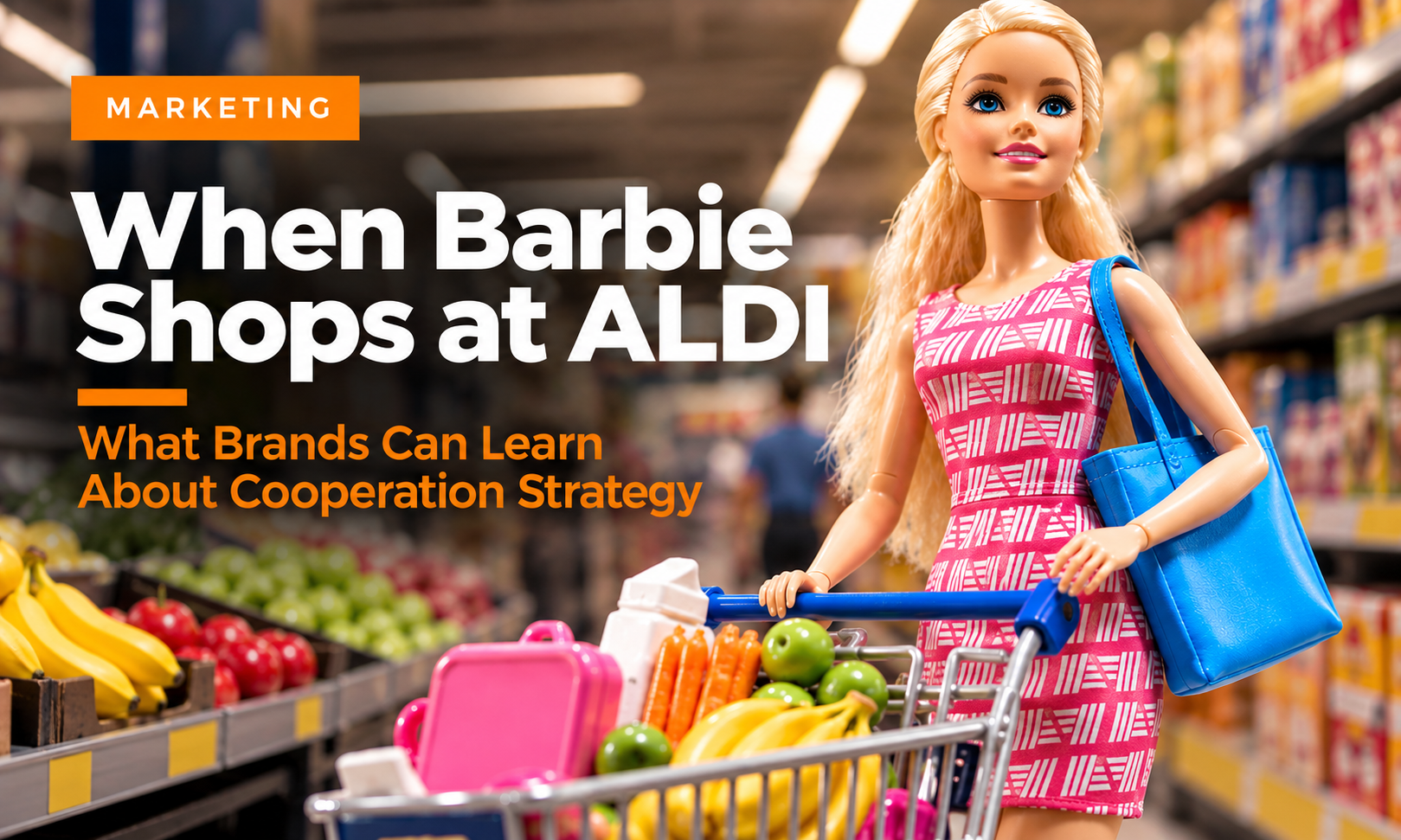
This week, I came across the limited ALDImania Barbie among ALDI’s non-food specials.
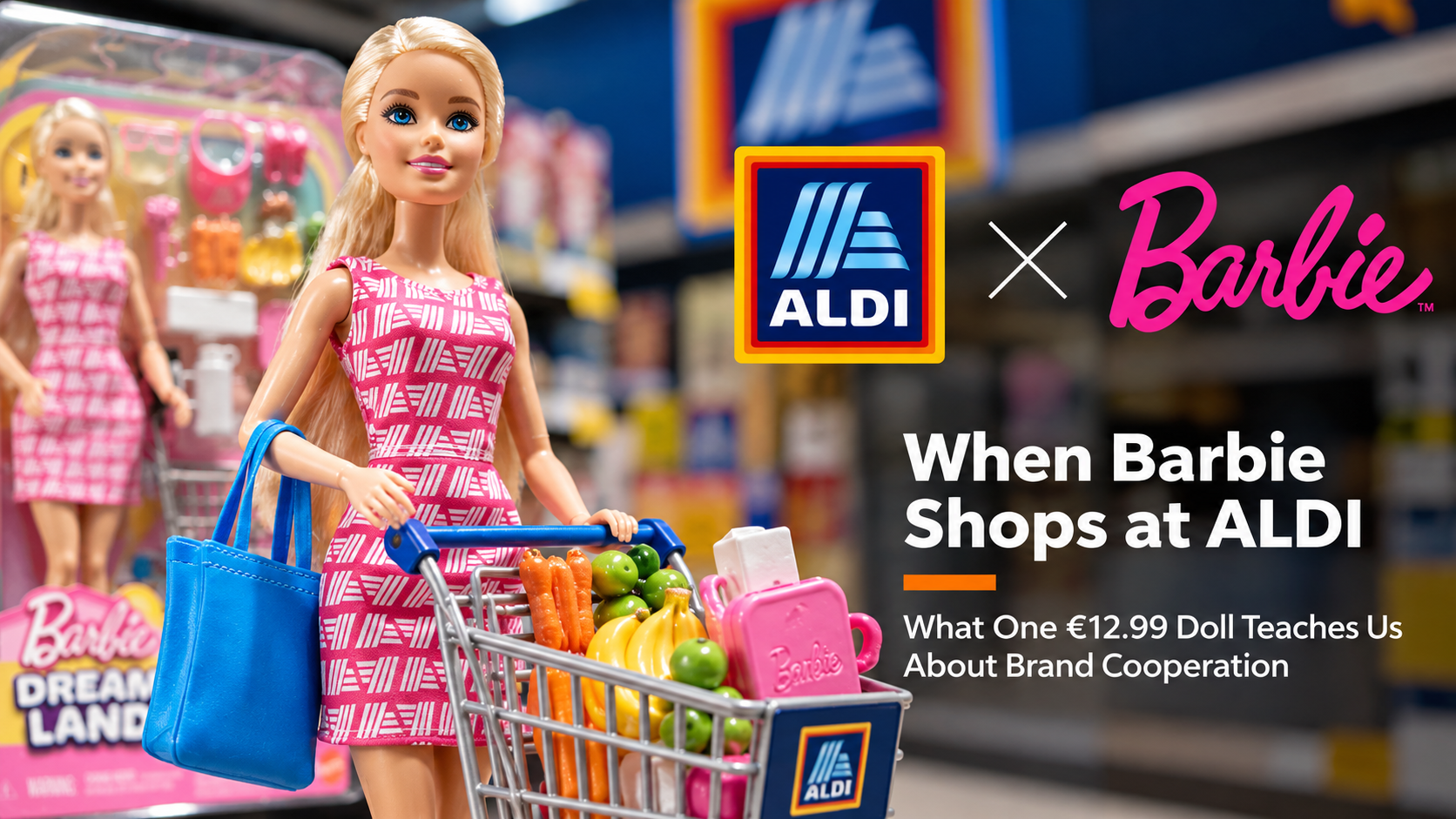
A Barbie in an ALDImania outfit. A miniature shopping cart. Groceries. Shopping accessories. Two highly recognisable brand worlds brought together in one product.
At first glance, it is fun.
At second glance, it becomes a fascinating case of what happens when two very different brands combine their strengths.
Because successful brand cooperation is not primarily about putting two famous logos next to each other.
It is about exchanging brand equity.
And the most interesting partnerships happen when each brand contributes something the other cannot create as effectively on its own.
What ALDI × Barbie Reveals About Brand Cooperation Strategy.
ALDI already has enormous strengths.
Reach. Accessibility. Price credibility. High shopping frequency. Strong recognition. A place in consumers’ everyday lives.
But these strengths do not automatically create everything a brand might want.
Price leadership does not necessarily create fandom.
Distribution does not automatically create cultural desirability.
Shopping frequency does not necessarily create collectability.
This is where Barbie brings something different.
Barbie contributes decades of emotional brand equity, iconic visual assets, storytelling, nostalgia, pop culture, collectability and recognition across generations.
For ALDI, the collaboration therefore has the potential to do more than sell another non-food promotional item.
It allows a highly rational retail proposition to borrow emotional and cultural currency.
Why would Barbie need ALDI?
Now reverse the perspective.
Mattel owns one of the world’s most recognisable toy brands.
Barbie has moved far beyond the toy aisle and become intellectual property spanning entertainment, fashion, collaborations, experiences and popular culture.
So what can ALDI possibly add?
Something surprisingly valuable:
everyday relevance.
ALDI brings Barbie into an environment millions of people associate with ordinary life.
Shopping.
Groceries.
Families.
Weekly routines.
Affordability.
The collaboration takes an iconic global brand and places it directly into an everyday consumer ritual.
That matters because even famous brands need more than awareness.
They need continued relevance.
Brand cooperation is an exchange
This is where I believe marketers should look differently at collaborations.
Instead of asking:
“Which famous brand could we work with?”
start by asking:
“What does our brand need that another brand could credibly provide?”
For ALDI and Barbie, the exchange can be described quite simply.
ALDI contributes
Accessibility
Retail reach
Everyday relevance
Price accessibility
Shopping context
Mass-market exposure
Barbie contributes
Emotion
Fandom
Collectability
Storytelling
Distinctive brand assets
Pop-cultural relevance
Intergenerational recognition
That does not mean every consumer will perceive every one of these attributes, nor does it prove that the collaboration will change long-term brand perceptions.
But strategically, this is the potential exchange.
And that distinction is important.
A strong cooperation should create value on both sides.
The €12.99 price is not a detail
The price of the ALDImania Barbie is €12.99.
From a brand perspective, that is interesting.
Imagine the identical collaboration as an €89 collector’s edition sold through a specialist store.
Same brands.
Same basic idea.
Completely different brand message.
At €12.99, the product remains consistent with ALDI’s accessibility proposition.
At the same time, Barbie potentially increases the emotional and perceived value of the promotional item.
This creates an interesting formula:
Accessible price × iconic IP × scarcity × surprise = attention potential
The collaboration therefore does not simply place Barbie inside ALDI.
It translates Barbie into ALDI’s commercial model.
That is much more powerful than conventional logo licensing.
Why brands need a cooperation strategy
A strong brand cooperation strategy should go beyond individual marketing activations. Too often, a campaign opportunity appears, someone knows someone, two marketing departments meet and a limited edition is created.
A campaign opportunity appears. Someone knows someone. Two marketing departments meet. A limited edition is created.
That can work.
But there is a more strategic approach.
Start with the gaps in your own brand.
What are you missing?
A younger audience?
Premium credentials?
Cultural relevance?
Technology?
Distribution?
Access to a community?
Sustainability expertise?
A new usage occasion?
Entertainment?
Design credibility?
Then identify partners capable of contributing those attributes credibly.
This turns cooperation from opportunistic marketing into portfolio strategy.
Over time, the right partnership portfolio can help a brand enter new communities, create new products, reach different audiences and experiment with new brand associations.
It can also generate something increasingly difficult to achieve through paid advertising alone:
curiosity.
Two familiar brands combined in an unfamiliar way make people look twice.
In an attention economy, that has value.
The problem: you are sharing more than attention
There is also a fundamental risk.
The moment two brands publicly connect themselves, they begin sharing associations.
That is the attraction.
It is also the danger.
Consumers do not necessarily assign responsibility according to contractual boundaries.
Your cooperation partner’s product quality can affect perceptions of you.
Their customer experience can affect you.
Their sustainability practices can affect you.
Their communication can affect you.
Their supply chain can affect you.
Their pricing decisions can affect you.
Their next reputational crisis may affect you too.
I call this:
Brand Equity Transfer Risk
The principle is simple:
If positive associations can move from one brand to another, negative associations can travel as well.
That means partner selection cannot be based purely on creative fit.
It requires proper due diligence.
This is why a professional brand cooperation strategy needs more than creative chemistry. It requires a structured way to evaluate strategic fit, commercial potential, operational compatibility and reputational risk.
The 10-Gate Brand Cooperation Test
Before entering a significant brand partnership, I would evaluate the potential partner against ten criteria.
1. Strategic Fit
What business or brand objective is the cooperation supposed to address?
Define the problem before evaluating the partner.
If the objective is unclear, almost any exciting collaboration can look strategically attractive.
2. Audience Complementarity
Do not look only at audience overlap.
Look at incremental audience value.
Who does the partner allow you to reach credibly that you currently struggle to reach yourself?
3. Equity Exchange
Complete two sentences:
Our brand gives the partner ______.
The partner gives our brand ______.
If one of those sentences is difficult to complete, investigate why.
The exchange does not need to be identical, but both sides should have a credible reason to participate.
4. Values & Reputation Fit
Look beyond the campaign idea.
Review reputation, previous controversies, sustainability claims, labour practices, governance, customer sentiment and previous collaborations.
You are not acquiring the partner.
But you are temporarily connecting your reputation to theirs.
5. Product Credibility
Would consumers understand why the two brands belong together?
The ALDI × Barbie example is interesting because shopping already belongs naturally within Barbie’s world of role-play.
The shopping cart and groceries help tell the story.
The consumer does not need a strategy presentation to understand the idea.
That is a good sign.
6. Distinctive Asset Compatibility
Examine what happens when both brand worlds meet.
Colours.
Shapes.
Characters.
Packaging.
Typography.
Environments.
Products.
Language.
Rituals.
A strong collaboration should allow both brands to remain recognisable without turning the execution into a visual compromise.
7. Commercial Logic
Brand excitement does not replace economics.
Consider:
Volumes
Margins
Licensing fees
Royalties
Minimum guarantees
Distribution
Cannibalisation
Markdown exposure
Operational costs
Potential incremental revenue
A collaboration can generate enormous social attention and still be commercially disappointing.
8. Operational Compatibility
This is where the glamorous collaboration becomes very practical.
Who owns approvals?
Who manufactures?
Who controls quality?
Who handles complaints?
Who owns customer data?
Who manages product recalls?
Who approves communications?
Who makes the decision when both brands disagree?
Good governance rarely makes the campaign announcement.
But it can determine whether the partnership succeeds.
9. Reputation & Exit Risk
Ask the uncomfortable question before signing:
What happens if our cooperation partner has a major reputational problem tomorrow?
Define escalation procedures, communication responsibilities, usage rights, crisis processes and termination clauses before you need them.
Risk management should be designed into the partnership.
10. Measurement & Learning
Sales matter.
But sales alone may tell you very little about whether the cooperation strengthened your brand.
Depending on the objective, consider measuring:
Brand consideration
Brand associations
New customer penetration
Incremental reach
Earned media
Social conversation
Traffic
Sell-through
Repeat purchase
Incremental revenue
Most importantly, compare the results with the original strategic objective.
A collaboration should produce business results and organisational learning.
Should brands test cooperation prototypes?
Prototype testing should be part of a robust brand cooperation strategy, particularly when the partnership has meaningful strategic or reputational implications.
There is a major difference between testing a cooperation concept and testing the actual execution.
A concept might sound fantastic:
Brand A × Brand B
Consumers then see the packaging and think something entirely different.
This is why realistic prototypes matter.
Test the product.
Test the packaging.
Test pricing.
Test communication.
Test desirability.
Test brand attribution.
And ideally, do something marketers sometimes find uncomfortable:
Do not explain the concept first.
Simply show it.
Then ask:
What do you think this is?
Which brands do you recognise?
How does this change your perception of Brand A?
How does this change your perception of Brand B?
Would you buy it?
Why?
This can reveal one of the biggest hidden risks in cooperation strategy.
Watch for asymmetric equity transfer
Imagine a collaboration between a premium brand and a mass-market brand.
The mass-market brand might become more premium.
Excellent.
But what happened to the premium brand?
Did it become more accessible?
Or did it become cheaper?
Those are very different outcomes.
The same partnership can therefore create positive equity transfer for one participant and negative equity transfer for the other.
That is why measuring only sales or social engagement can be misleading.
You need to understand what moved inside consumers’ minds.
The best collaborations create Brand C
For me, this is the ultimate test.
Weak cooperation creates:
Brand A + Brand B
Strong cooperation creates:
Brand C
Not a literal third company.
A new experience.
Something that would not make sense without both brands.
The ALDImania Barbie is interesting for precisely this reason.
It is not simply a Barbie placed on an ALDI shelf.
It is not simply an ALDI logo placed on a Barbie box.
The clothing, miniature trolley, groceries and shopping accessories bring the two brand worlds together.
The cooperation itself becomes part of the product.
And that gives us a simple test for future partnerships.
Before approving the next cooperation, remove both logos from the presentation.
Then ask:
Is there still an idea?
If there is not, you may simply have sponsorship or licensing.
If there is, you may have a genuine collaboration.
And if consumers see the result and immediately think:
“Of course. Why hasn’t anyone done this before?”
you may have created something even better.
A cooperation where 1 + 1 genuinely becomes 3.
One final question
Ultimately, a brand cooperation strategy should answer a much bigger question than who a brand could collaborate with. It should define what the brand wants to gain, what it can contribute and which risks it is prepared to share.
Brand cooperation should not start with:
“Who could we collaborate with?”
It should start with:
“What are we trying to become that we cannot achieve as effectively alone?”
That changes partner selection completely.
And it turns cooperation from a marketing stunt into a strategic brand capability.
Which brand cooperation has changed your perception of both brands involved?
Sources & Further Reading
MATTEL and another source from MATTEL on “Why we collabrorate”