

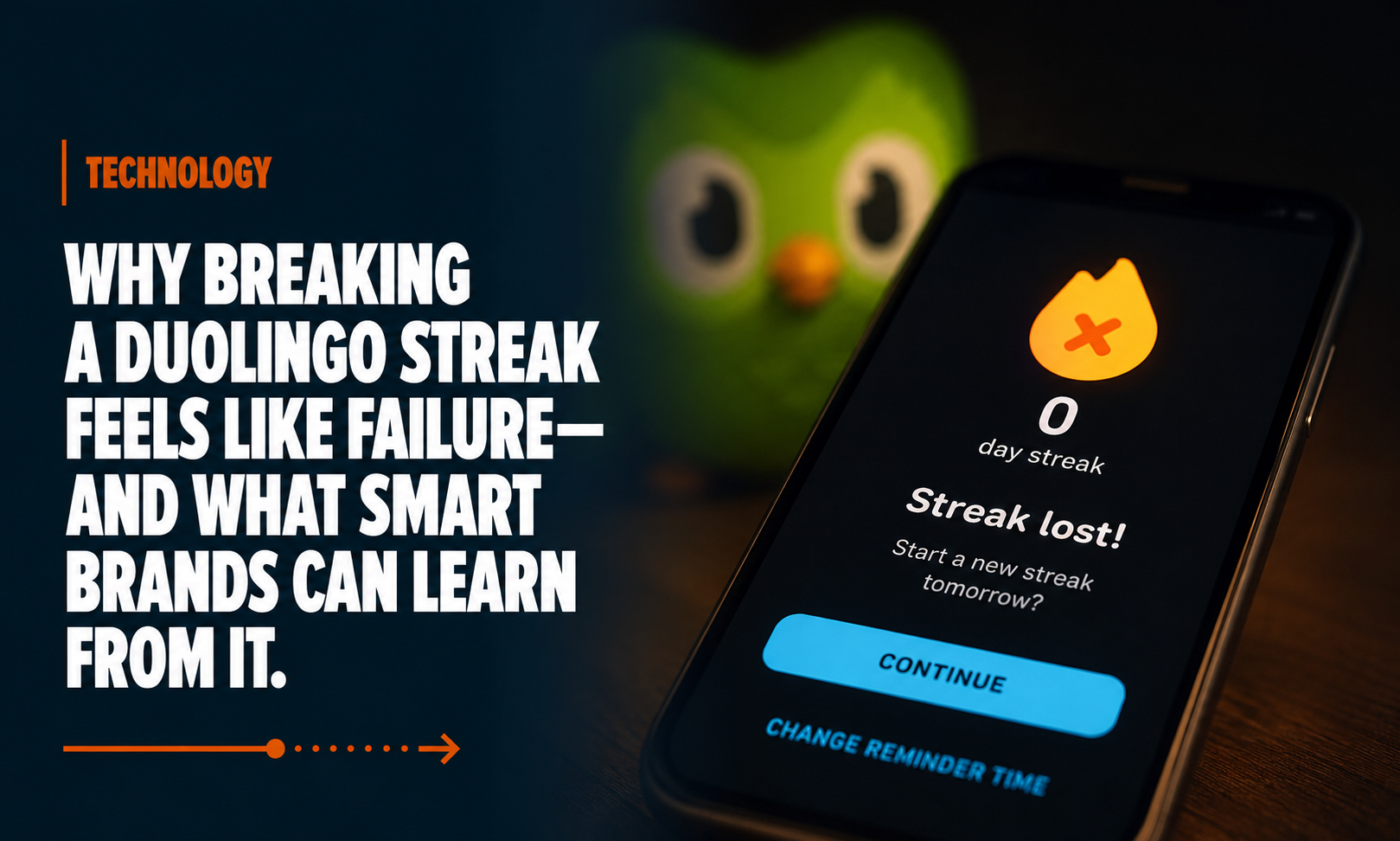
Duolingo streak psychology is one of the strongest examples of behavioral marketing in action.
Have you ever found yourself opening Duolingo just before midnight, simply to protect your streak?
Not because you had time.
Not because you felt like it.
But because you didn’t want to lose what you had built.
That moment reveals one of the most powerful truths in modern marketing:
The strongest brands don’t just sell products. They create habits.
And habits are the foundation of long-term engagement.
Duolingo has become one of the most effective examples of behavioral brand design. Not because of its product alone, but because it understands how psychology, technology and community work together to keep people engaged daily.
For B2C and B2B brands alike, there is a lot to learn here.
The psychology behind the streak: Why Duolingo streak psychology works
A streak is deceptively simple.
Complete one action every day.
Miss one, and it resets.
What makes this so powerful?
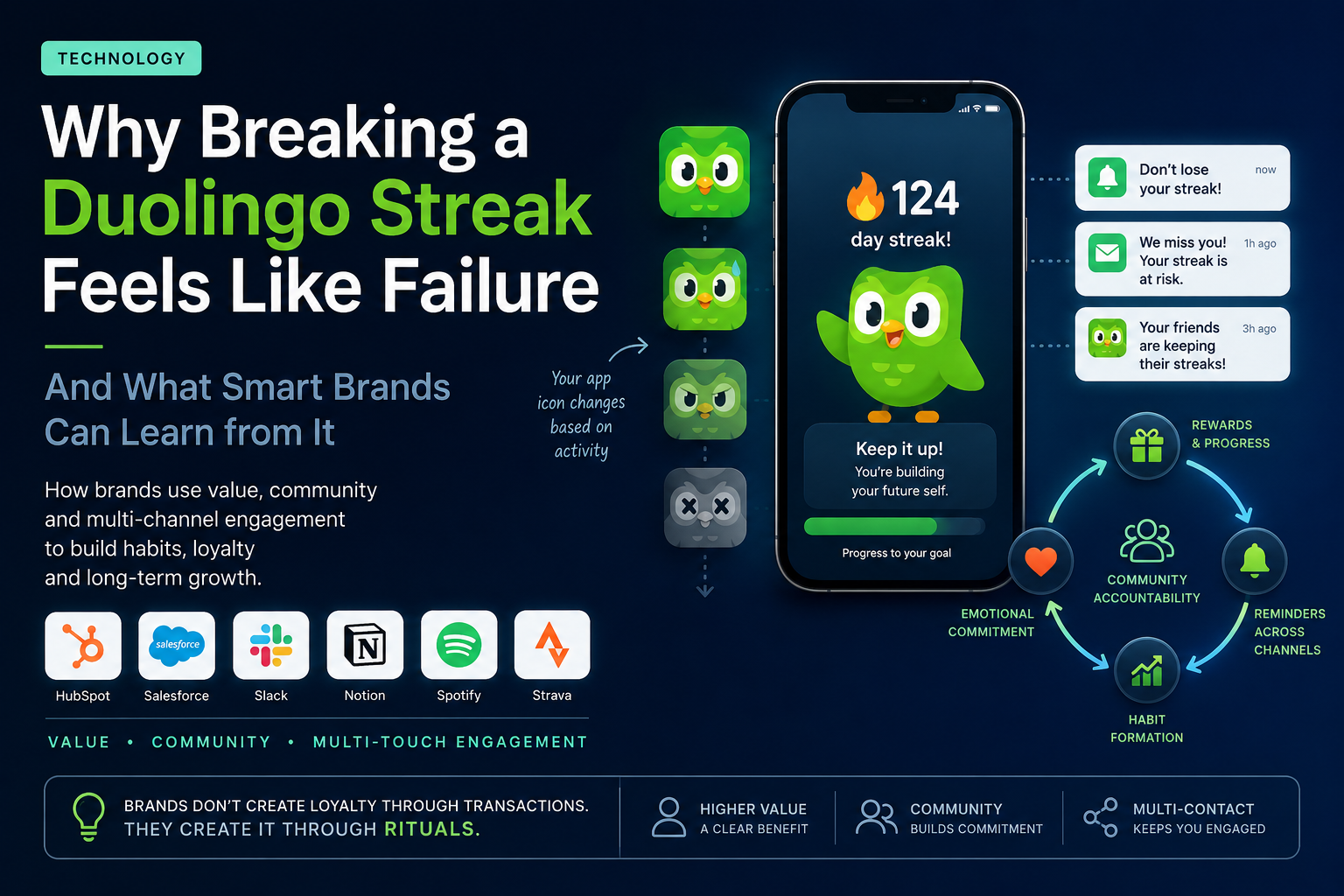
Because it combines:
- Progress visibility
- Commitment bias
- Loss aversion
- Identity reinforcement
- Social accountability
Over time, the streak becomes more valuable than the action itself.
People are no longer “using the app.”
They are protecting their identity.
“I am someone who learns every day.”
That’s where emotional brand attachment begins.
Lesson 1: The value must be bigger than the product
Duolingo streak psychology works because the reward is bigger than the action itself.
This is the most important lesson.
Duolingo doesn’t sell lessons.
It sells transformation.
The future reward is clear:
“Learn consistently and one day you will master a new language.”
The streak is simply proof that the user is moving closer to that goal.
Smart brands do the same.
B2C examples
Strava
Value = better health, better performance, social recognition.
Headspace
Value = less stress, better focus, emotional balance.
Spotify
Value = discovery, identity, belonging.
B2B examples
HubSpot
Value = business growth, better conversion.
Salesforce
Value = pipeline visibility, customer retention.
Slack
Value = faster collaboration, team efficiency.
If the end value isn’t meaningful enough, people will not return.
No reminder can fix weak value.
Lesson 2: Community amplifies commitment
A major part of Duolingo streak psychology is the use of community-driven accountability.
Leaderboards.
Leagues.
Friend streaks.
Social competition.
It creates subtle pressure.
And pressure creates consistency.
This principle is powerful far beyond consumer apps.
Where B2C brands can apply this
Retail loyalty clubs
Fitness brands
Travel memberships
Food subscriptions
Gaming ecosystems
Imagine:
A coffee brand rewarding consecutive weekly purchases.
A travel app rewarding consistent trip planning.
A health brand rewarding healthy daily choices.
Where B2B brands can apply this
Sales organizations
Project management tools
Learning platforms
Partner ecosystems
Examples:
A CRM showing daily deal movement streaks.
A learning platform rewarding consecutive training completions.
A project tool rewarding weekly team collaboration milestones.
The principle is always the same:
People stay committed when progress becomes visible to others.
Lesson 3: Multi-touchpoint orchestration keeps habits alive
This is where the real sophistication begins.
Duolingo uses an entire ecosystem:
- Push notifications
- Email reminders
- In-app celebrations
- Character evolution
- Fear-of-loss messaging
- Re-engagement campaigns
Each touchpoint plays a different role.
Together, they create a behavioral loop.
Many brands still treat channels separately.
That’s outdated.
Customers experience brands as one connected system.
The most effective engagement strategies connect:
Email + App + Social + CRM + UX + Community.
That is where modern retention happens.
What brands should ask themselves
To build stronger engagement, ask:
A) What higher value do we offer?
Not product features.
Transformation.
What future state is the customer buying into?
B) How can we make progress visible?
Can users track growth?
Can they compare?
Can they celebrate?
C) How can we create connected touchpoints?
Not random notifications.
Intentional, behavior-driven interactions.
Final thought: Loyalty is built through rituals
Brand engagement is no longer just about awareness.
It’s about presence.
Relevance.
Consistency.
Ritual.
Duolingo streak psychology shows that the strongest brands build habits, rituals and emotional loyalty over time.
Duolingo teaches us that when brands combine value, community, and intelligent multi-touchpoint design, engagement becomes part of daily life.
And that’s where true loyalty begins.
Because the strongest brands are not the ones customers remember. They are the ones customers return to — every single day.