

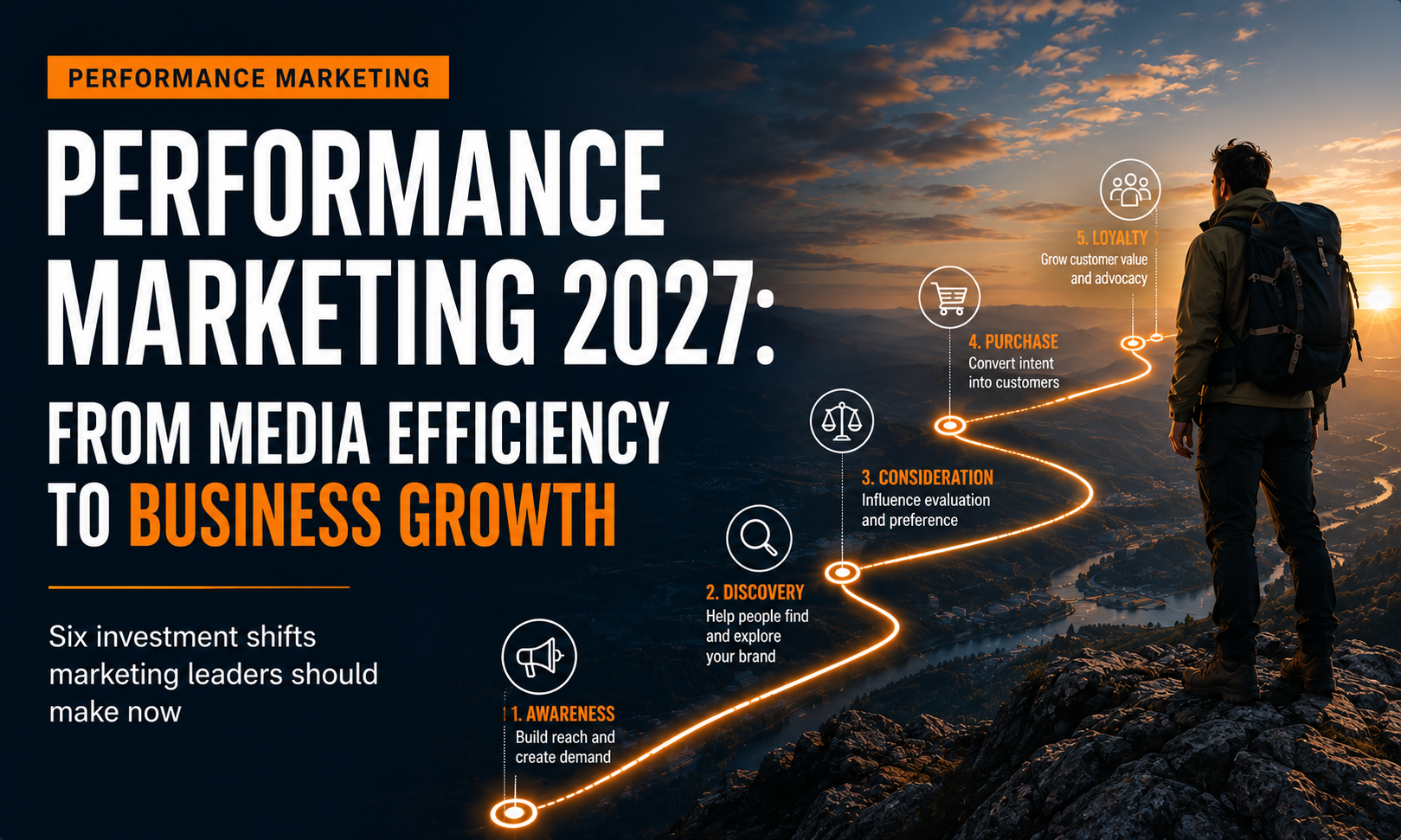
Six investment shifts marketing leaders should make now
Performance marketing has earned its seat at the management table.
It brought accountability into marketing. It connected investment with outcomes. And it gave us a common language of CTR, CPC, CPA, conversion and ROAS.
But there is a problem.
We have become incredibly good at optimizing what we can measure. That doesn’t necessarily mean we are investing in what creates the most growth.
This isn’t an argument against performance marketing.
Quite the opposite.
As marketing leaders plan for 2027, I believe we need to expand our definition of performance.
Because the next competitive advantage may not come from another 5% improvement in CPC, another automated bidding strategy or another platform added to the media plan.
It may come from making fundamentally better investment decisions.
Welcome to Performance Marketing 2027.
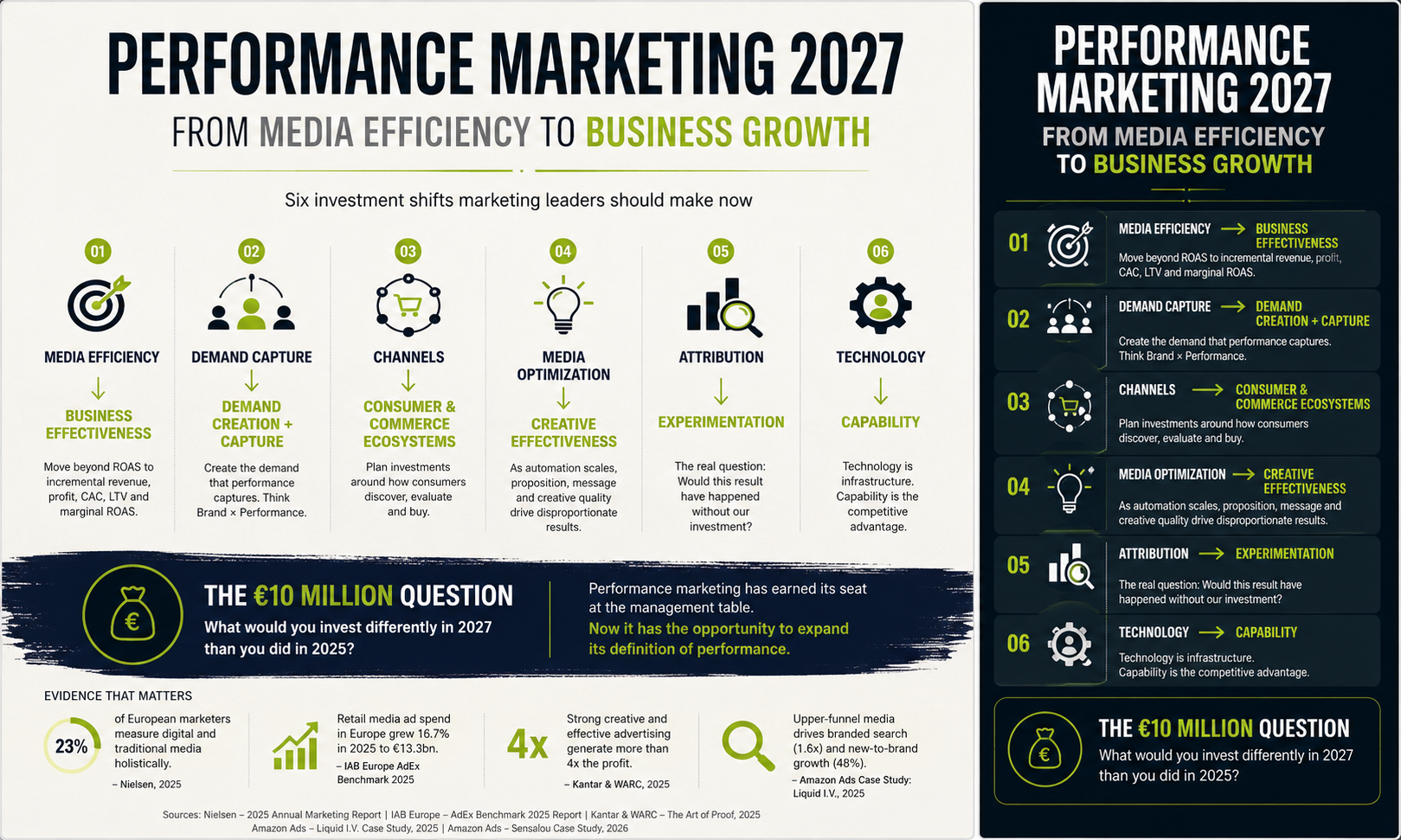
The €10 Million Question
Imagine you are responsible for a €10 million marketing budget.
Your CFO asks:
“Why should we invest this €10 million differently in 2027 than we did in 2025?”
More Google?
More Meta?
More Amazon?
More retail media?
More programmatic?
Another piece of marketing technology?
More AI?
All could be legitimate answers.
But they’re channel and technology answers to what is fundamentally a business question.
I would start somewhere else.
Where do we need to create demand?
Where can we capture existing demand?
Where do consumers discover, evaluate and buy our products?
Which customers should we acquire?
What are those customers actually worth?
Which investments generate incremental sales rather than simply claim credit for them?
Where does creative make the biggest difference?
And what capabilities will make the next €10 million more effective than the last?
Those questions change the conversation.
And they should increasingly change the investment plan.
I see six shifts.
01 | Media Efficiency ? Business Effectiveness
Performance marketing became powerful because it made marketing measurable.
But measurable and incremental are not the same thing.
Consider a campaign reporting:
ROAS: 5.0
For every €1 invested, €5 in revenue was attributed to advertising.
Excellent.
Or is it?
How many customers would have purchased anyway?
How many were existing customers?
What was the contribution margin?
Did advertising create additional demand or simply redirect existing demand through a paid touchpoint?
And what happened to profitability after media, promotion, fulfilment and marketplace costs?
These aren’t arguments against ROAS.
ROAS remains an important operational metric.
The problem begins when an operational metric becomes our definition of business success.
And there is evidence of a significant measurement gap.
Nielsen’s 2025 global research found that 85% of marketers expressed confidence in their ability to measure ROI, while only 32% actually measured ROI holistically across traditional and digital media.
In Europe, that figure was just 23%.
That is an extraordinary gap between perceived and actual measurement capability.
The next performance dashboard therefore needs another layer:
Incremental Revenue
Incremental Profit
Contribution Margin
Customer Acquisition Cost
New-to-Brand
Customer Lifetime Value
Marginal ROAS
The management question changes from:
“What revenue can we attribute to marketing?”
to:
“What business would we not have generated without this investment?”
That’s harder to answer.
It’s also far more valuable.
A simple example
Imagine:
Campaign A
ROAS: 6.2
High proportion of existing customers
Strong branded-search activity
Limited incremental lift
Campaign B
ROAS: 3.8
High proportion of genuinely new customers
Strong incremental sales
Higher predicted customer value
Which campaign performed better?
The performance dashboard may choose Campaign A.
The growth dashboard may put the next euro into Campaign B.
That distinction matters.
02 | Demand Capture ? Demand Creation + Capture
Performance marketing is exceptionally good at capturing intent.
Someone searches.
Compares.
Clicks.
Visits Amazon.
Returns to a product page.
Adds to basket.
Converts.
These are incredibly valuable signals.
But there is an uncomfortable question we should occasionally ask:
Who created that demand in the first place?
Consumers don’t suddenly want a product because a retargeting algorithm found them.
Brands, experiences, recommendations, creators, culture, PR, retail visibility, social conversations and previous product experiences all contribute to demand.
This is why the traditional debate between brand and performance increasingly feels artificial.
Brand creates familiarity, preference, mental availability and future demand.
Performance identifies, captures and converts demand.
And performance data feeds valuable signals back into brand strategy.
The two aren’t competing systems.
They are parts of the same growth system.
So perhaps the equation should no longer be:
Brand OR Performance
but:
Brand × Performance
We can see this relationship in actual commerce data.
Ahead of Prime Day 2025, Liquid I.V. used streaming TV, online video and audio to reach new audiences before the conversion moment.
According to the Amazon Ads case study, consumers exposed to the activity were 1.6× more likely to conduct a branded search, while 48% of ad-attributed purchases came from new-to-brand customers.
That is an interesting performance story precisely because it doesn’t begin at the bottom of the funnel.
Demand was created before it was captured.
The investment implication
Stop asking only:
“How much goes to brand and how much goes to performance?”
Ask:
“Where are we creating demand, where are we capturing it, and where is the system losing potential growth?”
03 | Channel Planning ? Consumer & Commerce Ecosystems
Consumers don’t have channel strategies.
Marketing organizations do.
A consumer might:
discover a product through social,
see it again on YouTube,
ask an AI assistant about alternatives,
search Google,
read reviews,
compare products on Amazon,
visit the manufacturer’s website,
see the product in-store,
and ultimately purchase through a retailer.
From the consumer’s perspective, that’s one decision journey.
Inside a large organization, it might touch six teams, several agencies and multiple budgets.
That organizational fragmentation increasingly conflicts with how demand actually works.
And nowhere is that more visible than commerce.
Amazon can simultaneously function as:
a retailer,
a search environment,
an advertising platform,
a product-discovery engine,
a review ecosystem,
a conversion environment
and a source of consumer signals.
Retail media is therefore not a niche addition to the media plan anymore.
In Europe, retail media advertising investment grew 16.7% in 2025 to €13.3 billion, according to IAB Europe, and now represents more than 10% of total European digital advertising spend.
Nielsen separately found that 65% of global marketers expected retail media networks to play a growing role in their media strategies.
This isn’t simply another channel growing.
It represents a structural convergence of media + data + commerce.
Think beyond Amazon ROAS
Imagine an FMCG brand reports:
Sponsored Products ROAS: 5.2
Good.
But Performance Marketing 2027 asks:
Did upper-funnel activity increase branded search?
Did we acquire new-to-brand customers?
Did product visibility improve?
What happened to organic ranking?
Did paid investment generate incremental sales?
Did organic sales increase?
What happened to contribution margin?
Did Amazon activity create a halo elsewhere?
A 2026 Amazon Ads case illustrates this broader view particularly well.
Sensalou’s full-funnel strategy reportedly increased new-to-brand customers by 64% year-on-year, while total sales increased 38% and organic sales increased 25%.
The interesting part isn’t simply that advertising generated sales.
It’s that paid activity, customer acquisition and organic momentum were viewed as parts of the same growth system.
That is a much more useful way to think about commerce performance.
04 | Media Optimization ? Creative Effectiveness
For much of digital advertising’s history, enormous energy went into optimizing media variables:
Audience.
Bid.
Placement.
Frequency.
Timing.
Keyword.
Device.
Targeting.
All still matter.
But platforms increasingly automate them.
That creates an interesting paradox.
The more execution becomes automated, the more important genuine differentiation becomes.
If competitors have access to similar targeting capabilities, similar algorithms and increasingly similar AI tools, advantage shifts elsewhere:
The proposition.
The product truth.
The idea.
The message.
The distinctive brand assets.
And the ability to understand which creative works, for whom, where and why.
The evidence here is particularly striking.
Research combining Kantar’s creative-effectiveness database with WARC profitability data found that the strongest creative and effective advertising generated more than four times as much profit.
Think about the implication.
Marketing organizations routinely spend enormous effort negotiating fractional improvements in media costs.
Yet creative quality can have a dramatically larger impact on the economics.
Creative intelligence, not content volume
AI makes it possible to generate hundreds of creative variations.
That’s useful.
But 500 mediocre ads don’t constitute a strategy.
The opportunity is to test meaningful hypotheses:
Does convenience outperform price?
Does demonstration outperform lifestyle?
Which benefit attracts new customers?
Which proposition increases consideration?
Which creative captures attention?
Which message converts existing demand?
Which assets work differently in retail media, social and video?
That’s creative intelligence.
AI can accelerate it.
Human judgment still determines what is worth saying.
05 | Attribution ? Experimentation
Marketing has spent years asking:
“Which channel gets credit for the sale?”
But perhaps the more valuable question is:
“Would the sale have happened anyway?”
That’s the difference between attribution and causality.
Attribution distributes credit.
Experimentation tests impact.
Consider a simple journey:
A consumer sees a video campaign.
Later searches for the brand.
Clicks a paid-search advertisement.
Purchases.
Search receives the conversion.
But did search create the demand?
Or capture it?
Would the consumer have bought anyway?
What happens if paid search is removed?
What happens if video is removed?
What happens when both operate together?
These questions cannot be answered reliably by simply adding another attribution model.
They require experimentation.
That can mean:
Geo experiments
Holdout groups
Conversion-lift studies
Incrementality testing
A/B testing
Marketing Mix Modelling
Controlled retail-media experiments
No single methodology answers everything.
The capability lies in combining them intelligently.
This is why measurement shouldn’t simply sit at the end of a campaign as reporting.
Measurement is an investment capability.
It tells us where the next euro should go.
And that’s a much more important function than explaining where the last one went.
06 | Technology ? Capability
Marketing has spent the last decade assembling increasingly sophisticated technology stacks.
CRM.
CDP.
Marketing automation.
Analytics.
Personalization.
Attribution.
Retail media technology.
And now AI.
These technologies can create enormous value.
But they can also create enormous complexity.
Nielsen’s 2025 research found marketers citing siloed teams, incomparable data, unclear KPIs and too many vendors or tools among the barriers to effective ROI measurement.
Adding another platform to a fragmented operating model doesn’t necessarily solve the fragmentation.
It can simply make it more expensive.
The more interesting investment question for 2027 is therefore:
What can our organization do better because of technology?
I’d focus capability investment in five areas.
1. Measurement & Experimentation
Can we distinguish attributed revenue from incremental business impact?
2. First-Party Signals
Can we connect meaningful customer, commerce and behavioral data to decisions?
3. Creative Intelligence
Can we systematically learn which propositions, messages and assets drive both immediate response and future demand?
4. Commerce & Retail Media
Do we understand the increasingly blurred relationship between media, shopper data, product visibility and transaction?
5. Integrated Decision-Making
Can brand, performance, commerce, CRM, analytics and creative teams work from the same growth objectives?
AI cuts across all five.
But that’s precisely why “invest in AI” isn’t a strategy.
AI is becoming infrastructure.
The competitive advantage lies in the capability built on top of it.
The Performance Marketing Investment Shift 2027
If I had to summarize the change on one page, it would look like this:
MEDIA EFFICIENCY
?
BUSINESS EFFECTIVENESS
DEMAND CAPTURE
?
DEMAND CREATION + CAPTURE
CHANNEL PLANNING
?
CONSUMER & COMMERCE ECOSYSTEMS
MEDIA OPTIMIZATION
?
CREATIVE EFFECTIVENESS
ATTRIBUTION
?
EXPERIMENTATION
TECHNOLOGY
?
CAPABILITY
These aren’t replacements.
Efficiency still matters.
Channels still matter.
Attribution still has a role.
Technology remains essential.
But the management layer above them needs to evolve.
Back to the €10 Million
So how should our hypothetical €10 million move?
I deliberately wouldn’t prescribe percentages.
A global FMCG company shouldn’t allocate marketing investment like a D2C challenger.
A premium automotive brand shouldn’t behave like an online retailer.
A B2B technology company operates under different economics again.
Instead, I would put six questions on the investment table:
1. How much are we investing in creating future demand?
Not simply harvesting existing intent.
2. How much are we investing in capturing demand?
And are we present where customers actually make decisions?
3. How much are we investing in creative effectiveness?
Not content volume. Effectiveness.
4. How much are we investing in valuable customers?
Are we optimizing transactions or customer economics?
5. How much are we investing in proving incrementality?
Can we demonstrate what marketing actually added?
6. How much are we investing in making the system itself better?
People.
Data.
Measurement.
Experimentation.
Processes.
Technology.
Capabilities.
Because the €10 million budget shouldn’t only buy this year’s growth.
Part of it should make next year’s €10 million work harder.
The CMO Dashboard Needs Another Layer
I wouldn’t remove:
CTR
CPC
CPA
CVR
ROAS
Performance teams need them.
But above them, I would increasingly put:
Incremental Revenue
What additional revenue did marketing create?
Incremental Profit
Did that growth create economic value?
CAC
What does acquiring a genuinely new customer cost?
LTV
Are we acquiring customers worth acquiring?
New-to-Brand
Are we expanding the customer base?
Marginal ROAS
What return does the next euro generate?
Contribution Margin
Does growth remain attractive after the economics of delivering it?
These metrics move performance marketing closer to the language of business leadership.
That’s where it belongs.
Where Does AI Fit?
Almost everywhere.
And that’s exactly why it doesn’t need to be the headline.
AI is changing discovery.
Media buying is becoming increasingly automated.
Creative production is accelerating.
Analytics is becoming more predictive.
Personalization can operate at greater scale.
But virtually everyone will have access to these capabilities.
Google will.
Meta will.
Amazon will.
Agencies will.
Brands will.
Your competitors will.
Having AI will not be a strategy.
The strategic questions remain:
Which customers matter?
Where will growth come from?
What should the brand stand for?
Where should we invest?
What should we stop doing?
What constitutes profitable growth?
And what evidence would make us change our decision?
AI can help us answer those questions faster.
It doesn’t remove the need to ask them.
Performance Marketing Has Earned the Right to Think Bigger
Performance marketing shouldn’t retreat from its obsession with accountability.
It should expand it.
From clicks to customers.
From attributed revenue to incremental growth.
From channel optimization to consumer journeys.
From media efficiency to business effectiveness.
From content production to creative intelligence.
From attribution to experimentation.
From technology acquisition to organizational capability.
That doesn’t make performance marketing less performance-driven.
It makes our definition of performance more ambitious.
So when the CFO asks:
“Why should our €10 million marketing investment look different in 2027?”
the answer shouldn’t simply be:
because the platforms changed,
because AI arrived,
or because another new channel emerged.
It should be:
Because we now have the data, technology and measurement capabilities to hold marketing accountable for something bigger than media efficiency.
Business growth.
That, to me, is the next chapter of performance marketing.