When AI Does the Shopping, Which Brands Make the Shortlist?

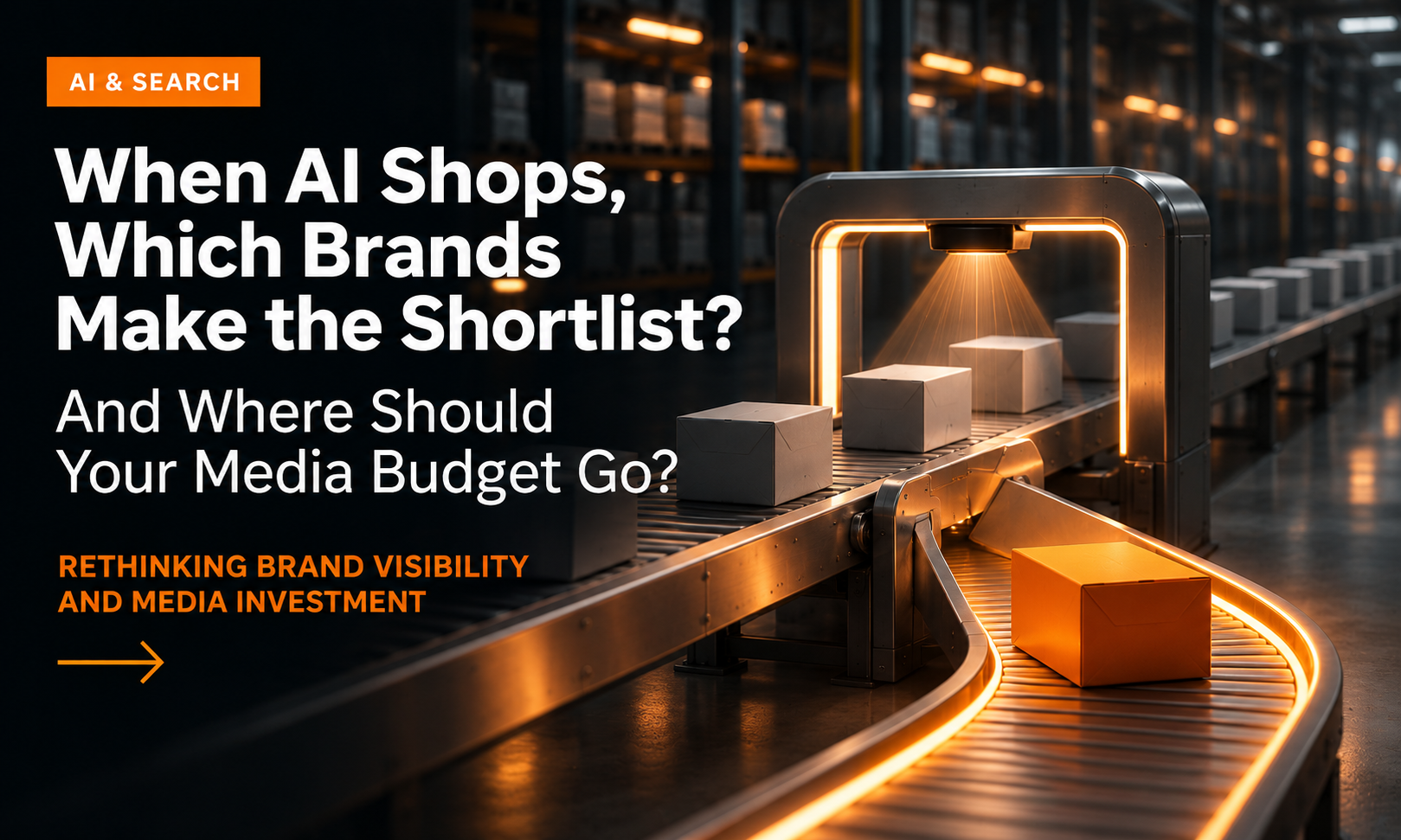
Conceptual illustration of AI shopping agents selecting products, with one orange package diverted from grey alternatives on a conveyor belt.

AI shopping agents are changing how people discover, compare and choose products. For marketers, this raises a bigger question: how do brands make the shortlist, and where should the next media euro go?

Imagine planning a weekend away with your family.

You tell your AI assistant what matters: somewhere quiet, good food, activities for the children and a realistic total price. It returns three hotels, explains the differences and helps you choose.

Convenient? Absolutely.

But what happened to all the hotels you never saw? The carefully designed websites, the paid search campaigns, the inspirational videos?

Somewhere between your request and the recommendation, a shortlist formed.

For brands, understanding that moment could become one of marketing’s most important challenges.

How AI shopping agents change product discovery

On 11 November, Zalando described how its Assistant now supports product comparisons, size recommendations, basket preparation and order tracking. According to the company, customer queries in the Assistant are three times longer than traditional search queries. People can explain their situation rather than squeeze it into a few keywords.

That distinction matters.

“Waterproof jacket” describes a product category.

“I need a jacket for a wet November weekend outdoors, but I don’t want to look as though I’m climbing Everest” describes a person, a situation and a compromise.

My view is that this creates a new competitive challenge: brands need to communicate clearly enough to be considered in that context, while remaining distinctive enough for people to want them.

Who actually controls the recommendation?

We should be careful about treating AI as a neutral personal shopper.

A retailer’s assistant operates within a commercial environment. An independent assistant may draw on different sources, partnerships and technical access. A sponsored placement and an organic recommendation are different things.

The questions become: which products can the assistant access, what evidence does it use, and how clearly does it distinguish advertising from advice?

For marketers, “being visible in AI” is therefore too vague to be a strategy. Visibility needs a context: which assistant, which market, which customer need and which stage of the decision?

What this means for media spending

As AI shopping agents influence more purchase decisions, marketers need to examine which placements still reach customers and generate additional demand.

The immediate response should be to examine how media contributes to decisions.

Reuters recently reported that AI shopping agents could reduce exposure to retailer websites and advertising placements. It also reported that Amazon had seen no meaningful impact on its advertising from third-party agents so far. The direction of change deserves attention; the timing and scale remain uncertain.

That argues for disciplined experimentation.

I would put three kinds of spending under closer scrutiny:

  • Repeated exposure with little evidence of additional demand. High impression counts can conceal weak commercial impact.
  • Search activity that mainly captures customers already looking for the brand. Reported conversions deserve a closer look at what would have happened without the ad.
  • Traffic acquisition that leads to incomplete information or disappointing experiences. More visitors will rarely solve an unclear offer.

These are useful questions today. AI makes them more urgent.

Where I would invest

Marketer reviewing hotel recommendations from AI shopping agents alongside campaign photos of advertising, events and customer service.
Investing in visibility means connecting AI discovery with memorable human experiences.

Preparing for AI shopping agents means coordinating paid media with accurate product information, credible evidence and a dependable customer experience.

I would organise investment around five priorities, with paid media working alongside product, content and customer experience.

Investment priorityWhat I would fundWhat I would assess
Brand demandDistinctive creative, relevant video, social, OOH and partnershipsWhether more people remember, seek out and consider the brand
Useful product informationAccurate feeds, clear specifications, availability, pricing and practical FAQsInformation quality, discovery and conversion
Independent evidenceCredible reviews, expert coverage, customer cases and relevant PRQuality of coverage, consideration and referral activity
Customer experienceBetter advice, booking, delivery, service and recoveryRepeat purchase, complaints, returns and recommendations
Controlled experimentsRelevant AI discovery and advertising testsAdditional sales, acquisition cost and customer quality

The balance will vary. A hotel, a software provider and a consumer electronics brand should arrive at different allocations.

1. Give people a reason to ask for you

There is a meaningful difference between asking an assistant for “a good hotel” and asking it to check availability at a particular hotel.

Brand building can influence the starting point of the conversation.

I would continue investing in creative work that builds recognition and preference. The channel should follow the audience and the task. A memorable physical experience, a strong video or a relevant partnership can all contribute.

2. Make the offer easy to understand

Google has introduced additional Merchant Center attributes intended to support conversational discovery, including answers to product questions and information about compatible accessories or substitutes. That is a practical signal that the quality of product information deserves investment.

For a hotel, “family friendly” is a claim. Connecting rooms, children’s meal times, pool restrictions and transparent additional charges help someone make a decision.

Clear information helps customers and gives discovery systems more useful material to work with. It cannot guarantee a recommendation.

3. Build evidence beyond your own advertising

Independent reviews, relevant editorial coverage and specific customer stories give prospective buyers ways to check a promise.

I would fund those activities for their credibility and usefulness. Their influence on AI recommendations should be tested rather than assumed.

4. Invest in the experience people remember

My background in hospitality taught me how quickly a polished promise meets reality.

The welcome. The room. The meal. The response when something goes wrong.

Marketing can create an expectation. Operations determine whether that expectation was justified.

That is why part of the growth conversation belongs with service and product teams. A recurring complaint may point to a better investment than another acquisition campaign.

How much should move?

There is no defensible universal percentage.

For an established advertiser, I would start with a bounded 90-day test funded from activity with the weakest evidence of incremental return. Protect effective campaigns, define the hypothesis and agree on the success criteria before spending.

Keep the accounting clear, too: product data, service improvements and paid media are different budget categories. They need coordination and appropriate measures.

Alongside sales and acquisition cost, I would track AI recommendations across a consistent set of relevant customer questions. That is a diagnostic measure. Inclusion in an answer is useful only if it eventually contributes to a worthwhile business outcome.

The shortlist is only the beginning

My working thesis is that brands will need to earn consideration in more places, often before a customer reaches their website.

That makes distinctive communication, dependable information and a credible customer experience valuable investments.

Getting recommended creates an opportunity. Delivering on the recommendation creates the relationship.

AI shopping agents may help shape the shortlist, but the experience after purchase determines whether customers return.

If an assistant compared your brand tomorrow, what evidence would give it a good reason to put you on the shortlist?
Merchandise Strategy in 2026: Stop Printing Logos. Start Creating Brand Utility

Your logo isn´t the problem

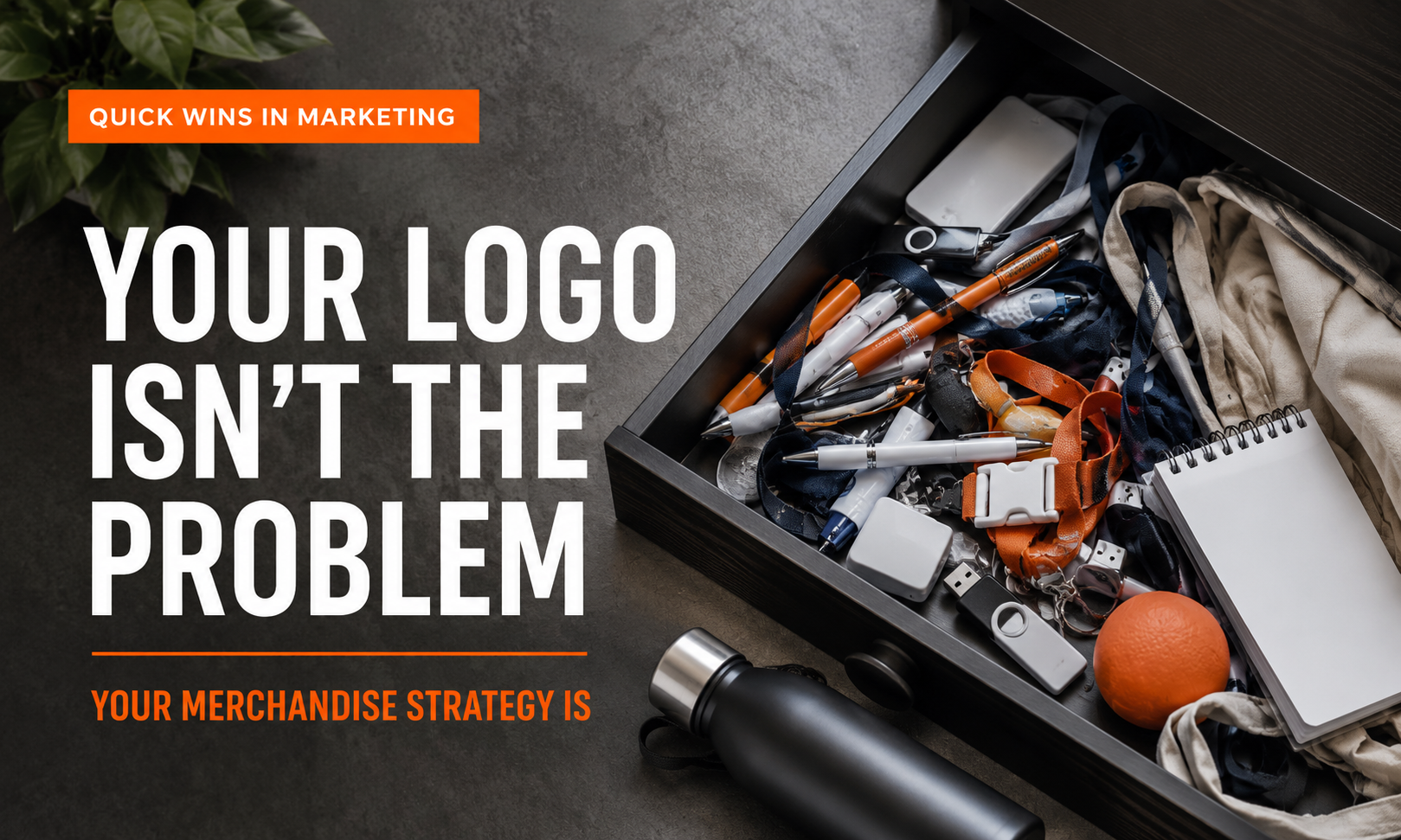
Most corporate merchandise ends up forgotten in a drawer. A modern merchandise strategy should do far more than display a logo. It should create utility, strengthen brand awareness, support ESG ambitions and become another meaningful customer touchpoint. Summer is the perfect time to step back, reflect and ask a simple question: are we creating memorable brand experiences or simply producing more promotional clutter?

Summer has a way of slowing us down.

It gives us space to recharge, spend time with family and reflect on habits that have quietly become routines.

For many marketers, summer is also trade fair planning season. Budgets are reviewed, autumn events are scheduled, and the familiar checklist appears once again.

Pens.

Lanyards.

Notebooks.

Cotton bags.

Power banks.

Whatever the latest trend may be.

And somewhere in the planning meeting, someone inevitably asks:

“What should we give away this year?”

Perhaps we’re asking the wrong question.

Open Your Drawer

Before answering it, open the drawer next to your desk.

You’ll probably find a collection of conference giveaways gathered over the years.

Pens from companies you can’t remember.

USB sticks from technology conferences.

Lanyards from exhibitions you’ve long forgotten.

Stress balls.

Cheap keyrings.

Notepads you’ll never use.

Every single one carries a perfectly printed corporate logo.

Almost none created a memorable brand experience.

That drawer tells a story.

Not about successful merchandising.

But about missed opportunities.

Why Most Merchandise Strategies Fail

The problem isn’t branded merchandise itself.

The problem is that many organisations still design merchandise from their own perspective instead of the customer’s.

The conversation often starts with questions like:

  • How many visitors do we expect?
  • What’s our budget?
  • Which supplier offers the best price?
  • Where can we print the biggest logo?

Rarely does it begin with the most important question:

What will people actually use?

A successful merchandise strategy starts by understanding what creates value for the recipient, not what is easiest to produce.

Brand awareness isn’t created when someone receives an item.

It’s created every time they use it.

A Merchandise Strategy Needs New KPIs

For decades, merchandise has been measured by quantity.

  • 2,000 visitors
  • 2,000 giveaways
  • Campaign completed

But distribution is not impact.

Imagine measuring your merchandise strategy differently.

Instead of asking how many items were handed out, ask:

  • How long will this product remain in use?
  • How often will someone interact with it?
  • Does it solve a genuine problem?
  • Will it still be useful six months from now?
  • Does it create a positive association with the brand?
  • Would someone recommend it to a colleague?

Suddenly, merchandise becomes much more than a promotional expense.

It becomes another customer touchpoint.

A Successful Merchandise Strategy Creates Utility

One simple question can transform an entire merchandise strategy.

Would someone still want this if our logo wasn’t printed on it?

If the answer is no, perhaps it shouldn’t be produced.

People rarely keep products because they’re branded.

They keep them because they’re useful.

Everyday utility creates repeated exposure.

Repeated exposure builds familiarity.

Familiarity builds trust.

Trust strengthens brands.

The logo doesn’t create the value.

The usefulness does.

Merchandise Strategy Starts with Customer Value

Perhaps it’s time to stop thinking about giveaways altogether.

Instead, think about Brand Utility.

Brand Utility is the ability of every branded touchpoint to create recurring value for the user while simultaneously reinforcing the brand.

The best merchandise usually shares three characteristics.

It solves a small everyday problem

Useful products naturally become part of daily routines.

The more often they’re used, the more often your brand is experienced.

It survives the event

Good merchandise doesn’t end when the exhibition closes.

Its value continues long afterwards.

Months later.

Sometimes years.

It creates positive emotion

Every interaction becomes another micro-experience.

A small reminder that your company cared enough to create something genuinely valuable instead of simply printing another logo.

A Sustainable Merchandise Strategy Starts Before Production

Sustainability has become an important part of corporate merchandise discussions.

Recycled materials.

FSC-certified paper.

Organic cotton.

Bamboo.

These are all positive developments.

But they don’t answer the most important sustainability question.

Was the product actually needed?

A recycled notebook that remains unopened isn’t sustainable.

A bamboo pen that ends up in landfill after two weeks isn’t sustainable.

Perhaps the most sustainable promotional product is one that replaces disposable alternatives, remains useful for years or simply doesn’t need to be produced at all.

ESG isn’t only about materials.

It’s also about purpose.

A thoughtful merchandise strategy reduces waste by creating products people genuinely value.

Merchandise Strategy Is Customer Experience

Customer experience professionals spend enormous amounts of time analysing every touchpoint.

Websites.

Retail stores.

Packaging.

Customer service.

Digital journeys.

Yet merchandise often escapes the same level of strategic thinking.

It shouldn’t.

Every branded object is another customer touchpoint.

Every interaction contributes to perception.

Every useful experience reinforces trust.

Merchandise shouldn’t simply display a logo.

It should demonstrate your brand promise.

Imagine if every promotional product had to pass the same design thinking workshops as your website or mobile app.

Would you still choose another cheap plastic pen?

Probably not.

What Makes Sense in 2026?

The question isn’t which product is trending.

The question is which product creates lasting value.

Instead of chasing novelty, think in terms of utility.

Examples might include:

  • Premium reusable bottles that replace disposable plastics.
  • Refillable notebooks instead of disposable notepads.
  • High-quality cable organisers that travel everywhere.
  • NFC-enabled business cards that never become outdated.
  • Smart luggage tags for frequent travellers.
  • Digital resources, AI prompt collections or exclusive industry insights delivered through QR codes.
  • Products designed to be repaired rather than replaced.

In every case, the product should continue the brand experience long after the event has ended.

The Future of Merchandise Strategy

Rather than choosing products because they’re inexpensive, ask different questions.

  • Will people genuinely keep this?
  • Does it solve a real problem?
  • Is it consistent with our brand positioning?
  • Does it reduce waste?
  • Can it replace disposable products?
  • Is the quality good enough to reflect our brand?
  • Would I personally use it every week?

If the answer is yes, you’re probably investing in brand building rather than promotional clutter.

The best merchandise strategy doesn’t produce more items.

It produces better ones.

Frequently Asked Questions About Merchandise Strategy

What is a merchandise strategy?

A merchandise strategy defines how branded products support marketing, customer experience, brand awareness and sustainability. Instead of simply distributing promotional items, it focuses on creating products people genuinely use, remember and value.

How can merchandise increase brand awareness?

Useful merchandise creates repeated brand exposure over months or even years. Every interaction becomes another positive brand touchpoint, making the brand far more memorable than one-off promotional giveaways.

What makes sustainable merchandise?

Sustainable merchandise is designed for long-term use, solves a real customer problem and avoids unnecessary waste. The most sustainable promotional product is often the one people keep for years rather than replacing after a single event.

Final Thought

The next time you’re planning a trade fair, conference or customer event, don’t begin with the catalogue.

Begin with your customer.

Ask yourself one question:

What could we create that people would genuinely miss if they lost it?

That’s where a great merchandise strategy begins.

Because nobody remembers the company that handed them another pen.

But people do remember the brand that made their day just a little easier.

And perhaps that’s what merchandise was always supposed to do.

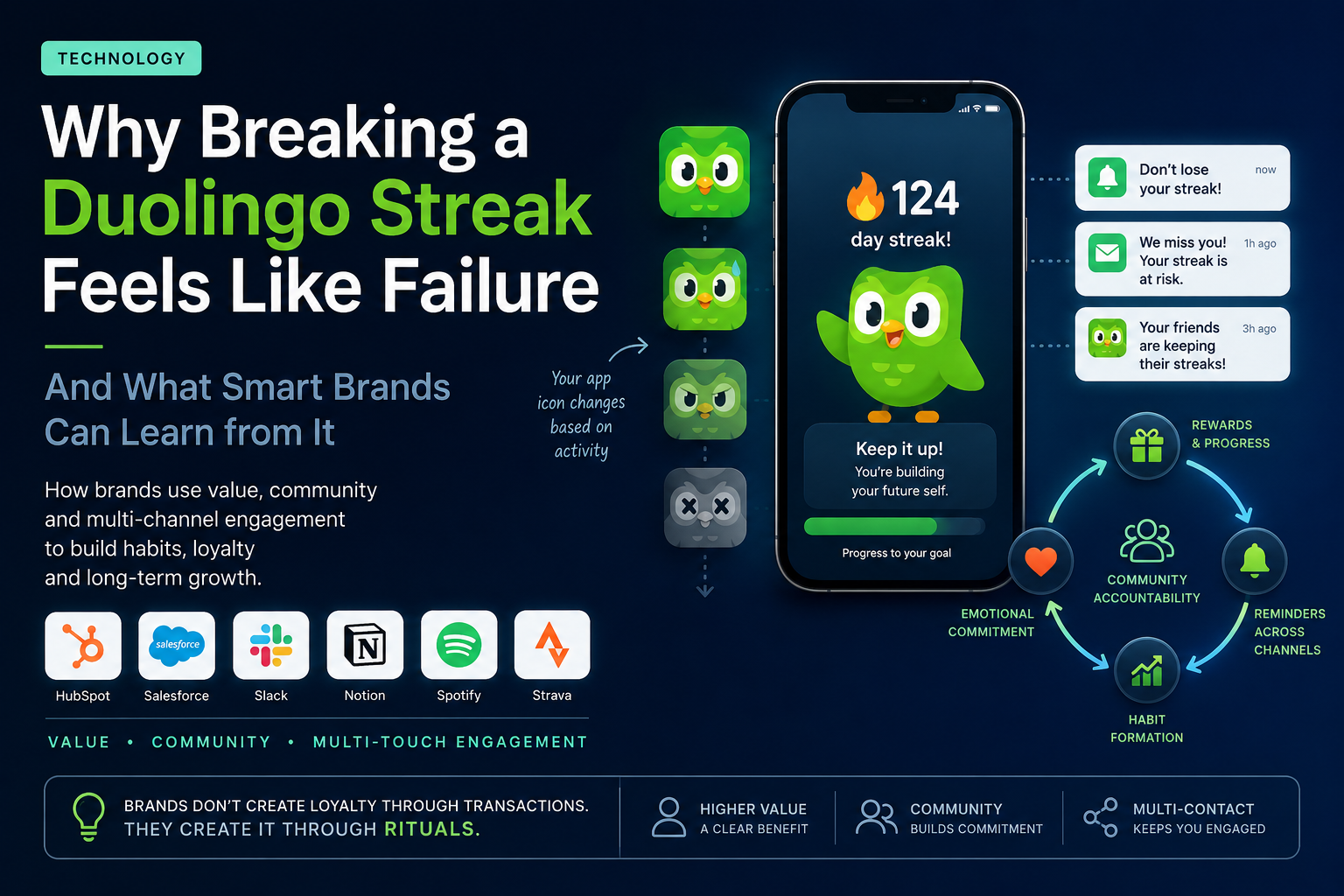
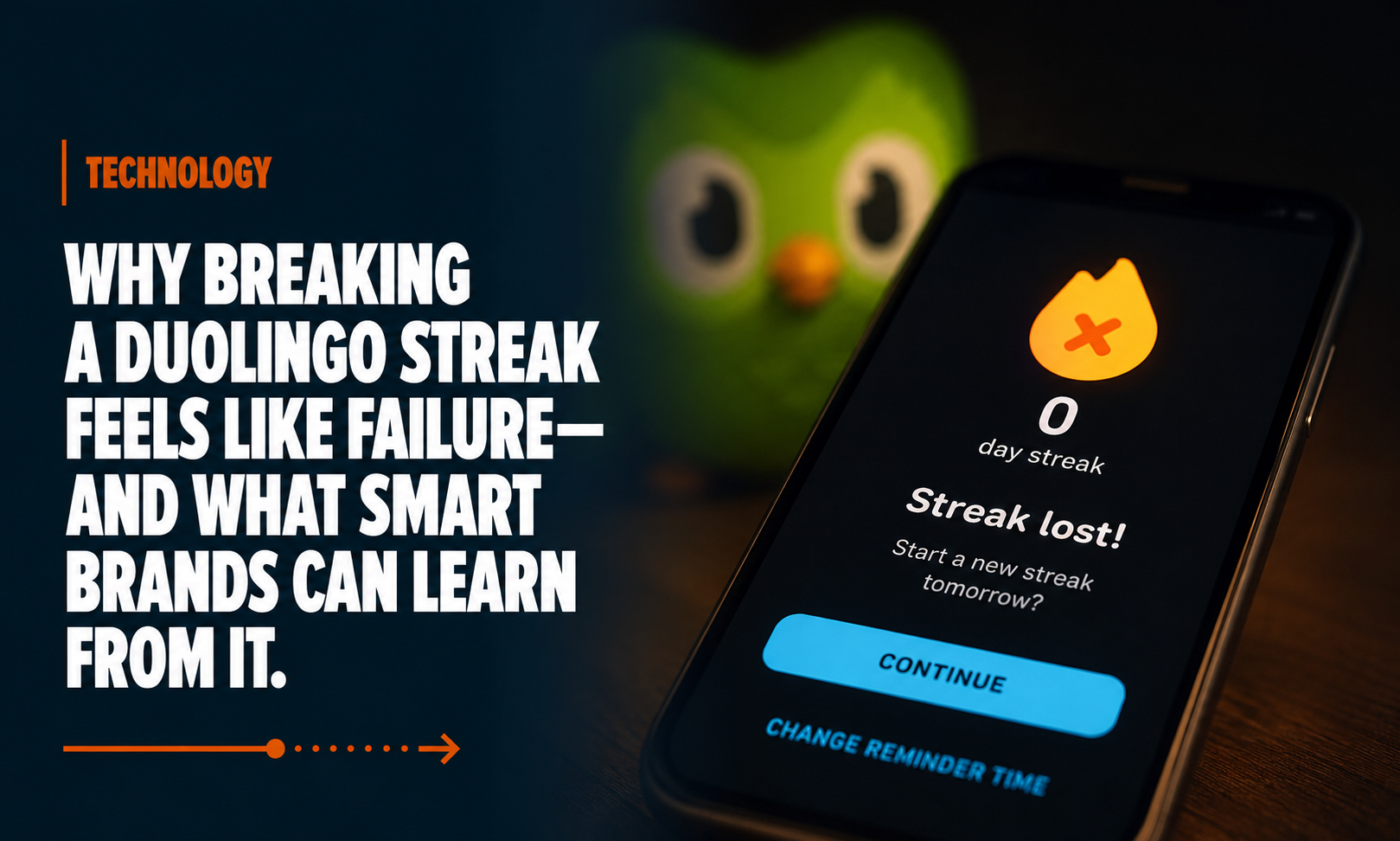
Why Breaking a Duolingo Streak Feels Like Failure — and What Smart Brands Can Learn from It

Why breaking a duolingo streal feels like failure - and what smart brands can learn from it

Duolingo streak psychology is one of the strongest examples of behavioral marketing in action.

Have you ever found yourself opening Duolingo just before midnight, simply to protect your streak?

Not because you had time.

Not because you felt like it.

But because you didn’t want to lose what you had built.

That moment reveals one of the most powerful truths in modern marketing:

The strongest brands don’t just sell products. They create habits.

And habits are the foundation of long-term engagement.

Duolingo has become one of the most effective examples of behavioral brand design. Not because of its product alone, but because it understands how psychology, technology and community work together to keep people engaged daily.

For B2C and B2B brands alike, there is a lot to learn here.

The psychology behind the streak: Why Duolingo streak psychology works

A streak is deceptively simple.

Complete one action every day.

Miss one, and it resets.

What makes this so powerful?

Because it combines:

  • Progress visibility
  • Commitment bias
  • Loss aversion
  • Identity reinforcement
  • Social accountability

Over time, the streak becomes more valuable than the action itself.

People are no longer “using the app.”

They are protecting their identity.

“I am someone who learns every day.”

That’s where emotional brand attachment begins.

Duolingo streak psychology

Lesson 1: The value must be bigger than the product

Duolingo streak psychology works because the reward is bigger than the action itself.

This is the most important lesson.

Duolingo doesn’t sell lessons.

It sells transformation.

The future reward is clear:

“Learn consistently and one day you will master a new language.”

The streak is simply proof that the user is moving closer to that goal.

Smart brands do the same.

B2C examples

Strava
Value = better health, better performance, social recognition.

Headspace
Value = less stress, better focus, emotional balance.

Spotify
Value = discovery, identity, belonging.

B2B examples

HubSpot
Value = business growth, better conversion.

Salesforce
Value = pipeline visibility, customer retention.

Slack
Value = faster collaboration, team efficiency.

If the end value isn’t meaningful enough, people will not return.

No reminder can fix weak value.

Lesson 2: Community amplifies commitment

A major part of Duolingo streak psychology is the use of community-driven accountability.

Leaderboards.

Leagues.

Friend streaks.

Social competition.

It creates subtle pressure.

And pressure creates consistency.

This principle is powerful far beyond consumer apps.

Where B2C brands can apply this

Retail loyalty clubs
Fitness brands
Travel memberships
Food subscriptions
Gaming ecosystems

Imagine:

A coffee brand rewarding consecutive weekly purchases.

A travel app rewarding consistent trip planning.

A health brand rewarding healthy daily choices.

Where B2B brands can apply this

Sales organizations
Project management tools
Learning platforms
Partner ecosystems

Examples:

A CRM showing daily deal movement streaks.

A learning platform rewarding consecutive training completions.

A project tool rewarding weekly team collaboration milestones.

The principle is always the same:

People stay committed when progress becomes visible to others.

Lesson 3: Multi-touchpoint orchestration keeps habits alive

This is where the real sophistication begins.

Duolingo uses an entire ecosystem:

  • Push notifications
  • Email reminders
  • In-app celebrations
  • Character evolution
  • Fear-of-loss messaging
  • Re-engagement campaigns

Each touchpoint plays a different role.

Together, they create a behavioral loop.

Many brands still treat channels separately.

That’s outdated.

Customers experience brands as one connected system.

The most effective engagement strategies connect:

Email + App + Social + CRM + UX + Community.

That is where modern retention happens.

What brands should ask themselves

To build stronger engagement, ask:

A) What higher value do we offer?

Not product features.

Transformation.

What future state is the customer buying into?

B) How can we make progress visible?

Can users track growth?

Can they compare?

Can they celebrate?

C) How can we create connected touchpoints?

Not random notifications.

Intentional, behavior-driven interactions.

Final thought: Loyalty is built through rituals

Brand engagement is no longer just about awareness.

It’s about presence.

Relevance.

Consistency.

Ritual.

Duolingo streak psychology shows that the strongest brands build habits, rituals and emotional loyalty over time.

Duolingo teaches us that when brands combine value, community, and intelligent multi-touchpoint design, engagement becomes part of daily life.

And that’s where true loyalty begins.

Because the strongest brands are not the ones customers remember. They are the ones customers return to — every single day.