
Most corporate merchandise ends up forgotten in a drawer. A modern merchandise strategy should do far more than display a logo. It should create utility, strengthen brand awareness, support ESG ambitions and become another meaningful customer touchpoint. Summer is the perfect time to step back, reflect and ask a simple question: are we creating memorable brand experiences or simply producing more promotional clutter?
Summer has a way of slowing us down.
It gives us space to recharge, spend time with family and reflect on habits that have quietly become routines.
For many marketers, summer is also trade fair planning season. Budgets are reviewed, autumn events are scheduled, and the familiar checklist appears once again.
Pens.
Lanyards.
Notebooks.
Cotton bags.
Power banks.
Whatever the latest trend may be.
And somewhere in the planning meeting, someone inevitably asks:
“What should we give away this year?”
Perhaps we’re asking the wrong question.
Open Your Drawer
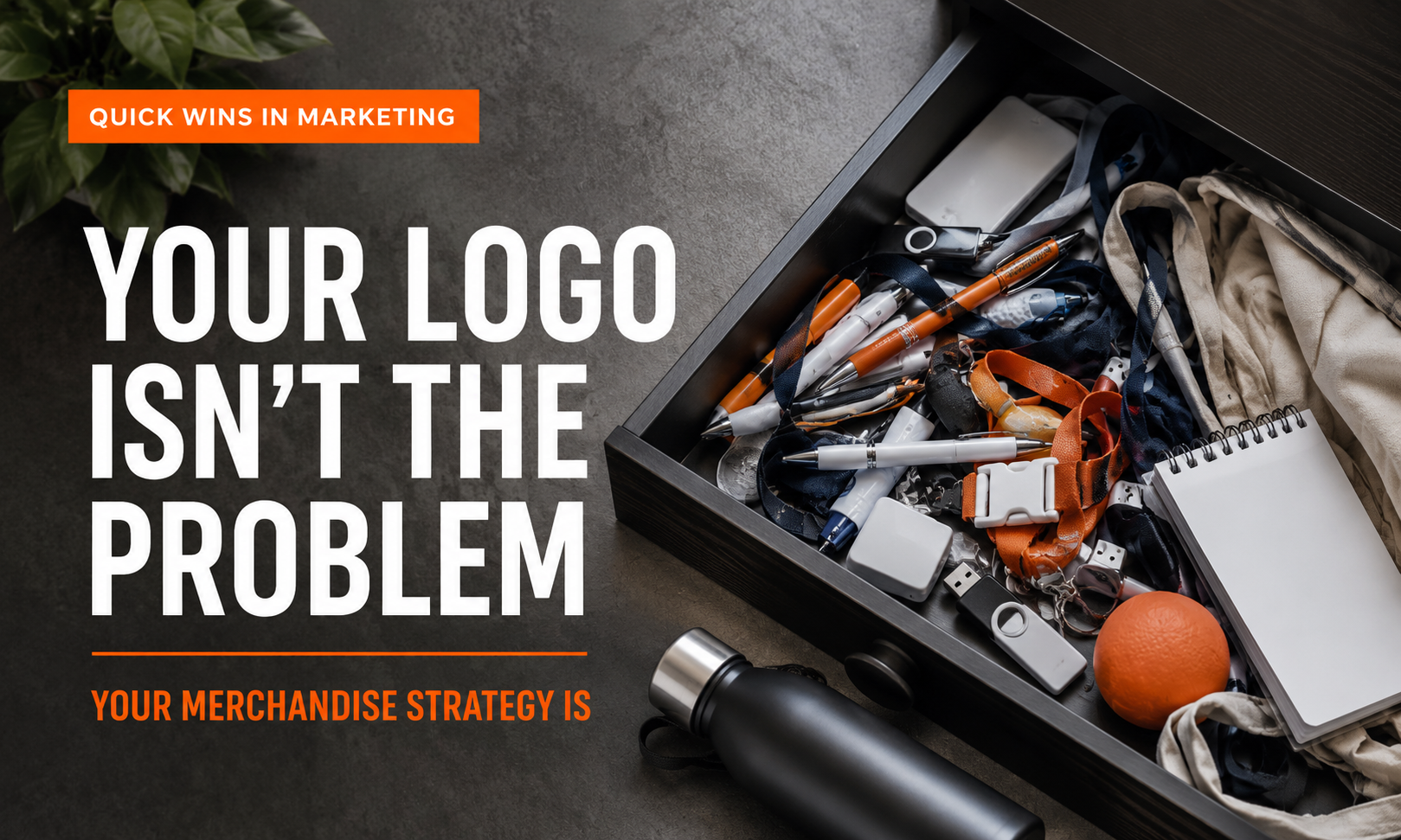
Before answering it, open the drawer next to your desk.
You’ll probably find a collection of conference giveaways gathered over the years.
Pens from companies you can’t remember.
USB sticks from technology conferences.
Lanyards from exhibitions you’ve long forgotten.
Stress balls.
Cheap keyrings.
Notepads you’ll never use.
Every single one carries a perfectly printed corporate logo.
Almost none created a memorable brand experience.
That drawer tells a story.
Not about successful merchandising.
But about missed opportunities.
Why Most Merchandise Strategies Fail
The problem isn’t branded merchandise itself.
The problem is that many organisations still design merchandise from their own perspective instead of the customer’s.
The conversation often starts with questions like:
- How many visitors do we expect?
- What’s our budget?
- Which supplier offers the best price?
- Where can we print the biggest logo?
Rarely does it begin with the most important question:
What will people actually use?
A successful merchandise strategy starts by understanding what creates value for the recipient, not what is easiest to produce.
Brand awareness isn’t created when someone receives an item.
It’s created every time they use it.
A Merchandise Strategy Needs New KPIs
For decades, merchandise has been measured by quantity.
- 2,000 visitors
- 2,000 giveaways
- Campaign completed
But distribution is not impact.
Imagine measuring your merchandise strategy differently.
Instead of asking how many items were handed out, ask:
- How long will this product remain in use?
- How often will someone interact with it?
- Does it solve a genuine problem?
- Will it still be useful six months from now?
- Does it create a positive association with the brand?
- Would someone recommend it to a colleague?
Suddenly, merchandise becomes much more than a promotional expense.
It becomes another customer touchpoint.
A Successful Merchandise Strategy Creates Utility
One simple question can transform an entire merchandise strategy.
Would someone still want this if our logo wasn’t printed on it?
If the answer is no, perhaps it shouldn’t be produced.
People rarely keep products because they’re branded.
They keep them because they’re useful.
Everyday utility creates repeated exposure.
Repeated exposure builds familiarity.
Familiarity builds trust.
Trust strengthens brands.
The logo doesn’t create the value.
The usefulness does.
Merchandise Strategy Starts with Customer Value
Perhaps it’s time to stop thinking about giveaways altogether.
Instead, think about Brand Utility.
Brand Utility is the ability of every branded touchpoint to create recurring value for the user while simultaneously reinforcing the brand.
The best merchandise usually shares three characteristics.
It solves a small everyday problem
Useful products naturally become part of daily routines.
The more often they’re used, the more often your brand is experienced.
It survives the event
Good merchandise doesn’t end when the exhibition closes.
Its value continues long afterwards.
Months later.
Sometimes years.
It creates positive emotion
Every interaction becomes another micro-experience.
A small reminder that your company cared enough to create something genuinely valuable instead of simply printing another logo.
A Sustainable Merchandise Strategy Starts Before Production
Sustainability has become an important part of corporate merchandise discussions.
Recycled materials.
FSC-certified paper.
Organic cotton.
Bamboo.
These are all positive developments.
But they don’t answer the most important sustainability question.
Was the product actually needed?
A recycled notebook that remains unopened isn’t sustainable.
A bamboo pen that ends up in landfill after two weeks isn’t sustainable.
Perhaps the most sustainable promotional product is one that replaces disposable alternatives, remains useful for years or simply doesn’t need to be produced at all.
ESG isn’t only about materials.
It’s also about purpose.
A thoughtful merchandise strategy reduces waste by creating products people genuinely value.
Merchandise Strategy Is Customer Experience
Customer experience professionals spend enormous amounts of time analysing every touchpoint.
Websites.
Retail stores.
Packaging.
Customer service.
Digital journeys.
Yet merchandise often escapes the same level of strategic thinking.
It shouldn’t.
Every branded object is another customer touchpoint.
Every interaction contributes to perception.
Every useful experience reinforces trust.
Merchandise shouldn’t simply display a logo.
It should demonstrate your brand promise.
Imagine if every promotional product had to pass the same design thinking workshops as your website or mobile app.
Would you still choose another cheap plastic pen?
Probably not.
What Makes Sense in 2026?
The question isn’t which product is trending.
The question is which product creates lasting value.
Instead of chasing novelty, think in terms of utility.
Examples might include:
- Premium reusable bottles that replace disposable plastics.
- Refillable notebooks instead of disposable notepads.
- High-quality cable organisers that travel everywhere.
- NFC-enabled business cards that never become outdated.
- Smart luggage tags for frequent travellers.
- Digital resources, AI prompt collections or exclusive industry insights delivered through QR codes.
- Products designed to be repaired rather than replaced.
In every case, the product should continue the brand experience long after the event has ended.
The Future of Merchandise Strategy
Rather than choosing products because they’re inexpensive, ask different questions.
- Will people genuinely keep this?
- Does it solve a real problem?
- Is it consistent with our brand positioning?
- Does it reduce waste?
- Can it replace disposable products?
- Is the quality good enough to reflect our brand?
- Would I personally use it every week?
If the answer is yes, you’re probably investing in brand building rather than promotional clutter.
The best merchandise strategy doesn’t produce more items.
It produces better ones.
Frequently Asked Questions About Merchandise Strategy
What is a merchandise strategy?
A merchandise strategy defines how branded products support marketing, customer experience, brand awareness and sustainability. Instead of simply distributing promotional items, it focuses on creating products people genuinely use, remember and value.
How can merchandise increase brand awareness?
Useful merchandise creates repeated brand exposure over months or even years. Every interaction becomes another positive brand touchpoint, making the brand far more memorable than one-off promotional giveaways.
What makes sustainable merchandise?
Sustainable merchandise is designed for long-term use, solves a real customer problem and avoids unnecessary waste. The most sustainable promotional product is often the one people keep for years rather than replacing after a single event.
Final Thought
The next time you’re planning a trade fair, conference or customer event, don’t begin with the catalogue.
Begin with your customer.
Ask yourself one question:
What could we create that people would genuinely miss if they lost it?
That’s where a great merchandise strategy begins.
Because nobody remembers the company that handed them another pen.
But people do remember the brand that made their day just a little easier.
And perhaps that’s what merchandise was always supposed to do.