AI shopping agents are changing how people discover, compare and choose products. For marketers, this raises a bigger question: how do brands make the shortlist, and where should the next media euro go?
Imagine planning a weekend away with your family.
You tell your AI assistant what matters: somewhere quiet, good food, activities for the children and a realistic total price. It returns three hotels, explains the differences and helps you choose.
Convenient? Absolutely.
But what happened to all the hotels you never saw? The carefully designed websites, the paid search campaigns, the inspirational videos?
Somewhere between your request and the recommendation, a shortlist formed.
For brands, understanding that moment could become one of marketing’s most important challenges.
How AI shopping agents change product discovery
On 11 November, Zalando described how its Assistant now supports product comparisons, size recommendations, basket preparation and order tracking. According to the company, customer queries in the Assistant are three times longer than traditional search queries. People can explain their situation rather than squeeze it into a few keywords.
That distinction matters.
“Waterproof jacket” describes a product category.
“I need a jacket for a wet November weekend outdoors, but I don’t want to look as though I’m climbing Everest” describes a person, a situation and a compromise.
My view is that this creates a new competitive challenge: brands need to communicate clearly enough to be considered in that context, while remaining distinctive enough for people to want them.
Who actually controls the recommendation?
We should be careful about treating AI as a neutral personal shopper.
A retailer’s assistant operates within a commercial environment. An independent assistant may draw on different sources, partnerships and technical access. A sponsored placement and an organic recommendation are different things.
The questions become: which products can the assistant access, what evidence does it use, and how clearly does it distinguish advertising from advice?
For marketers, “being visible in AI” is therefore too vague to be a strategy. Visibility needs a context: which assistant, which market, which customer need and which stage of the decision?
What this means for media spending
As AI shopping agents influence more purchase decisions, marketers need to examine which placements still reach customers and generate additional demand.
The immediate response should be to examine how media contributes to decisions.
Reuters recently reported that AI shopping agents could reduce exposure to retailer websites and advertising placements. It also reported that Amazon had seen no meaningful impact on its advertising from third-party agents so far. The direction of change deserves attention; the timing and scale remain uncertain.
That argues for disciplined experimentation.
I would put three kinds of spending under closer scrutiny:
Repeated exposure with little evidence of additional demand. High impression counts can conceal weak commercial impact.
Search activity that mainly captures customers already looking for the brand. Reported conversions deserve a closer look at what would have happened without the ad.
Traffic acquisition that leads to incomplete information or disappointing experiences. More visitors will rarely solve an unclear offer.
These are useful questions today. AI makes them more urgent.
Where I would invest
Investing in visibility means connecting AI discovery with memorable human experiences.
Preparing for AI shopping agents means coordinating paid media with accurate product information, credible evidence and a dependable customer experience.
I would organise investment around five priorities, with paid media working alongside product, content and customer experience.
Investment priority
What I would fund
What I would assess
Brand demand
Distinctive creative, relevant video, social, OOH and partnerships
Whether more people remember, seek out and consider the brand
Useful product information
Accurate feeds, clear specifications, availability, pricing and practical FAQs
Information quality, discovery and conversion
Independent evidence
Credible reviews, expert coverage, customer cases and relevant PR
Quality of coverage, consideration and referral activity
Customer experience
Better advice, booking, delivery, service and recovery
Repeat purchase, complaints, returns and recommendations
Controlled experiments
Relevant AI discovery and advertising tests
Additional sales, acquisition cost and customer quality
The balance will vary. A hotel, a software provider and a consumer electronics brand should arrive at different allocations.
1. Give people a reason to ask for you
There is a meaningful difference between asking an assistant for “a good hotel” and asking it to check availability at a particular hotel.
Brand building can influence the starting point of the conversation.
I would continue investing in creative work that builds recognition and preference. The channel should follow the audience and the task. A memorable physical experience, a strong video or a relevant partnership can all contribute.
2. Make the offer easy to understand
Google has introduced additional Merchant Center attributes intended to support conversational discovery, including answers to product questions and information about compatible accessories or substitutes. That is a practical signal that the quality of product information deserves investment.
For a hotel, “family friendly” is a claim. Connecting rooms, children’s meal times, pool restrictions and transparent additional charges help someone make a decision.
Clear information helps customers and gives discovery systems more useful material to work with. It cannot guarantee a recommendation.
3. Build evidence beyond your own advertising
Independent reviews, relevant editorial coverage and specific customer stories give prospective buyers ways to check a promise.
I would fund those activities for their credibility and usefulness. Their influence on AI recommendations should be tested rather than assumed.
4. Invest in the experience people remember
My background in hospitality taught me how quickly a polished promise meets reality.
The welcome. The room. The meal. The response when something goes wrong.
Marketing can create an expectation. Operations determine whether that expectation was justified.
That is why part of the growth conversation belongs with service and product teams. A recurring complaint may point to a better investment than another acquisition campaign.
How much should move?
There is no defensible universal percentage.
For an established advertiser, I would start with a bounded 90-day test funded from activity with the weakest evidence of incremental return. Protect effective campaigns, define the hypothesis and agree on the success criteria before spending.
Keep the accounting clear, too: product data, service improvements and paid media are different budget categories. They need coordination and appropriate measures.
Alongside sales and acquisition cost, I would track AI recommendations across a consistent set of relevant customer questions. That is a diagnostic measure. Inclusion in an answer is useful only if it eventually contributes to a worthwhile business outcome.
The shortlist is only the beginning
My working thesis is that brands will need to earn consideration in more places, often before a customer reaches their website.
That makes distinctive communication, dependable information and a credible customer experience valuable investments.
Getting recommended creates an opportunity. Delivering on the recommendation creates the relationship.
AI shopping agents may help shape the shortlist, but the experience after purchase determines whether customers return.
If an assistant compared your brand tomorrow, what evidence would give it a good reason to put you on the shortlist?
What if a new retail experience business model could reward physical stores for the value they create, even when customers complete their purchases online?
The Experience Dividend explores how AI-powered simulations, immersive commerce, cross-brand partnerships and intelligent cross-selling could transform traditional retail into a collaborative experience economy. This detailed business case examines the commercial opportunities, financial assumptions and challenges of making that vision a reality.
The €15 Problem That Reveals a Bigger Retail Challenge
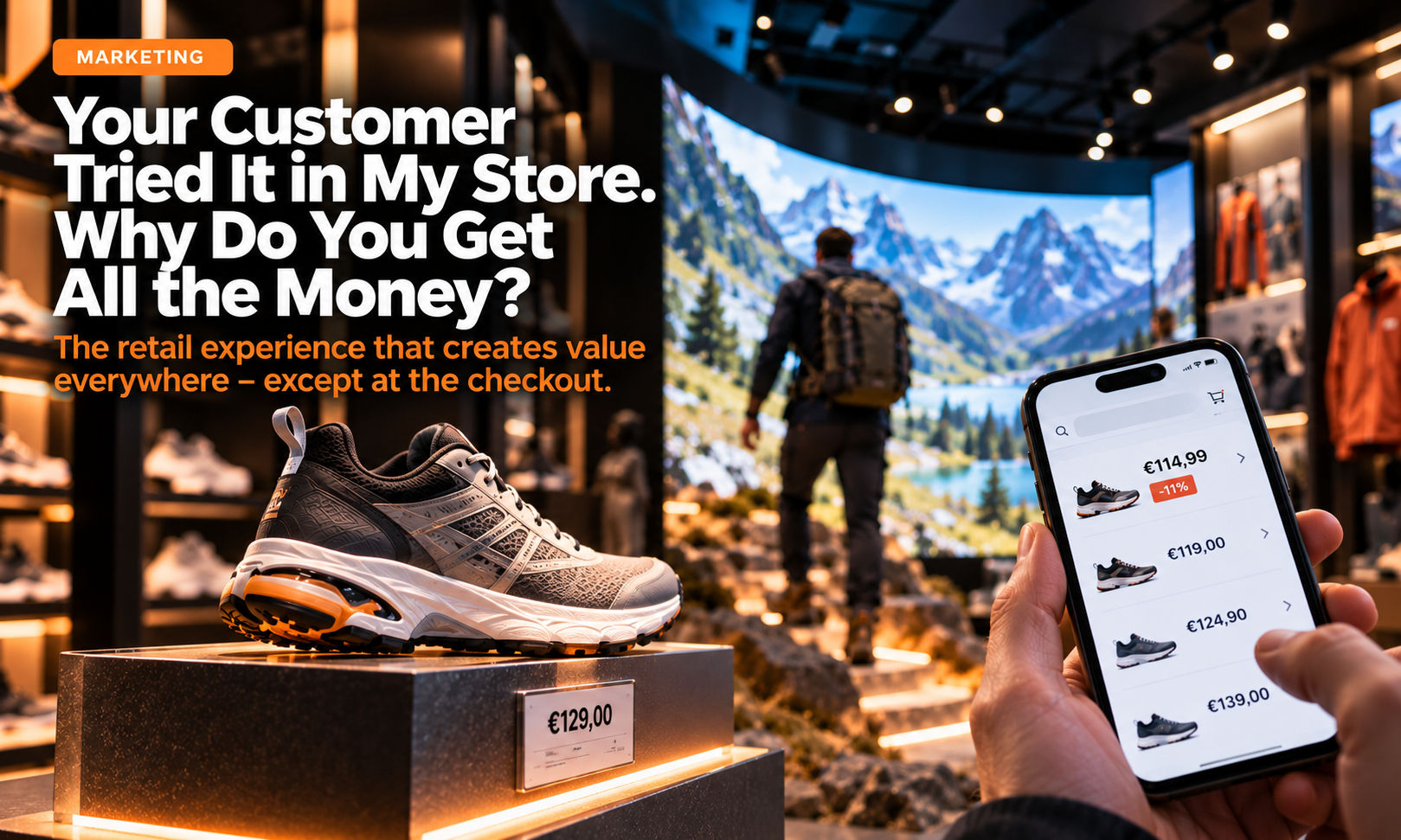
A customer enters a specialist shoe store.
He spends 30 minutes trying different models, comparing materials and receiving professional advice.
The employee explains cushioning, stability and fit. The customer finally finds the perfect shoe.
Then he checks his smartphone.
The same model is available online for €15 less.
He leaves without buying.
The physical retailer paid for the store, inventory, employee, training and product experience.
The online retailer completes the transaction.
The experience was created offline. The revenue was captured online.
This is showrooming, a familiar phenomenon in omnichannel retail.
But the deeper problem is not simply price competition.
It is the way value is recognised and distributed across the customer journey.
A 2025 study published in the Journal of Consumer Marketing found that customers tend to use a single channel for cheaper products but are more inclined towards showrooming for higher-priced products.
That distinction matters.
The more complex or expensive a purchase becomes, the more valuable professional advice and physical product experience can be.
Yet conventional retail economics often recognise only the final transaction.
What if we changed that?
The Experience Dividend: A New Retail Experience Business Model
Imagine an independent outdoor retailer participating in a shared commercial ecosystem.
The retailer provides specialist consultations, product demonstrations and immersive experiences.
Manufacturers contribute product knowledge, equipment, training and experience funding.
E-commerce platforms provide availability, payment processing and fulfilment.
An attribution system recognises verified contributions to customer purchases.
When a customer receives advice in the store and subsequently purchases from a participating online retailer, the store receives an agreed experience-related payment.
The customer remains free to choose where to buy.
The store no longer needs to own every transaction to participate in the economic value it creates.
I call this proposed model The Experience Dividend.
Its ambition is to move beyond conventional omnichannel integration.
Most omnichannel strategies connect touchpoints.
The Experience Dividend would also connect their economics.
Instead of asking which channel owns the customer, the partners would ask which activities created measurable value and how those contributions should be rewarded.
The Next Opportunity: From Product Showrooms to Immersive Experience Hubs
Now imagine taking the concept one step further.
A customer visits an outdoor store looking for trekking boots.
Rather than simply trying on footwear, he enters an immersive mountain environment.
A large panoramic display recreates an Alpine landscape.
A controlled testing surface simulates rocky terrain, wet ground and uneven paths.
Lighting, sound and environmental effects create a more realistic impression of different trekking conditions.
A trained specialist guides the customer through the experience.
AI-supported software adapts the demonstration to the customer’s intended activity and experience level.
A weekend hike in the Alps requires different equipment from a multi-day expedition in Scandinavia.
The customer tests footwear, compares backpack carrying systems and explores different layering options.
The simulation does not replace certified product testing or real-world safety assessments. It creates a more relevant, engaging environment for education and comparison.
The customer is no longer simply examining products. The customer is exploring the situations in which those products will be used.
This changes the commercial potential of the store.
Because the customer rarely needs just one product.
Cross-Selling Through Experience, Not Sales Pressure
Consider what happens during the simulated trekking journey.
The customer begins by testing boots.
As the terrain changes, a specialist explains the benefits of trekking poles.
When simulated weather conditions deteriorate, the customer discovers the differences between waterproof jackets.
A backpack demonstration reveals the importance of weight distribution.
An AI-supported recommendation engine identifies compatible equipment, drawing on the customer’s planned activity, preferences and existing gear.
The journey naturally introduces complementary categories.
Footwear, backpacks, clothing, navigation equipment, hydration systems and potentially outdoor services.
This is not traditional cross-selling based on generic product bundles.
It is experience-driven cross-selling, where recommendations emerge from a realistic use case.
For example, a customer buying trekking boots might also discover that an appropriately fitted backpack would make a planned multi-day hike more comfortable.
The additional product becomes relevant because the experience reveals a genuine need.
That distinction is essential.
Cross-selling should improve the customer’s outcome, not simply increase basket size.
A well-designed experience could potentially improve attachment rates, average order value and satisfaction while reducing unsuitable purchases.
Those outcomes would need to be validated experimentally.
Why the Entire Retail Value Chain Could Benefit
The opportunity extends beyond the physical retailer.
Manufacturers: From Product Exposure to Product Understanding
Manufacturers invest substantial resources in advertising, retail distribution and product education.
An immersive experience hub could offer a shared environment for demonstrating products in context.
A footwear manufacturer might contribute technical expertise.
An outdoor apparel brand could provide weather-protection demonstrations.
A backpack manufacturer could support load-distribution testing.
A navigation technology provider could demonstrate route-planning functionality.
The participating brands would gain opportunities for qualified customer engagement and, where appropriately permitted, aggregated insights into product preferences and common customer questions.
Physical Retailers: From Transaction Revenue to Experience Revenue
Retailers could develop several complementary revenue streams.
Traditional product sales would remain important.
But additional income could come from verified purchase referrals, paid specialist experiences and commercial partnerships supporting the experience environment.
This would reduce dependence on the physical checkout as the only measure of commercial success.
E-Commerce Platforms: Better Purchase Quality
An online retailer receiving customers who have already tested products and received specialist advice may benefit from more informed purchasing decisions.
That could translate into stronger conversion quality, better product suitability and fewer returns.
The potential is commercially relevant.
According to the National Retail Federation’s 2025 Retail Returns Landscape report, an estimated 19.3% of online sales in the United States were expected to be returned.
That figure is an industry-wide estimate, not a benchmark for outdoor equipment or European retail.
Nevertheless, it illustrates why reducing unsuitable purchases could create substantial value.
Employees: Expertise as a Revenue-Generating Capability
A specialist employee could contribute directly to consultation revenue, customer satisfaction, cross-selling and verified online purchases.
Instead of evaluating staff exclusively through immediate sales, retailers could measure the quality and commercial impact of customer experiences.
Customers: Better Decisions Without Channel Restrictions
Customers would receive more relevant advice, practical demonstrations and greater confidence in their purchasing decisions.
They would retain the freedom to buy immediately, order later or choose another participating channel.
The objective is not to restrict customer choice.
It is to make better experiences economically sustainable.
Business Case: An Independent Outdoor Retailer
Let’s translate the concept into a financial model.
Imagine a medium-sized independent outdoor retailer introducing a modular immersive experience zone.
The store already exists and continues its normal retail operations.
The proposed investment covers an additional experience environment, digital attribution capabilities, staff training and AI-assisted product discovery.
This distinction matters.
The following calculation is an incremental business case. It evaluates the additional revenue and costs of the Experience Dividend programme, rather than the profitability of the entire retail store.
All figures are hypothetical planning assumptions, not observed market results.
1. Initial Investment
Investment category
Estimated cost
Modular terrain and testing installation
€15,000
Immersive display and audiovisual equipment
€12,000
CRM, attribution and AI integration
€10,000
Staff training and experience design
€5,000
Launch and contingency
€3,000
Total initial investment
€45,000
The concept deliberately avoids starting with an expensive, fully immersive installation.
A modular environment would allow the retailer to test demand and commercial viability before making larger investments.
2. Revenue Model
The proposed programme has three incremental revenue streams.
A. Verified Online Purchase Compensation
Assume the store conducts 600 qualifying consultations per month.
Of those, 40% result in an eligible, verified online purchase through a participating partner.
With an average transaction value of €150 and an 8% experience compensation:
600 × 40% × €150 × 8% = €2,880 monthly.
Annual revenue: €34,560
The 40% figure represents an assumed attribution-eligible purchase rate, not a demonstrated conversion benchmark.
B. Paid Immersive Experiences
The retailer offers specialist experience sessions, such as backpack fitting or guided trekking equipment preparation.
Assume 120 paid sessions per month at an average net price of €18.
120 × €18 × 12 = €25,920 annually.
Annual revenue: €25,920
These paid sessions are modelled separately from the consultations compensated through online referrals to avoid counting the same service twice.
C. Brand Experience Partnerships
Three complementary brands participate in the experience environment.
Each contributes an assumed €1,000 per month for defined demonstrations, staff education and experience participation.
3 × €1,000 × 12 = €36,000 annually.
Annual revenue: €36,000
Brand payments would need to be supported by independently measurable commercial value. They cannot be assumed to be available automatically.
3. Annual Revenue Summary
Revenue stream
Annual revenue
Verified purchase compensation
€34,560
Paid immersive experiences
€25,920
Brand partnerships
€36,000
Total incremental revenue
€96,480
4. Annual Operating Costs
Cost category
Annual cost
Incremental specialist staffing
€42,000
Technology, software and maintenance
€18,000
Experience operations and content
€12,000
Attribution, administration and data governance
€8,000
Total incremental operating costs
€80,000
The model assumes the existing store provides the necessary space without material additional rent. Where this is not possible, an opportunity cost for floor space must be included.
5. Operating Result
Annual incremental revenue: €96,480
Annual incremental operating costs: €80,000
Indicative annual operating surplus: €16,480
That represents an operating surplus margin of approximately 17.1% on programme revenue.
The €45,000 initial investment is excluded from annual operating costs.
Under these simplified assumptions, the initial investment would be recovered through operating surplus after approximately 2.7 years if annual performance remained constant.
This is not a guaranteed ROI.
The result is sensitive to consultation volumes, customer willingness to pay, partner contributions, attribution rules and actual operating costs.
It also excludes financing, tax, depreciation and any material displacement of existing store sales.
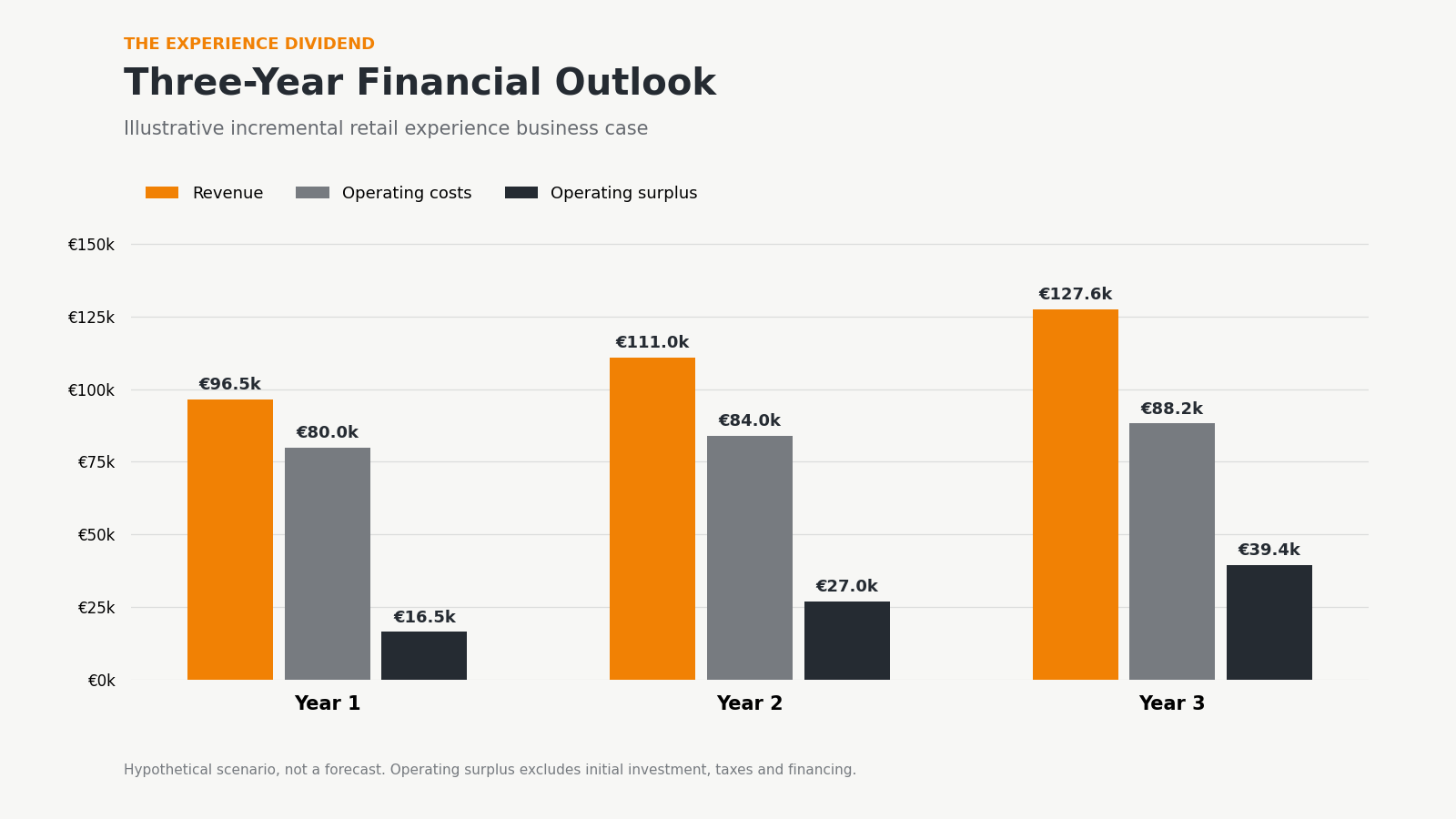
Three-Year Financial Outlook
The Experience Dividend: Illustrative three-year financial outlook showing potential revenue growth, operating costs and operating surplus for an independent retail experience hub.
Assume programme revenue grows by 15% annually after Year 1 as customer awareness and partner participation increase.
Operating costs rise by 5% annually.
Financial metric
Year 1
Year 2
Year 3
Revenue
€96,480
€110,952
€127,595
Operating costs
€80,000
€84,000
€88,200
Operating surplus
€16,480
€26,952
€39,395
The cumulative three-year operating surplus would be approximately €82,827.
After subtracting the initial €45,000 investment, the simplified cumulative programme cash contribution would be approximately €37,827.
This projection assumes that revenue growth can be achieved without proportionate increases in staffing or technology costs.
It is therefore an illustrative scenario rather than a forecast.
The important question is not whether these exact figures will materialise.
It is whether shared experience funding, verified purchase compensation and relevant cross-selling can collectively generate enough incremental contribution to support the investment.
Where the Additional Value Really Comes From
The financial model above considers direct programme revenue.
But the wider value chain could generate additional benefits.
Cross-Selling Contribution
Imagine that immersive consultations increase the share of customers purchasing relevant complementary products.
The resulting incremental contribution margin could improve the economics for participating retailers, brands and platforms.
However, additional sales should only count as incremental if they exceed what a comparable customer group would have purchased without the experience.
Return Reduction
Better fitting and product understanding might reduce unsuitable purchases.
A reduction in returns could create savings in reverse logistics, handling, inspection and inventory losses.
Those savings should be measured after accounting for the costs of providing the experience.
Brand Experience Efficiency
Instead of financing separate installations, brands could share a single experience environment.
That could reduce duplicated investment and improve access to qualified customers.
Employee Productivity
AI-assisted product information and preparation tools could help employees deliver more relevant consultations.
But productivity should not be measured solely through shorter interactions.
For complex purchases, a longer, higher-quality consultation may create more value than a faster transaction.
The Critical Economic Question: Who Pays Whom?
A shared value model only works if the participants understand the economic exchange.
Consider a customer purchasing a €150 product online after receiving specialist advice in a participating store.
An 8% experience compensation would equal €12.
The online retailer cannot automatically afford that payment.
It would need to be funded by a combination of incremental contribution margin, avoided acquisition costs, measurable return savings or a separately agreed manufacturer contribution.
The commercial arrangement must also account for existing wholesale margins, marketing allowances and fulfilment costs.
Otherwise, the system could simply redistribute margin without creating additional value.
The Experience Dividend therefore needs two separate mechanisms.
Attribution: Which interaction materially contributed to the purchase?
Compensation: What verified incremental value was created, and how much can the participating partners sustainably share?
These are related but different questions.
A customer may receive advice in several locations, encounter advertising and compare multiple online retailers before purchasing.
The system should not assume that the last recorded store visit deserves full credit.
A practical pilot could begin with simple, consent-based referral identifiers and predefined compensation rules.
More sophisticated multi-touch attribution should only be introduced if it improves accuracy enough to justify its cost and complexity.
AI at the Point of Sale: Beyond Recommendation Engines
The role of AI in this concept goes beyond suggesting another product.
It could connect five capabilities.
Contextual discovery: Understanding the customer’s intended activity and product requirements.
Adaptive simulation: Selecting relevant scenarios, such as different hiking environments or weather conditions.
Product compatibility: Identifying suitable combinations of footwear, clothing and equipment.
Human-assisted guidance: Giving trained employees reliable information to support their recommendations.
Commercial measurement: Analysing which experiences contribute to customer satisfaction, suitable purchases and verified incremental value.
The customer should remain in control of personal information.
An anonymous experience should be possible without creating a customer profile.
Cross-channel tracking would require a valid legal basis and appropriate transparency, with consent where required.
AI recommendations should be explainable, based on reliable product information and subject to human oversight, especially where safety-related equipment is involved.
AI should make the experience more relevant. It should not make the customer feel monitored.
What Could Go Wrong?
A credible business case must consider failure scenarios.
Attribution failure: Purchases cannot be reliably linked to consultations, or several partners claim the same contribution.
Commercial resistance: Platforms and manufacturers refuse to fund the proposed compensation model.
Low utilisation: Customers enjoy the installation but are unwilling to pay for sessions or do not purchase additional products.
Experience novelty decay: Initial interest declines once the immersive environment is no longer new.
Technology costs: Software, hardware maintenance and content updates exceed the initial budget.
Channel conflict: Existing retailers or distribution partners perceive the model as unfair competition.
Data protection: Customers do not want their in-store activity connected with online purchases.
Weak incrementality: The programme rewards transactions that would have occurred anyway.
None of these risks can be solved through storytelling.
They require commercial negotiation, operational discipline, careful system design and real-world testing.
A 90-Day Pilot: From Concept to Evidence
Rather than launching a large network immediately, the concept should begin with a controlled experiment.
Days 1–30: Establish the Foundation
Select three to five independent outdoor retailers, complementary brands and one participating online retailer.
Agree on commercial responsibilities, customer data handling and attribution rules.
Establish baseline metrics and suitable comparison groups.
Build a modular experience prototype focused on one use case, such as trekking footwear and backpack fitting.
Days 31–60: Launch and Measure
Introduce the experience to customers.
Train staff in product consultation and AI-assisted discovery.
Monitor operating costs and technical reliability.
Days 61–90: Evaluate the Economics
Compare pilot results with the baseline and control group.
Determine whether the programme generated incremental contribution margin.
Assess whether cross-selling improved product suitability rather than merely increasing sales volume.
Measure any early signals relating to returns, recognising that the full return window may extend beyond the pilot.
Review the financial viability for every participating partner.
Then decide whether to stop, redesign or scale the concept.
A 90-day experiment would not prove long-term profitability or employment effects.
But it could establish whether the central commercial hypothesis deserves further investment.
From Retail Fiction to a Different Economic Reality
There is just one problem with the integrated ecosystem described here.
The Experience Dividend, in this proposed form, is fictional.
The financial projections are hypothetical.
The immersive outdoor experience is a concept scenario, not an operating pilot.
And no brand, retailer or e-commerce platform is represented as having committed to this model.
Yet many of the underlying capabilities already exist.
Retailers already provide professional consultations.
Brands already invest in product experiences.
E-commerce platforms already use referral systems.
AI already supports product discovery and personalisation.
Immersive technologies already allow customers to experience simulated environments.
What remains unresolved is how these capabilities could be integrated into a commercially fair, interoperable system.
The innovation may not be another technology. It may be a new agreement about who creates value and who deserves to benefit from it.
The Future of Retail Is a Value Chain Question
For years, retail transformation has focused on connecting physical and digital channels.
But connecting channels is not the same as aligning their economics.
If physical retailers are expected to provide product discovery, personal expertise and immersive experiences, they need a viable commercial model to support those investments.
If online platforms benefit from more confident customers and better product choices, there may be an opportunity to recognise the contribution of physical experiences.
If manufacturers want richer product engagement, shared experience environments could offer a new form of cooperation.
And if local stores can generate sustainable income from expertise rather than relying exclusively on checkout transactions, that could create new opportunities for investment, training and employment.
The objective should not be to protect physical retail from digital commerce.
It should be to create a more productive relationship between them.
What if we stopped treating physical retail as a distribution channel and started treating it as an experience economy?
And here is the question I would put to retail leaders, brand manufacturers and e-commerce platforms:
Would you reward a retail partner who created the customer experience, even if your business completed the sale?
And would you invest alongside other brands in immersive experiences that none of you could justify building alone?
Perhaps that is where the next chapter of retail innovation begins.
Concept disclosure: The Experience Dividend is an independent, hypothetical retail business model developed as a thought-leadership exercise. Financial figures are illustrative assumptions and should not be interpreted as forecasts, market benchmarks or evidence of an operating commercial network. The proposed pilot, partnerships and immersive experience environment are fictional scenarios.
Research & Data Sources
The following research publications and industry reports provide context for the retail trends, customer behaviour and data governance considerations discussed in this article.
National Retail Federation (NRF) – 2025 Retail Returns Landscape Industry research examining retail return rates, the economic impact of product returns and the challenges associated with online shopping, particularly in the US market. View Report
Journal of Consumer Marketing (2025) – Omnichannel Usage, Webrooming and Showrooming Academic research exploring omnichannel shopping behaviour, including how product prices influence customers’ decisions to research and purchase across physical and digital channels. Read Publication
Journal of Business Research (2025) – How Do Omnichannel Customer Experiences Affect Customer Engagement? Academic research investigating the relationship between omnichannel customer experiences and customer engagement, highlighting the importance of understanding how different touchpoints contribute to customer relationships. Read Publication
European Data Protection Board (EDPB) – Guidelines 05/2020 on Consent under Regulation 2016/679 Official European guidance on valid consent under the General Data Protection Regulation (GDPR), relevant to customer data collection, personalisation and consent-based attribution across physical and digital retail environments. Read Guidelines
Research note: The Experience Dividend is a hypothetical retail business model. The sources above provide supporting industry context and academic perspectives; they do not validate the proposed financial projections, revenue-sharing mechanisms or commercial feasibility of the concept.
Sometimes inspiration for brand cooperation strategy does not come from a conference, a trend report or a marketing textbook. Sometimes it is sitting in the middle of a supermarket.
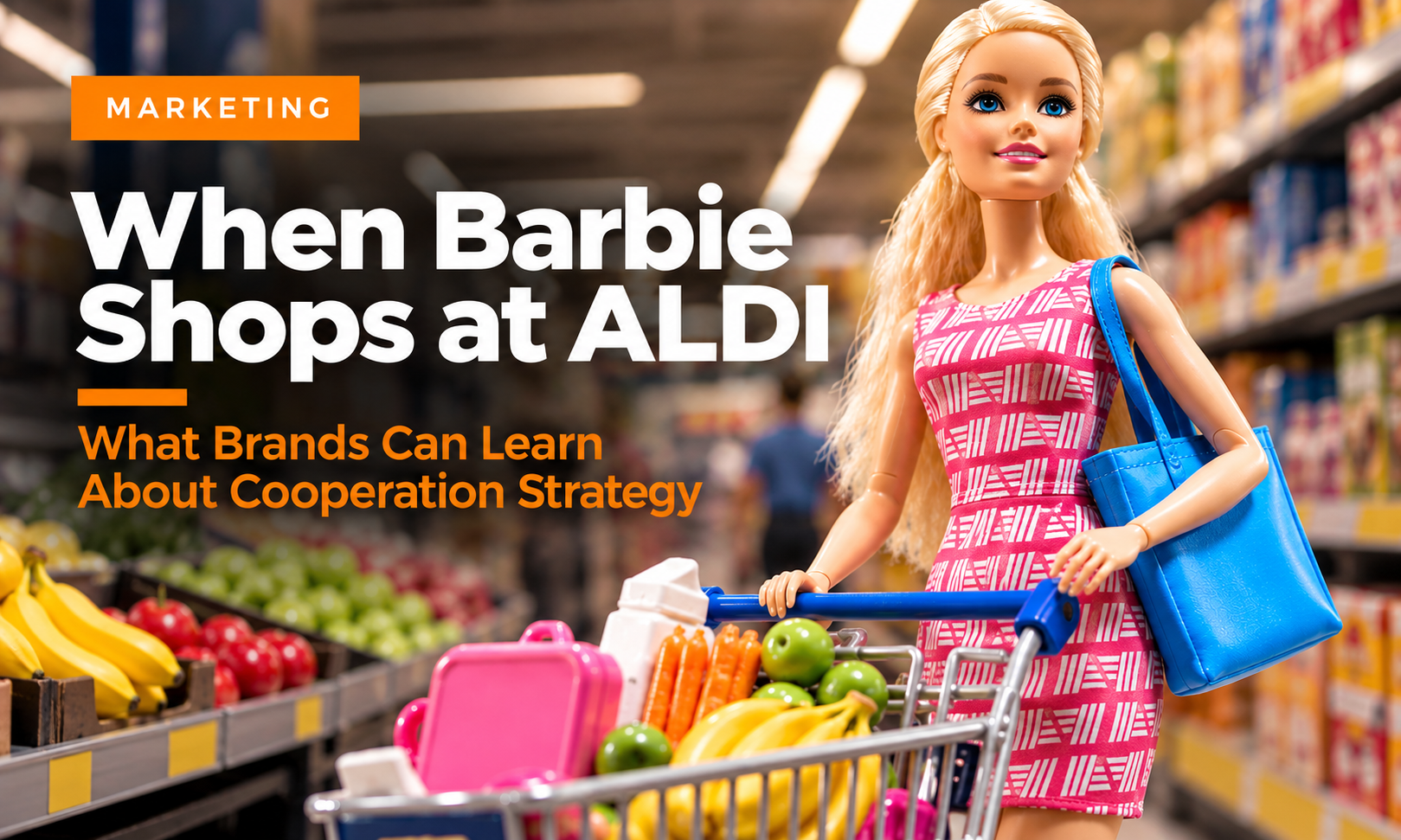
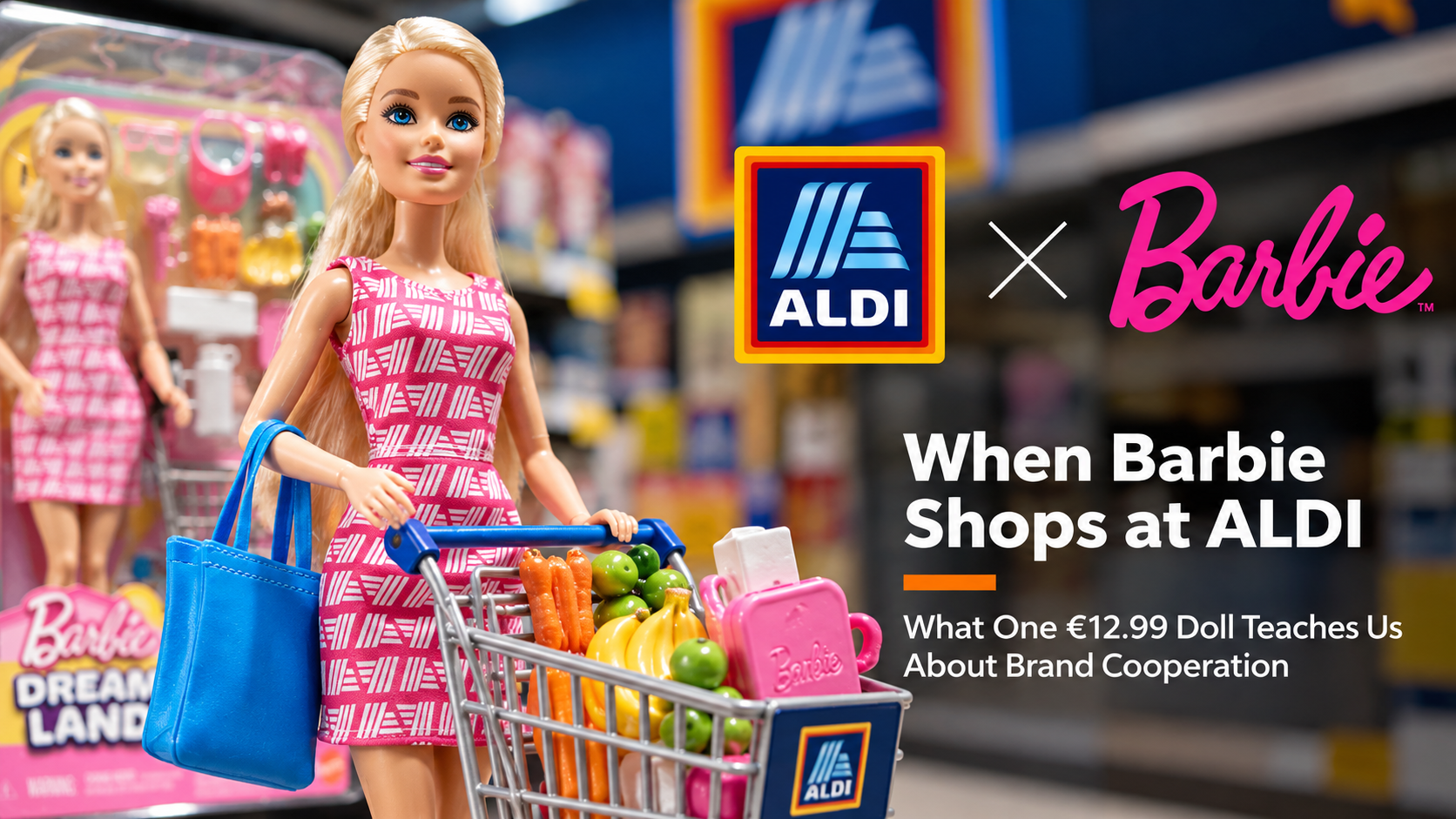
This week, I came across the limited ALDImania Barbie among ALDI’s non-food specials.
A Barbie in an ALDImania outfit. A miniature shopping cart. Groceries. Shopping accessories. Two highly recognisable brand worlds brought together in one product.
At first glance, it is fun.
At second glance, it becomes a fascinating case of what happens when two very different brands combine their strengths.
Because successful brand cooperation is not primarily about putting two famous logos next to each other.
It is about exchanging brand equity.
And the most interesting partnerships happen when each brand contributes something the other cannot create as effectively on its own.
What ALDI × Barbie Reveals About Brand Cooperation Strategy.
ALDI already has enormous strengths.
Reach. Accessibility. Price credibility. High shopping frequency. Strong recognition. A place in consumers’ everyday lives.
But these strengths do not automatically create everything a brand might want.
Price leadership does not necessarily create fandom.
Distribution does not automatically create cultural desirability.
Shopping frequency does not necessarily create collectability.
This is where Barbie brings something different.
Barbie contributes decades of emotional brand equity, iconic visual assets, storytelling, nostalgia, pop culture, collectability and recognition across generations.
For ALDI, the collaboration therefore has the potential to do more than sell another non-food promotional item.
It allows a highly rational retail proposition to borrow emotional and cultural currency.
Why would Barbie need ALDI?
Now reverse the perspective.
Mattel owns one of the world’s most recognisable toy brands.
Barbie has moved far beyond the toy aisle and become intellectual property spanning entertainment, fashion, collaborations, experiences and popular culture.
So what can ALDI possibly add?
Something surprisingly valuable:
everyday relevance.
ALDI brings Barbie into an environment millions of people associate with ordinary life.
Shopping.
Groceries.
Families.
Weekly routines.
Affordability.
The collaboration takes an iconic global brand and places it directly into an everyday consumer ritual.
That matters because even famous brands need more than awareness.
They need continued relevance.
Brand cooperation is an exchange
This is where I believe marketers should look differently at collaborations.
Instead of asking:
“Which famous brand could we work with?”
start by asking:
“What does our brand need that another brand could credibly provide?”
For ALDI and Barbie, the exchange can be described quite simply.
That does not mean every consumer will perceive every one of these attributes, nor does it prove that the collaboration will change long-term brand perceptions.
But strategically, this is the potential exchange.
And that distinction is important.
A strong cooperation should create value on both sides.
The €12.99 price is not a detail
The price of the ALDImania Barbie is €12.99.
From a brand perspective, that is interesting.
Imagine the identical collaboration as an €89 collector’s edition sold through a specialist store.
Same brands.
Same basic idea.
Completely different brand message.
At €12.99, the product remains consistent with ALDI’s accessibility proposition.
At the same time, Barbie potentially increases the emotional and perceived value of the promotional item.
The collaboration therefore does not simply place Barbie inside ALDI.
It translates Barbie into ALDI’s commercial model.
That is much more powerful than conventional logo licensing.
Why brands need a cooperation strategy
A strong brand cooperation strategy should go beyond individual marketing activations. Too often, a campaign opportunity appears, someone knows someone, two marketing departments meet and a limited edition is created.
A campaign opportunity appears. Someone knows someone. Two marketing departments meet. A limited edition is created.
That can work.
But there is a more strategic approach.
Start with the gaps in your own brand.
What are you missing?
A younger audience?
Premium credentials?
Cultural relevance?
Technology?
Distribution?
Access to a community?
Sustainability expertise?
A new usage occasion?
Entertainment?
Design credibility?
Then identify partners capable of contributing those attributes credibly.
This turns cooperation from opportunistic marketing into portfolio strategy.
Over time, the right partnership portfolio can help a brand enter new communities, create new products, reach different audiences and experiment with new brand associations.
It can also generate something increasingly difficult to achieve through paid advertising alone:
curiosity.
Two familiar brands combined in an unfamiliar way make people look twice.
In an attention economy, that has value.
The problem: you are sharing more than attention
There is also a fundamental risk.
The moment two brands publicly connect themselves, they begin sharing associations.
That is the attraction.
It is also the danger.
Consumers do not necessarily assign responsibility according to contractual boundaries.
Your cooperation partner’s product quality can affect perceptions of you.
Their customer experience can affect you.
Their sustainability practices can affect you.
Their communication can affect you.
Their supply chain can affect you.
Their pricing decisions can affect you.
Their next reputational crisis may affect you too.
I call this:
Brand Equity Transfer Risk
The principle is simple:
If positive associations can move from one brand to another, negative associations can travel as well.
That means partner selection cannot be based purely on creative fit.
It requires proper due diligence.
This is why a professional brand cooperation strategy needs more than creative chemistry. It requires a structured way to evaluate strategic fit, commercial potential, operational compatibility and reputational risk.
The 10-Gate Brand Cooperation Test
Before entering a significant brand partnership, I would evaluate the potential partner against ten criteria.
1. Strategic Fit
What business or brand objective is the cooperation supposed to address?
Define the problem before evaluating the partner.
If the objective is unclear, almost any exciting collaboration can look strategically attractive.
2. Audience Complementarity
Do not look only at audience overlap.
Look at incremental audience value.
Who does the partner allow you to reach credibly that you currently struggle to reach yourself?
3. Equity Exchange
Complete two sentences:
Our brand gives the partner ______.
The partner gives our brand ______.
If one of those sentences is difficult to complete, investigate why.
The exchange does not need to be identical, but both sides should have a credible reason to participate.
4. Values & Reputation Fit
Look beyond the campaign idea.
Review reputation, previous controversies, sustainability claims, labour practices, governance, customer sentiment and previous collaborations.
You are not acquiring the partner.
But you are temporarily connecting your reputation to theirs.
5. Product Credibility
Would consumers understand why the two brands belong together?
The ALDI × Barbie example is interesting because shopping already belongs naturally within Barbie’s world of role-play.
The shopping cart and groceries help tell the story.
The consumer does not need a strategy presentation to understand the idea.
That is a good sign.
6. Distinctive Asset Compatibility
Examine what happens when both brand worlds meet.
Colours.
Shapes.
Characters.
Packaging.
Typography.
Environments.
Products.
Language.
Rituals.
A strong collaboration should allow both brands to remain recognisable without turning the execution into a visual compromise.
A collaboration can generate enormous social attention and still be commercially disappointing.
8. Operational Compatibility
This is where the glamorous collaboration becomes very practical.
Who owns approvals?
Who manufactures?
Who controls quality?
Who handles complaints?
Who owns customer data?
Who manages product recalls?
Who approves communications?
Who makes the decision when both brands disagree?
Good governance rarely makes the campaign announcement.
But it can determine whether the partnership succeeds.
9. Reputation & Exit Risk
Ask the uncomfortable question before signing:
What happens if our cooperation partner has a major reputational problem tomorrow?
Define escalation procedures, communication responsibilities, usage rights, crisis processes and termination clauses before you need them.
Risk management should be designed into the partnership.
10. Measurement & Learning
Sales matter.
But sales alone may tell you very little about whether the cooperation strengthened your brand.
Depending on the objective, consider measuring:
Brand consideration Brand associations New customer penetration Incremental reach Earned media Social conversation Traffic Sell-through Repeat purchase Incremental revenue
Most importantly, compare the results with the original strategic objective.
A collaboration should produce business results and organisational learning.
Should brands test cooperation prototypes?
Prototype testing should be part of a robust brand cooperation strategy, particularly when the partnership has meaningful strategic or reputational implications.
There is a major difference between testing a cooperation concept and testing the actual execution.
A concept might sound fantastic:
Brand A × Brand B
Consumers then see the packaging and think something entirely different.
This is why realistic prototypes matter.
Test the product.
Test the packaging.
Test pricing.
Test communication.
Test desirability.
Test brand attribution.
And ideally, do something marketers sometimes find uncomfortable:
Do not explain the concept first.
Simply show it.
Then ask:
What do you think this is?
Which brands do you recognise?
How does this change your perception of Brand A?
How does this change your perception of Brand B?
Would you buy it?
Why?
This can reveal one of the biggest hidden risks in cooperation strategy.
Watch for asymmetric equity transfer
Imagine a collaboration between a premium brand and a mass-market brand.
The mass-market brand might become more premium.
Excellent.
But what happened to the premium brand?
Did it become more accessible?
Or did it become cheaper?
Those are very different outcomes.
The same partnership can therefore create positive equity transfer for one participant and negative equity transfer for the other.
That is why measuring only sales or social engagement can be misleading.
You need to understand what moved inside consumers’ minds.
The best collaborations create Brand C
For me, this is the ultimate test.
Weak cooperation creates:
Brand A + Brand B
Strong cooperation creates:
Brand C
Not a literal third company.
A new experience.
Something that would not make sense without both brands.
The ALDImania Barbie is interesting for precisely this reason.
It is not simply a Barbie placed on an ALDI shelf.
It is not simply an ALDI logo placed on a Barbie box.
The clothing, miniature trolley, groceries and shopping accessories bring the two brand worlds together.
The cooperation itself becomes part of the product.
And that gives us a simple test for future partnerships.
Before approving the next cooperation, remove both logos from the presentation.
Then ask:
Is there still an idea?
If there is not, you may simply have sponsorship or licensing.
If there is, you may have a genuine collaboration.
And if consumers see the result and immediately think:
“Of course. Why hasn’t anyone done this before?”
you may have created something even better.
A cooperation where 1 + 1 genuinely becomes 3.
One final question
Ultimately, a brand cooperation strategy should answer a much bigger question than who a brand could collaborate with. It should define what the brand wants to gain, what it can contribute and which risks it is prepared to share.
Brand cooperation should not start with:
“Who could we collaborate with?”
It should start with:
“What are we trying to become that we cannot achieve as effectively alone?”
That changes partner selection completely.
And it turns cooperation from a marketing stunt into a strategic brand capability.
Which brand cooperation has changed your perception of both brands involved?
Why AI is changing where customers discover brands and why more content is no longer the answer
For years, digital marketing and the customer journey followed a relatively simple logic. Today, the emerging AI customer journey is beginning to challenge that logic.
Create content. Make it discoverable. Bring people to your website. Guide them through the funnel. Convert them.
We optimized search rankings, landing pages, click-through rates and conversion journeys. And while the customer journey was never truly linear, there was one comforting assumption behind much of our work:
At some point, the customer would come to us.
That assumption is beginning to break.
AI-powered search, answer engines, and assistants are reshaping the AI customer journey.
They also alter where discovery, consideration, and even decision-making happen.
And this is no longer a niche behavior.
Adobe’s 2026 Digital Trends research found that 25% of consumers globally already use AI-powered platforms as their primary research tool, ahead of brand websites and reviews. In Germany, the figure is 23%, while 39% of German consumers use AI assistants at least occasionally as their primary source of information.
A customer can learn about your category, compare solutions, understand your reputation and form an opinion about your brand without ever visiting your website.
At the same time, brands have never been able to create as much content as they can today.
And therein lies the paradox.
Our brands are producing more content, while customers may experience less of the brand itself.
Welcome to the invisible brand experience.
The AI customer journey hasn’t disappeared. Parts of it have moved somewhere else.
Consider how the AI customer journey is changing.
Instead of entering a few keywords, opening several results and visiting multiple websites, people can increasingly ask a question and receive a synthesized answer.
The interface becomes the destination. This is one of the defining characteristics of the AI customer journey: discovery can happen without a click.
That might be Google, ChatGPT, an AI assistant embedded in another platform or, increasingly, an agent acting on someone’s behalf.
The implications go much further than SEO.
For marketers, website traffic has traditionally been both an objective and a proxy for interest. We could observe visits, clicks, dwell time, downloads and conversions.
But what happens when a potential customer discovers your brand, evaluates it and perhaps even adds it to a shortlist somewhere else?
The journey still exists.
We just don’t necessarily see it anymore. As the AI customer journey develops, more of these interactions may happen beyond the environments brands can directly measure.
Gartner describes exactly this emerging problem. As answer engines absorb more of the discovery process, traditional click-based measurement captures a smaller share of how demand is actually formed. Gartner argues that declining organic traffic may therefore sometimes indicate a measurement gap rather than a decline in marketing performance.
This is an important distinction.
Traffic and influence are beginning to separate.
A brand can potentially become more visible within AI-generated answers while receiving fewer visits to its own digital properties.
This means marketers will need to complement familiar metrics such as traffic, conversions and acquisition costs with new indicators of influence. Gartner points to metrics such as Share of Answer, Citation Presence, Brand Mention Frequency and AEO-influenced conversions as potential additions to the measurement toolbox.
Not replacements.
Additions.
Because if part of the customer journey becomes invisible to our existing analytics, we need new ways to see it.
And then we decided to produce even more content
The marketing industry’s instinctive response to every new channel has traditionally been remarkably consistent:
Create more.
More formats. More posts. More videos. More landing pages. More keywords. More personalization.
Generative AI has removed one of the biggest constraints on this model: production capacity.
A company that previously produced ten pieces of content can theoretically produce one hundred. Or one thousand.
But so can everyone else.
That changes the economics of content.
When production becomes abundant, production itself stops being a competitive advantage.
The scarce resource is no longer content.
It is relevance.
And increasingly, trust.
A Gartner survey published in September 2026 makes this tension particularly visible. Among 1,006 U.S. consumers surveyed, 65% said brands are producing too much AI-generated marketing content.
Even more concerning for marketers, 57% said AI-generated content had made them less trusting of brand messaging overall.
And there is another interesting signal.
43% said they now rely more on real people for shopping information and recommendations because of the prevalence of AI-generated content.
That should make us think.
Consumers are not necessarily rejecting AI.
They are becoming more selective about what deserves their attention and trust.
The problem isn’t AI.
The problem is irrelevance at scale.
The danger: optimizing for algorithms and disappearing for humans
This is where the two developments collide.
Brands understandably want their information to be discoverable by AI systems. We are already talking about AEO, GEO, structured content, machine-readable information and optimizing for large language models.
And this is becoming a legitimate marketing discipline. Gartner now explicitly recommends that organizations integrate traditional SEO with Answer Engine Optimization and Generative Engine Optimization as AI-powered discovery grows.
All of that matters.
But there is a strategic risk.
In trying to become increasingly understandable to machines, brands could become increasingly interchangeable to people.
Imagine thousands of companies using similar models to generate similar articles based on similar keywords, search data and prompts.
The grammar will be correct.
The structure will be optimized.
The information will probably be useful.
And much of it will feel exactly the same.
This creates what I believe will become one of marketing’s defining tensions:
Brands need to become more legible to machines without becoming less distinctive to humans.
That is not primarily a content problem.
It is a brand experience problem.
AI can scale communication. It cannot manufacture meaning.
This is why I don’t believe the answer is to use less AI.
Quite the opposite.
AI can make marketing dramatically better.
It can analyze customer signals, identify patterns, accelerate research, adapt experiences, automate repetitive production and help organizations respond faster.
Used well, it creates more space for human judgment.
The mistake is using AI primarily to multiply output.
If every efficiency gain simply produces another 20 pieces of content, we haven’t transformed marketing.
We have accelerated the old model.
The more interesting question is:
What should we do with the capacity AI gives us?
My answer would be to reinvest it in experience.
Spend more time understanding the customer.
Talk to sales and service teams.
Observe where journeys break.
Test propositions.
Improve products and services.
Create useful tools.
Develop original points of view.
Build communities.
Design moments people actually remember.
And then use AI to help those experiences travel further.
That is a fundamentally different relationship between technology and marketing.
From content-led growth to experience-led growth
For a long time, digital growth could be driven heavily by acquisition.
More reach created more traffic. More traffic created more leads. Optimization improved conversion.
That logic isn’t disappearing.
But I believe another layer is becoming increasingly important:
Experience becomes the source. Content becomes the evidence. Technology becomes the amplifier.
That reverses the usual sequence.
Instead of asking:
What content should we create this week?
Start with:
What experience, expertise or value do we have that is worth talking about?
Instead of:
How can we generate more traffic?
Ask:
Where are customers actually making decisions and what signals influence those decisions?
Instead of:
How can we use AI to create more?
Ask:
Where can AI remove friction so that people can create something better?
That is what I mean by experience-led growth.
Not CX as another department.
Not a new funnel.
And certainly not a rejection of performance marketing.
It is the recognition that brand, customer experience, technology and growth increasingly operate as one connected system.
Five questions I think brands should be asking now
If parts of the customer journey are becoming invisible, traditional dashboards alone will not tell us whether the brand is healthy.
So perhaps the questions need to change.
1. Would an AI understand what makes our brand different?
Not just what we sell, but why someone should choose us.
2. Would a human?
The second question may actually be harder.
3. Are we creating original value or simply producing more content about existing information?
Original research, expertise, customer experiences and strong perspectives become increasingly valuable when generic information becomes abundant.
4. Are we measuring traffic or influence?
Website visits remain important, but mentions, recommendations, reviews, citations, community conversations and other signals may increasingly shape decisions outside owned channels.
5. Where does human experience create an advantage that automation cannot easily copy?
That could be service. Expertise. Design. Community. Hospitality. Creativity. Trust. Or simply making something complicated feel remarkably easy.
Those are difficult things to automate.
They are also difficult for competitors to replicate.
Maybe the website was never the destination
There is a temptation to see declining clicks or AI-generated answers primarily as a threat to websites.
I think that perspective is too narrow.
A website is a touchpoint.
So is a store, a salesperson, an app, a product, a review, a social post, a customer service conversation and now an AI-generated answer.
The strategic task has always been bigger:
Create a coherent experience across the places where customers encounter the brand.
What is changing is that we may control fewer of those places directly.
That makes consistency, distinctiveness and trust more important, not less.
Because in an AI-mediated world, customers may encounter the representation of your brand before they encounter the brand itself.
And that representation will be built from the signals you put into the world.
The opportunity hidden inside the disruption
I don’t think the future belongs to brands that produce the most content.
Nor necessarily to those deploying the most AI.
The advantage will belong to organizations that connect technology with something harder to replicate:
real expertise, distinctive ideas and experiences worth remembering.
AI can help those experiences become easier to discover.
It can help personalize them.
It can help scale them.
It may increasingly help customers navigate towards them.
But first, there needs to be something worth finding.
Perhaps that is the real shift ahead.
For years, marketers tried to bring customers to the brand.
Now we need to make sure the brand can travel to the customer without losing what makes it human along the way.
Sources and further reading
Gartner, AEO Is Creating New Blind Spots in Customer Demand, September 2026.
Gartner, Marketing Survey Finds 35% of Consumers Rely on Influencers Less Due to AI, September 2026. Survey of 1,006 U.S. consumers conducted May to June 2026.
Gartner, Unified Search: Integrating SEO, AEO and GEO to Improve Visibility, July 2026.
Adobe, AI and Digital Trends 2026. Research conducted with Oxford Economics among 3,000 executives and practitioners and 4,000 consumers globally.
10 insights marketing leaders should prepare for in the age of agentic commerce
By Andreas Zschischang | September 9, 2026
The next major shift in marketing may not be another channel, platform or content format. It may be a new participant in the customer journey: the AI agent.
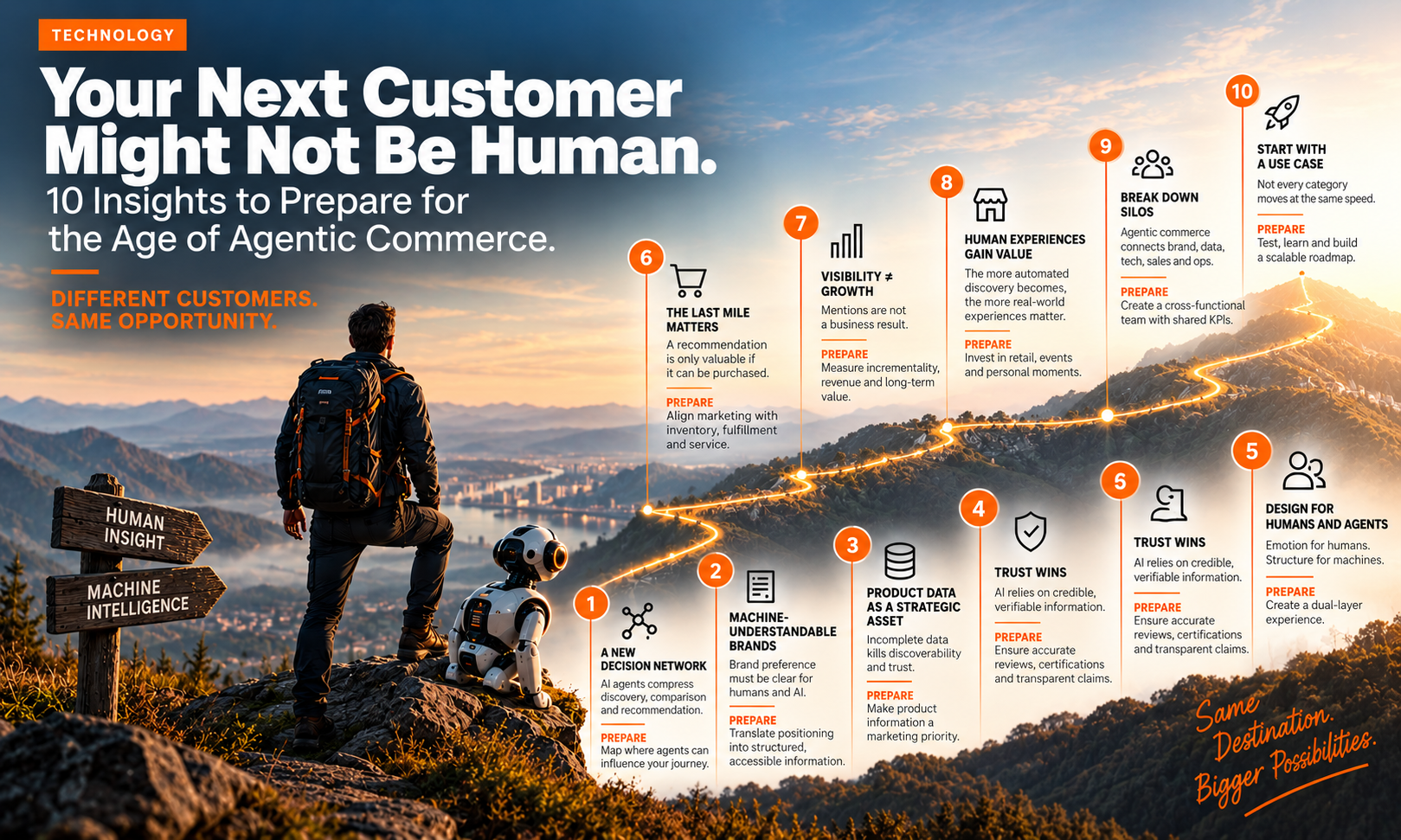
10 insights to prepare the age of agentic commerce.
The latest Future Marketing Index, published on September 8, 2026, places Agentic AI directly at number two among current marketing trends. Half of respondents consider it relevant today, rising to 61% when looking ahead. With DMEXCO 2026 approaching under the theme “Scaling Intelligence”, the conversation is moving from experimentation toward measurable business value.
But what happens to brand preference when an AI assistant researches, compares and potentially purchases on behalf of a customer?
My view: the future is not Brand vs. AI. It is Brand + AI. Marketing must prepare for a world in which human emotion and machine-readable relevance work together.
1. The customer journey is becoming a decision network
The traditional funnel assumes that people move through a sequence of touchpoints. AI agents can compress discovery, comparison and recommendation into a single interaction.
Prepare: Map where an agent could influence your existing journey, from initial research to post-purchase support.
2. Brand preference must become machine-understandable
A strong brand creates associations in the human mind. An AI agent also needs accessible, reliable information to understand why a product is relevant.
Prepare: Translate your positioning into clear product attributes, use cases, differentiators and trustworthy content without losing the emotional brand story.
3. Product data is becoming a marketing asset
Incomplete specifications, inconsistent descriptions and outdated availability can undermine discoverability and recommendation quality.
Prepare: Treat product information management as a strategic capability shared by marketing, commerce and IT, not merely an operational database.
4. Trust will become a competitive signal
AI-assisted recommendations depend on information that can be assessed. Reviews, transparent policies, credible claims and consistent brand information may influence how products are evaluated.
Prepare: Audit the evidence behind your claims and ensure that reviews, certifications, service policies and product details are accurate and accessible.
5. The experience must work for humans and agents
Humans value inspiration, reassurance and memorable experiences. Agents require structured information, clear options and reliable processes. These needs are different, but complementary.
Prepare: Design a dual-layer experience: emotionally compelling for people and functionally understandable for machines.
6. The last mile matters more than ever
A recommendation is only valuable if the product can actually be purchased. Poor availability, unclear delivery information or a complicated checkout can break the journey.
Prepare: Connect marketing promises with inventory, pricing, fulfillment and customer service. The entire commercial experience becomes part of the brand.
7. AI visibility is not the same as business growth
Being mentioned by an AI system is not automatically a commercial success. The important question is whether AI-assisted discovery generates qualified demand, profitable sales and long-term customers.
Prepare: Develop measurement beyond rankings and mentions, including qualified traffic, conversion, incremental revenue, margin and customer lifetime value.
8. Human experiences may become more valuable
As digital discovery becomes increasingly automated, physical and personal experiences can provide differentiation that is difficult to reduce to a product comparison.
Prepare: Invest selectively in retail, events, demonstrations, expert advice and other moments where customers can experience the brand rather than simply evaluate its attributes.
9. Marketing can no longer prepare in silos
Agentic commerce connects brand strategy, content, data, technology, legal, sales and operations. A campaign team alone cannot solve the underlying readiness challenge.
Prepare: Establish a cross-functional working group with clear ownership, practical use cases and shared commercial KPIs.
10. Start with a use case, not an AI transformation slogan
The market is still evolving. Not every category will adopt autonomous purchasing at the same speed, and customers will retain different levels of control depending on the purchase.
Prepare: Select one product category or customer journey, test AI-assisted discovery and comparison, identify the gaps and build a measurable roadmap before scaling.
The strategic question
The brands that succeed will not necessarily be those producing the most AI-generated content or deploying the largest number of agents. They will be those that combine a distinctive brand with reliable data, connected commerce and a customer experience that delivers on its promise.
DMEXCO’s “Scaling Intelligence” is therefore a useful challenge for marketing leaders: move beyond the technology itself and ask where intelligence creates real customer and business value.
The next customer journey may not be entirely human. The responsibility to create a meaningful brand experience still is.
Further reading and event references
BVDW, Marketing-Trends 2026: Agentische KI steigt in Top 3 ein, September 8, 2026.
DMEXCO 2026, Scaling Intelligence, September 23–24, Cologne.
DMEXCO session, Agentic Commerce: Wenn KI einkauft, September 23, 2026.
DMEXCO keynote, The Hidden Intelligence Behind AI Assisted Commerce, September 23, 2026.
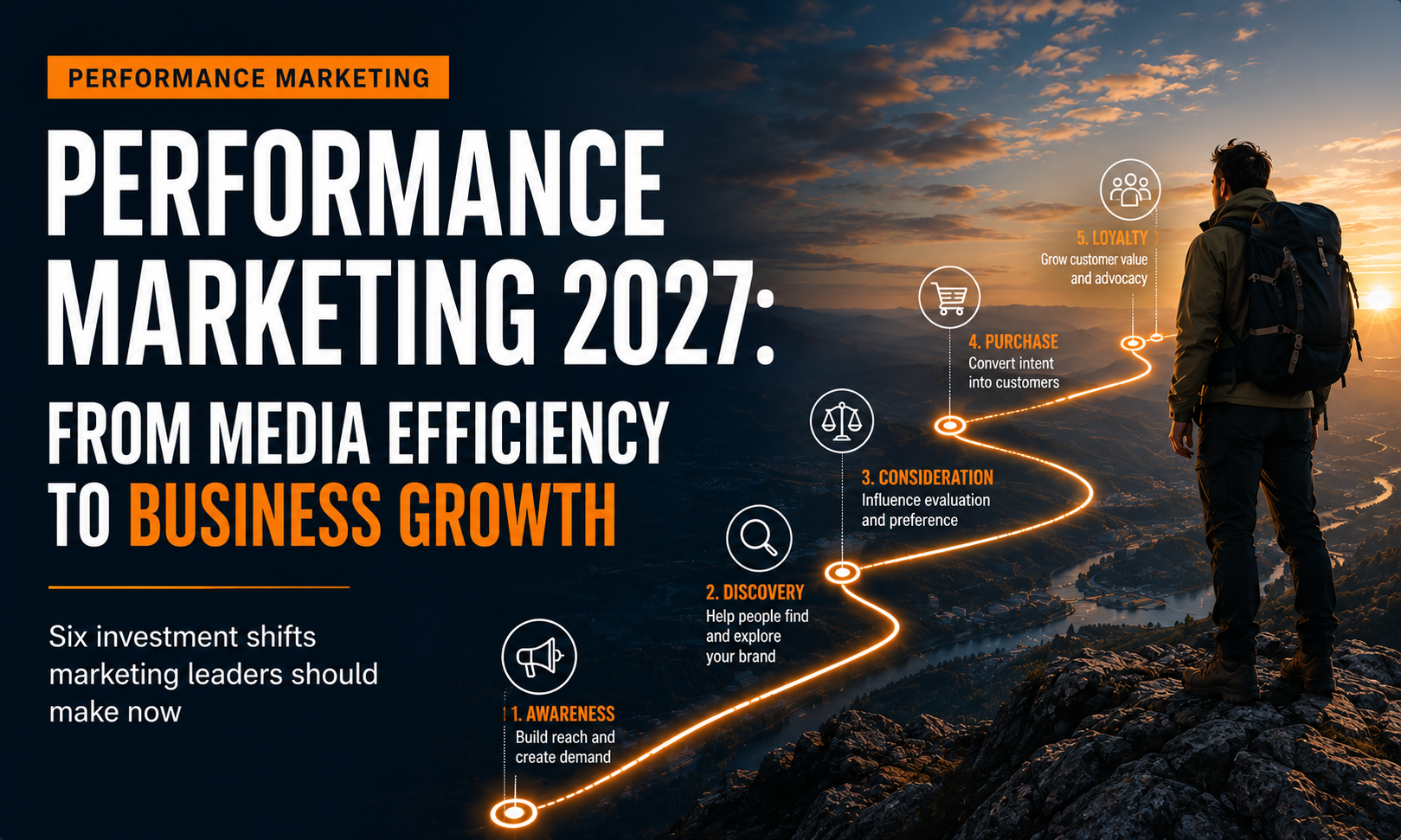
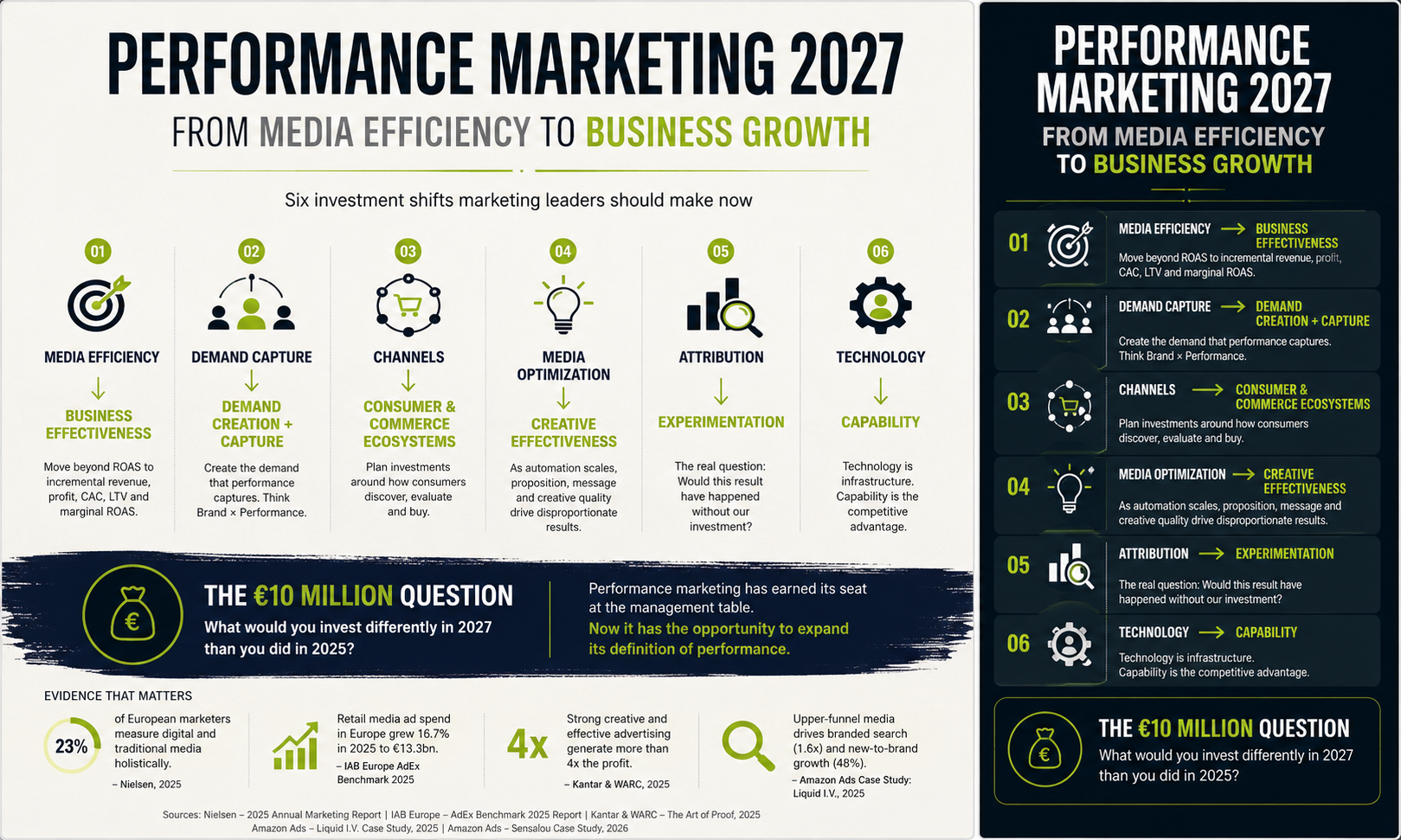
Six investment shifts marketing leaders should make now
Performance marketing has earned its seat at the management table.
It brought accountability into marketing. It connected investment with outcomes. And it gave us a common language of CTR, CPC, CPA, conversion and ROAS.
But there is a problem.
We have become incredibly good at optimizing what we can measure. That doesn’t necessarily mean we are investing in what creates the most growth.
This isn’t an argument against performance marketing.
Quite the opposite.
As marketing leaders plan for 2027, I believe we need to expand our definition of performance.
Because the next competitive advantage may not come from another 5% improvement in CPC, another automated bidding strategy or another platform added to the media plan.
It may come from making fundamentally better investment decisions.
Welcome to Performance Marketing 2027.
Performance Marketing 2027. From Media efficiency to business growth.
The €10 Million Question
Imagine you are responsible for a €10 million marketing budget.
Your CFO asks:
“Why should we invest this €10 million differently in 2027 than we did in 2025?”
More Google?
More Meta?
More Amazon?
More retail media?
More programmatic?
Another piece of marketing technology?
More AI?
All could be legitimate answers.
But they’re channel and technology answers to what is fundamentally a business question.
I would start somewhere else.
Where do we need to create demand?
Where can we capture existing demand?
Where do consumers discover, evaluate and buy our products?
Which customers should we acquire?
What are those customers actually worth?
Which investments generate incremental sales rather than simply claim credit for them?
Where does creative make the biggest difference?
And what capabilities will make the next €10 million more effective than the last?
Those questions change the conversation.
And they should increasingly change the investment plan.
I see six shifts.
01 | Media Efficiency ? Business Effectiveness
Performance marketing became powerful because it made marketing measurable.
But measurable and incremental are not the same thing.
Consider a campaign reporting:
ROAS: 5.0
For every €1 invested, €5 in revenue was attributed to advertising.
Excellent.
Or is it?
How many customers would have purchased anyway?
How many were existing customers?
What was the contribution margin?
Did advertising create additional demand or simply redirect existing demand through a paid touchpoint?
And what happened to profitability after media, promotion, fulfilment and marketplace costs?
These aren’t arguments against ROAS.
ROAS remains an important operational metric.
The problem begins when an operational metric becomes our definition of business success.
And there is evidence of a significant measurement gap.
Nielsen’s 2025 global research found that 85% of marketers expressed confidence in their ability to measure ROI, while only 32% actually measured ROI holistically across traditional and digital media.
In Europe, that figure was just 23%.
That is an extraordinary gap between perceived and actual measurement capability.
The next performance dashboard therefore needs another layer:
Incremental Revenue
Incremental Profit
Contribution Margin
Customer Acquisition Cost
New-to-Brand
Customer Lifetime Value
Marginal ROAS
The management question changes from:
“What revenue can we attribute to marketing?”
to:
“What business would we not have generated without this investment?”
That’s harder to answer.
It’s also far more valuable.
A simple example
Imagine:
Campaign A
ROAS: 6.2 High proportion of existing customers Strong branded-search activity Limited incremental lift
Campaign B
ROAS: 3.8 High proportion of genuinely new customers Strong incremental sales Higher predicted customer value
Which campaign performed better?
The performance dashboard may choose Campaign A.
The growth dashboard may put the next euro into Campaign B.
That distinction matters.
02 | Demand Capture ? Demand Creation + Capture
Performance marketing is exceptionally good at capturing intent.
Someone searches.
Compares.
Clicks.
Visits Amazon.
Returns to a product page.
Adds to basket.
Converts.
These are incredibly valuable signals.
But there is an uncomfortable question we should occasionally ask:
Who created that demand in the first place?
Consumers don’t suddenly want a product because a retargeting algorithm found them.
Brands, experiences, recommendations, creators, culture, PR, retail visibility, social conversations and previous product experiences all contribute to demand.
This is why the traditional debate between brand and performance increasingly feels artificial.
Brand creates familiarity, preference, mental availability and future demand.
Performance identifies, captures and converts demand.
And performance data feeds valuable signals back into brand strategy.
The two aren’t competing systems.
They are parts of the same growth system.
So perhaps the equation should no longer be:
Brand OR Performance
but:
Brand × Performance
We can see this relationship in actual commerce data.
Ahead of Prime Day 2025, Liquid I.V. used streaming TV, online video and audio to reach new audiences before the conversion moment.
According to the Amazon Ads case study, consumers exposed to the activity were 1.6× more likely to conduct a branded search, while 48% of ad-attributed purchases came from new-to-brand customers.
That is an interesting performance story precisely because it doesn’t begin at the bottom of the funnel.
Demand was created before it was captured.
The investment implication
Stop asking only:
“How much goes to brand and how much goes to performance?”
Ask:
“Where are we creating demand, where are we capturing it, and where is the system losing potential growth?”
From the consumer’s perspective, that’s one decision journey.
Inside a large organization, it might touch six teams, several agencies and multiple budgets.
That organizational fragmentation increasingly conflicts with how demand actually works.
And nowhere is that more visible than commerce.
Amazon can simultaneously function as:
a retailer,
a search environment,
an advertising platform,
a product-discovery engine,
a review ecosystem,
a conversion environment
and a source of consumer signals.
Retail media is therefore not a niche addition to the media plan anymore.
In Europe, retail media advertising investment grew 16.7% in 2025 to €13.3 billion, according to IAB Europe, and now represents more than 10% of total European digital advertising spend.
Nielsen separately found that 65% of global marketers expected retail media networks to play a growing role in their media strategies.
This isn’t simply another channel growing.
It represents a structural convergence of media + data + commerce.
Think beyond Amazon ROAS
Imagine an FMCG brand reports:
Sponsored Products ROAS: 5.2
Good.
But Performance Marketing 2027 asks:
Did upper-funnel activity increase branded search?
Did we acquire new-to-brand customers?
Did product visibility improve?
What happened to organic ranking?
Did paid investment generate incremental sales?
Did organic sales increase?
What happened to contribution margin?
Did Amazon activity create a halo elsewhere?
A 2026 Amazon Ads case illustrates this broader view particularly well.
Sensalou’s full-funnel strategy reportedly increased new-to-brand customers by 64% year-on-year, while total sales increased 38% and organic sales increased 25%.
The interesting part isn’t simply that advertising generated sales.
It’s that paid activity, customer acquisition and organic momentum were viewed as parts of the same growth system.
That is a much more useful way to think about commerce performance.
04 | Media Optimization ? Creative Effectiveness
For much of digital advertising’s history, enormous energy went into optimizing media variables:
Audience.
Bid.
Placement.
Frequency.
Timing.
Keyword.
Device.
Targeting.
All still matter.
But platforms increasingly automate them.
That creates an interesting paradox.
The more execution becomes automated, the more important genuine differentiation becomes.
If competitors have access to similar targeting capabilities, similar algorithms and increasingly similar AI tools, advantage shifts elsewhere:
The proposition.
The product truth.
The idea.
The message.
The distinctive brand assets.
And the ability to understand which creative works, for whom, where and why.
The evidence here is particularly striking.
Research combining Kantar’s creative-effectiveness database with WARC profitability data found that the strongest creative and effective advertising generated more than four times as much profit.
Think about the implication.
Marketing organizations routinely spend enormous effort negotiating fractional improvements in media costs.
Yet creative quality can have a dramatically larger impact on the economics.
Creative intelligence, not content volume
AI makes it possible to generate hundreds of creative variations.
That’s useful.
But 500 mediocre ads don’t constitute a strategy.
The opportunity is to test meaningful hypotheses:
Does convenience outperform price?
Does demonstration outperform lifestyle?
Which benefit attracts new customers?
Which proposition increases consideration?
Which creative captures attention?
Which message converts existing demand?
Which assets work differently in retail media, social and video?
That’s creative intelligence.
AI can accelerate it.
Human judgment still determines what is worth saying.
05 | Attribution ? Experimentation
Marketing has spent years asking:
“Which channel gets credit for the sale?”
But perhaps the more valuable question is:
“Would the sale have happened anyway?”
That’s the difference between attribution and causality.
Attribution distributes credit.
Experimentation tests impact.
Consider a simple journey:
A consumer sees a video campaign.
Later searches for the brand.
Clicks a paid-search advertisement.
Purchases.
Search receives the conversion.
But did search create the demand?
Or capture it?
Would the consumer have bought anyway?
What happens if paid search is removed?
What happens if video is removed?
What happens when both operate together?
These questions cannot be answered reliably by simply adding another attribution model.
They require experimentation.
That can mean:
Geo experiments
Holdout groups
Conversion-lift studies
Incrementality testing
A/B testing
Marketing Mix Modelling
Controlled retail-media experiments
No single methodology answers everything.
The capability lies in combining them intelligently.
This is why measurement shouldn’t simply sit at the end of a campaign as reporting.
Measurement is an investment capability.
It tells us where the next euro should go.
And that’s a much more important function than explaining where the last one went.
06 | Technology ? Capability
Marketing has spent the last decade assembling increasingly sophisticated technology stacks.
CRM.
CDP.
Marketing automation.
Analytics.
Personalization.
Attribution.
Retail media technology.
And now AI.
These technologies can create enormous value.
But they can also create enormous complexity.
Nielsen’s 2025 research found marketers citing siloed teams, incomparable data, unclear KPIs and too many vendors or tools among the barriers to effective ROI measurement.
Adding another platform to a fragmented operating model doesn’t necessarily solve the fragmentation.
It can simply make it more expensive.
The more interesting investment question for 2027 is therefore:
What can our organization do better because of technology?
I’d focus capability investment in five areas.
1. Measurement & Experimentation
Can we distinguish attributed revenue from incremental business impact?
2. First-Party Signals
Can we connect meaningful customer, commerce and behavioral data to decisions?
3. Creative Intelligence
Can we systematically learn which propositions, messages and assets drive both immediate response and future demand?
4. Commerce & Retail Media
Do we understand the increasingly blurred relationship between media, shopper data, product visibility and transaction?
5. Integrated Decision-Making
Can brand, performance, commerce, CRM, analytics and creative teams work from the same growth objectives?
AI cuts across all five.
But that’s precisely why “invest in AI” isn’t a strategy.
AI is becoming infrastructure.
The competitive advantage lies in the capability built on top of it.
The Performance Marketing Investment Shift 2027
If I had to summarize the change on one page, it would look like this:
MEDIA EFFICIENCY ? BUSINESS EFFECTIVENESS
DEMAND CAPTURE ? DEMAND CREATION + CAPTURE
CHANNEL PLANNING ? CONSUMER & COMMERCE ECOSYSTEMS
MEDIA OPTIMIZATION ? CREATIVE EFFECTIVENESS
ATTRIBUTION ? EXPERIMENTATION
TECHNOLOGY ? CAPABILITY
These aren’t replacements.
Efficiency still matters.
Channels still matter.
Attribution still has a role.
Technology remains essential.
But the management layer above them needs to evolve.
Back to the €10 Million
So how should our hypothetical €10 million move?
I deliberately wouldn’t prescribe percentages.
A global FMCG company shouldn’t allocate marketing investment like a D2C challenger.
A premium automotive brand shouldn’t behave like an online retailer.
A B2B technology company operates under different economics again.
Instead, I would put six questions on the investment table:
1. How much are we investing in creating future demand?
Not simply harvesting existing intent.
2. How much are we investing in capturing demand?
And are we present where customers actually make decisions?
3. How much are we investing in creative effectiveness?
Not content volume. Effectiveness.
4. How much are we investing in valuable customers?
Are we optimizing transactions or customer economics?
5. How much are we investing in proving incrementality?
Can we demonstrate what marketing actually added?
6. How much are we investing in making the system itself better?
People.
Data.
Measurement.
Experimentation.
Processes.
Technology.
Capabilities.
Because the €10 million budget shouldn’t only buy this year’s growth.
Part of it should make next year’s €10 million work harder.
The CMO Dashboard Needs Another Layer
I wouldn’t remove:
CTR CPC CPA CVR ROAS
Performance teams need them.
But above them, I would increasingly put:
Incremental Revenue
What additional revenue did marketing create?
Incremental Profit
Did that growth create economic value?
CAC
What does acquiring a genuinely new customer cost?
LTV
Are we acquiring customers worth acquiring?
New-to-Brand
Are we expanding the customer base?
Marginal ROAS
What return does the next euro generate?
Contribution Margin
Does growth remain attractive after the economics of delivering it?
These metrics move performance marketing closer to the language of business leadership.
That’s where it belongs.
Where Does AI Fit?
Almost everywhere.
And that’s exactly why it doesn’t need to be the headline.
AI is changing discovery.
Media buying is becoming increasingly automated.
Creative production is accelerating.
Analytics is becoming more predictive.
Personalization can operate at greater scale.
But virtually everyone will have access to these capabilities.
Google will.
Meta will.
Amazon will.
Agencies will.
Brands will.
Your competitors will.
Having AI will not be a strategy.
The strategic questions remain:
Which customers matter?
Where will growth come from?
What should the brand stand for?
Where should we invest?
What should we stop doing?
What constitutes profitable growth?
And what evidence would make us change our decision?
AI can help us answer those questions faster.
It doesn’t remove the need to ask them.
Performance Marketing Has Earned the Right to Think Bigger
Performance marketing shouldn’t retreat from its obsession with accountability.
It should expand it.
From clicks to customers.
From attributed revenue to incremental growth.
From channel optimization to consumer journeys.
From media efficiency to business effectiveness.
From content production to creative intelligence.
From attribution to experimentation.
From technology acquisition to organizational capability.
That doesn’t make performance marketing less performance-driven.
It makes our definition of performance more ambitious.
So when the CFO asks:
“Why should our €10 million marketing investment look different in 2027?”
the answer shouldn’t simply be:
because the platforms changed,
because AI arrived,
or because another new channel emerged.
It should be:
Because we now have the data, technology and measurement capabilities to hold marketing accountable for something bigger than media efficiency.
Business growth.
That, to me, is the next chapter of performance marketing.
Most corporate merchandise ends up forgotten in a drawer. A modern merchandise strategy should do far more than display a logo. It should create utility, strengthen brand awareness, support ESG ambitions and become another meaningful customer touchpoint. Summer is the perfect time to step back, reflect and ask a simple question: are we creating memorable brand experiences or simply producing more promotional clutter?
Summer has a way of slowing us down.
It gives us space to recharge, spend time with family and reflect on habits that have quietly become routines.
For many marketers, summer is also trade fair planning season. Budgets are reviewed, autumn events are scheduled, and the familiar checklist appears once again.
Pens.
Lanyards.
Notebooks.
Cotton bags.
Power banks.
Whatever the latest trend may be.
And somewhere in the planning meeting, someone inevitably asks:
“What should we give away this year?”
Perhaps we’re asking the wrong question.
Open Your Drawer
Before answering it, open the drawer next to your desk.
You’ll probably find a collection of conference giveaways gathered over the years.
Pens from companies you can’t remember.
USB sticks from technology conferences.
Lanyards from exhibitions you’ve long forgotten.
Stress balls.
Cheap keyrings.
Notepads you’ll never use.
Every single one carries a perfectly printed corporate logo.
Almost none created a memorable brand experience.
That drawer tells a story.
Not about successful merchandising.
But about missed opportunities.
Why Most Merchandise Strategies Fail
The problem isn’t branded merchandise itself.
The problem is that many organisations still design merchandise from their own perspective instead of the customer’s.
The conversation often starts with questions like:
How many visitors do we expect?
What’s our budget?
Which supplier offers the best price?
Where can we print the biggest logo?
Rarely does it begin with the most important question:
What will people actually use?
A successful merchandise strategy starts by understanding what creates value for the recipient, not what is easiest to produce.
Brand awareness isn’t created when someone receives an item.
It’s created every time they use it.
A Merchandise Strategy Needs New KPIs
For decades, merchandise has been measured by quantity.
2,000 visitors
2,000 giveaways
Campaign completed
But distribution is not impact.
Imagine measuring your merchandise strategy differently.
Instead of asking how many items were handed out, ask:
How long will this product remain in use?
How often will someone interact with it?
Does it solve a genuine problem?
Will it still be useful six months from now?
Does it create a positive association with the brand?
Would someone recommend it to a colleague?
Suddenly, merchandise becomes much more than a promotional expense.
It becomes another customer touchpoint.
A Successful Merchandise Strategy Creates Utility
One simple question can transform an entire merchandise strategy.
Would someone still want this if our logo wasn’t printed on it?
If the answer is no, perhaps it shouldn’t be produced.
People rarely keep products because they’re branded.
They keep them because they’re useful.
Everyday utility creates repeated exposure.
Repeated exposure builds familiarity.
Familiarity builds trust.
Trust strengthens brands.
The logo doesn’t create the value.
The usefulness does.
Merchandise Strategy Starts with Customer Value
Perhaps it’s time to stop thinking about giveaways altogether.
Instead, think about Brand Utility.
Brand Utility is the ability of every branded touchpoint to create recurring value for the user while simultaneously reinforcing the brand.
The best merchandise usually shares three characteristics.
It solves a small everyday problem
Useful products naturally become part of daily routines.
The more often they’re used, the more often your brand is experienced.
It survives the event
Good merchandise doesn’t end when the exhibition closes.
Its value continues long afterwards.
Months later.
Sometimes years.
It creates positive emotion
Every interaction becomes another micro-experience.
A small reminder that your company cared enough to create something genuinely valuable instead of simply printing another logo.
A Sustainable Merchandise Strategy Starts Before Production
Sustainability has become an important part of corporate merchandise discussions.
Recycled materials.
FSC-certified paper.
Organic cotton.
Bamboo.
These are all positive developments.
But they don’t answer the most important sustainability question.
Was the product actually needed?
A recycled notebook that remains unopened isn’t sustainable.
A bamboo pen that ends up in landfill after two weeks isn’t sustainable.
Perhaps the most sustainable promotional product is one that replaces disposable alternatives, remains useful for years or simply doesn’t need to be produced at all.
ESG isn’t only about materials.
It’s also about purpose.
A thoughtful merchandise strategy reduces waste by creating products people genuinely value.
Merchandise Strategy Is Customer Experience
Customer experience professionals spend enormous amounts of time analysing every touchpoint.
Websites.
Retail stores.
Packaging.
Customer service.
Digital journeys.
Yet merchandise often escapes the same level of strategic thinking.
It shouldn’t.
Every branded object is another customer touchpoint.
Every interaction contributes to perception.
Every useful experience reinforces trust.
Merchandise shouldn’t simply display a logo.
It should demonstrate your brand promise.
Imagine if every promotional product had to pass the same design thinking workshops as your website or mobile app.
Would you still choose another cheap plastic pen?
Probably not.
What Makes Sense in 2026?
The question isn’t which product is trending.
The question is which product creates lasting value.
Instead of chasing novelty, think in terms of utility.
Examples might include:
Premium reusable bottles that replace disposable plastics.
Refillable notebooks instead of disposable notepads.
High-quality cable organisers that travel everywhere.
NFC-enabled business cards that never become outdated.
Smart luggage tags for frequent travellers.
Digital resources, AI prompt collections or exclusive industry insights delivered through QR codes.
Products designed to be repaired rather than replaced.
In every case, the product should continue the brand experience long after the event has ended.
The Future of Merchandise Strategy
Rather than choosing products because they’re inexpensive, ask different questions.
Will people genuinely keep this?
Does it solve a real problem?
Is it consistent with our brand positioning?
Does it reduce waste?
Can it replace disposable products?
Is the quality good enough to reflect our brand?
Would I personally use it every week?
If the answer is yes, you’re probably investing in brand building rather than promotional clutter.
The best merchandise strategy doesn’t produce more items.
It produces better ones.
Frequently Asked Questions About Merchandise Strategy
What is a merchandise strategy?
A merchandise strategy defines how branded products support marketing, customer experience, brand awareness and sustainability. Instead of simply distributing promotional items, it focuses on creating products people genuinely use, remember and value.
How can merchandise increase brand awareness?
Useful merchandise creates repeated brand exposure over months or even years. Every interaction becomes another positive brand touchpoint, making the brand far more memorable than one-off promotional giveaways.
What makes sustainable merchandise?
Sustainable merchandise is designed for long-term use, solves a real customer problem and avoids unnecessary waste. The most sustainable promotional product is often the one people keep for years rather than replacing after a single event.
Final Thought
The next time you’re planning a trade fair, conference or customer event, don’t begin with the catalogue.
Begin with your customer.
Ask yourself one question:
What could we create that people would genuinely miss if they lost it?
That’s where a great merchandise strategy begins.
Because nobody remembers the company that handed them another pen.
But people do remember the brand that made their day just a little easier.
And perhaps that’s what merchandise was always supposed to do.
Turning simple ingredients into a little kitchen adventure
Some recipes are more than recipes. This Volcano Griesflammerie is one of them. It turns simple pantry ingredients into a playful kitchen adventure for kids, where semolina becomes a mountain, fruit sauce becomes lava, and every spoonful tells a story.
And when cooking with kids, that’s where the real magic begins.
With a few simple ingredients, a little imagination, and two colorful fruit sauces, you can transform a classic dessert into an erupting volcano straight from a lost island.
The best part? Kids don’t just help make this Volcano Griesflammerie. They invent the world around it.
Is it a dinosaur island? A secret mountain on Mars? Or the home of the legendary cherry dragon?
That’s the beauty of cooking with storytelling. It turns the kitchen into a playground.
Why Kids Love Volcano Griesflammerie
A Volcano Griesflammerie is more than just dessert. It’s hands-on, creative, and full of surprises.
Classic Griesflammerie is one of those old-school comfort desserts that deserves a comeback. It’s creamy, fluffy, easy to prepare, and wonderfully forgiving.
For kids, it’s perfect because:
• they can help stir • they can watch the lava flow • they can decorate the volcano • and they can create their own story around it
Unlike a traditional semolina pudding, Volcano Griesflammerie invites imagination at every step.
And yes, it tastes as good as it looks.
Vulcano Griesflammerie full recipe
How to Build a Volcano Griesflammerie Mold at Home
No special baking mold needed.
The easiest way to shape your Volcano Griesflammerie is with things you probably already have in your kitchen.
Take a medium-sized mixing bowl (about 1–1.5 liters) and line it with cling film.
To create the volcano crater:
Place a small espresso cup, shot glass, or ramekin upside down in the center before filling.
Pour the warm Griesflammerie mixture around it.
Once chilled and turned over, remove the cup and you’ll have a perfect volcano crater ready for lava.
Simple. Effective. Kid-approved.
Volcano Griesflammerie Recipe Step by Step
Ingredients
For the Volcano Griesflammerie:
1 liter whole milk
100 g fine semolina
80 g sugar
1 tsp vanilla extract
zest of 1 organic lemon
3 eggs (separated)
1 pinch of salt
For the cherry lava:
250 g cherries (fresh or frozen)
2 tbsp sugar
1 tsp lemon juice
For the strawberry lava:
250 g strawberries
2 tbsp sugar
1 tsp lemon juice
For the magma rocks:
5–6 Oreo cookies, roughly crushed
Step 1: Make the fluffy volcano base
Heat the milk with sugar, vanilla, and lemon zest in a pot.
Slowly stir in the semolina and cook over low heat for about 4–5 minutes until thick.
Separate the eggs.
Stir the egg yolks into the warm semolina mixture.
Beat the egg whites with a pinch of salt until stiff and gently fold them into the mixture.
This makes the Volcano Griesflammerie extra fluffy and light.
Pour the mixture into your prepared mold.
Chill for at least 4 hours.
Making the Lava for Volcano Griesflammerie
For each sauce:
Add fruit, sugar, and lemon juice into a small pot.
Cook for 5–8 minutes until soft.
Blend lightly or mash with a fork.
Keep the cherry sauce darker and the strawberry sauce brighter for a layered lava effect.
This creates the perfect flowing lava for your Volcano Griesflammerie.
Decorating Your Volcano Griesflammerie with Oreo Magma
Turn the chilled Volcano Griesflammerie onto a large plate.
Carefully remove the center cup if you used one.
Pour the warm cherry sauce into the crater first and let it flow naturally.
Then add the strawberry sauce to create bright glowing lava streams.
Finish with crushed Oreo pieces around the volcano like cooled magma rocks.
This is where the Volcano Griesflammerie really comes alive.
And watch the kids’ eyes light up.
Storytelling Ideas for Volcano Griesflammerie Adventures
This is where the fun begins.
Once your Volcano Griesflammerie erupts with fruity lava, the story can start.
Ask:
Who lives inside the volcano?
What happens if it erupts?
Is there treasure hidden inside?
Which dinosaur is brave enough to climb it?
Is the cherry dragon waking up?
Sometimes the best family moments happen between the spoonfuls.
That’s what makes Volcano Griesflammerie so special. It’s not just dessert. It’s a shared adventure.
Final Thoughts on Volcano Griesflammerie
Cooking with kids doesn’t have to be perfect.
It should be messy. Creative. Funny.
This Volcano Griesflammerie proves that simple ingredients can become an experience, a memory, and a story all at once.
Why Gen Alpha will break your marketing if you still use yesterday’s playbook
Gen Alpha is already reshaping the future of consumer behavior, yet most marketers are still heavily focused on Gen Z. That may be one of the biggest strategic blind spots in marketing right now.
For years, Gen Z has dominated the conversation around digital culture, creator economies, authenticity and social commerce. And rightly so.
But while brands are still optimizing for Gen Z, Gen Alpha has quietly entered the system with a fundamentally different operating logic.
Watching my own son and his peer group, one thing became increasingly obvious:
They don’t think in brands.
They think in ecosystems.
That distinction matters.
Because if Gen Z taught brands how to be social, Gen Alpha will force brands to become adaptive systems.
And most brands are not ready.
The dangerous mistake marketers are making
Many assume Gen Alpha is simply younger Gen Z.
That’s a strategic error.
Gen Z grew up transitioning into digital life.
They adapted to platforms.
They learned how algorithms worked and how to perform within them.
Gen Alpha doesn’t.
They were born into fully integrated digital environments where platforms are infrastructure.
That changes:
how they discover how they trust how they compare how they influence how they expect brands to behave
This is not just a demographic shift.
It is a behavioral one.
And behavior is where the next decade of brand relevance will be decided.
Gen Alpha vs Gen Z: from algorithm-native to AI-native
Duolingo streak psychology is one of the strongest examples of behavioral marketing in action.
Have you ever found yourself opening Duolingo just before midnight, simply to protect your streak?
Not because you had time.
Not because you felt like it.
But because you didn’t want to lose what you had built.
That moment reveals one of the most powerful truths in modern marketing:
The strongest brands don’t just sell products. They create habits.
And habits are the foundation of long-term engagement.
Duolingo has become one of the most effective examples of behavioral brand design. Not because of its product alone, but because it understands how psychology, technology and community work together to keep people engaged daily.
For B2C and B2B brands alike, there is a lot to learn here.
The psychology behind the streak: Why Duolingo streak psychology works
A streak is deceptively simple.
Complete one action every day.
Miss one, and it resets.
What makes this so powerful?
Because it combines:
Progress visibility
Commitment bias
Loss aversion
Identity reinforcement
Social accountability
Over time, the streak becomes more valuable than the action itself.
People are no longer “using the app.”
They are protecting their identity.
“I am someone who learns every day.”
That’s where emotional brand attachment begins.
Lesson 1: The value must be bigger than the product
Duolingo streak psychology works because the reward is bigger than the action itself.
This is the most important lesson.
Duolingo doesn’t sell lessons.
It sells transformation.
The future reward is clear:
“Learn consistently and one day you will master a new language.”
The streak is simply proof that the user is moving closer to that goal.
Smart brands do the same.
B2C examples
Strava Value = better health, better performance, social recognition.
Headspace Value = less stress, better focus, emotional balance.
Customers experience brands as one connected system.
The most effective engagement strategies connect:
Email + App + Social + CRM + UX + Community.
That is where modern retention happens.
What brands should ask themselves
To build stronger engagement, ask:
A) What higher value do we offer?
Not product features.
Transformation.
What future state is the customer buying into?
B) How can we make progress visible?
Can users track growth?
Can they compare?
Can they celebrate?
C) How can we create connected touchpoints?
Not random notifications.
Intentional, behavior-driven interactions.
Final thought: Loyalty is built through rituals
Brand engagement is no longer just about awareness.
It’s about presence.
Relevance.
Consistency.
Ritual.
Duolingo streak psychology shows that the strongest brands build habits, rituals and emotional loyalty over time.
Duolingo teaches us that when brands combine value, community, and intelligent multi-touchpoint design, engagement becomes part of daily life.
And that’s where true loyalty begins.
Because the strongest brands are not the ones customers remember. They are the ones customers return to — every single day.
Manage Consent
We use cookies and similar technologies to make our website work and to improve your experience. Some cookies are essential. We use other cookies only with your consent. You can change your choices at any time in the cookie settings.
Functional
Always active
The technical storage or access is strictly necessary for the legitimate purpose of enabling the use of a specific service explicitly requested by the subscriber or user, or for the sole purpose of carrying out the transmission of a communication over an electronic communications network.
Preferences
The technical storage or access is necessary for the legitimate purpose of storing preferences that are not requested by the subscriber or user.
Statistics
The technical storage or access that is used exclusively for statistical purposes.The technical storage or access that is used exclusively for anonymous statistical purposes. Without a subpoena, voluntary compliance on the part of your Internet Service Provider, or additional records from a third party, information stored or retrieved for this purpose alone cannot usually be used to identify you.
Marketing
The technical storage or access is required to create user profiles to send advertising, or to track the user on a website or across several websites for similar marketing purposes.