
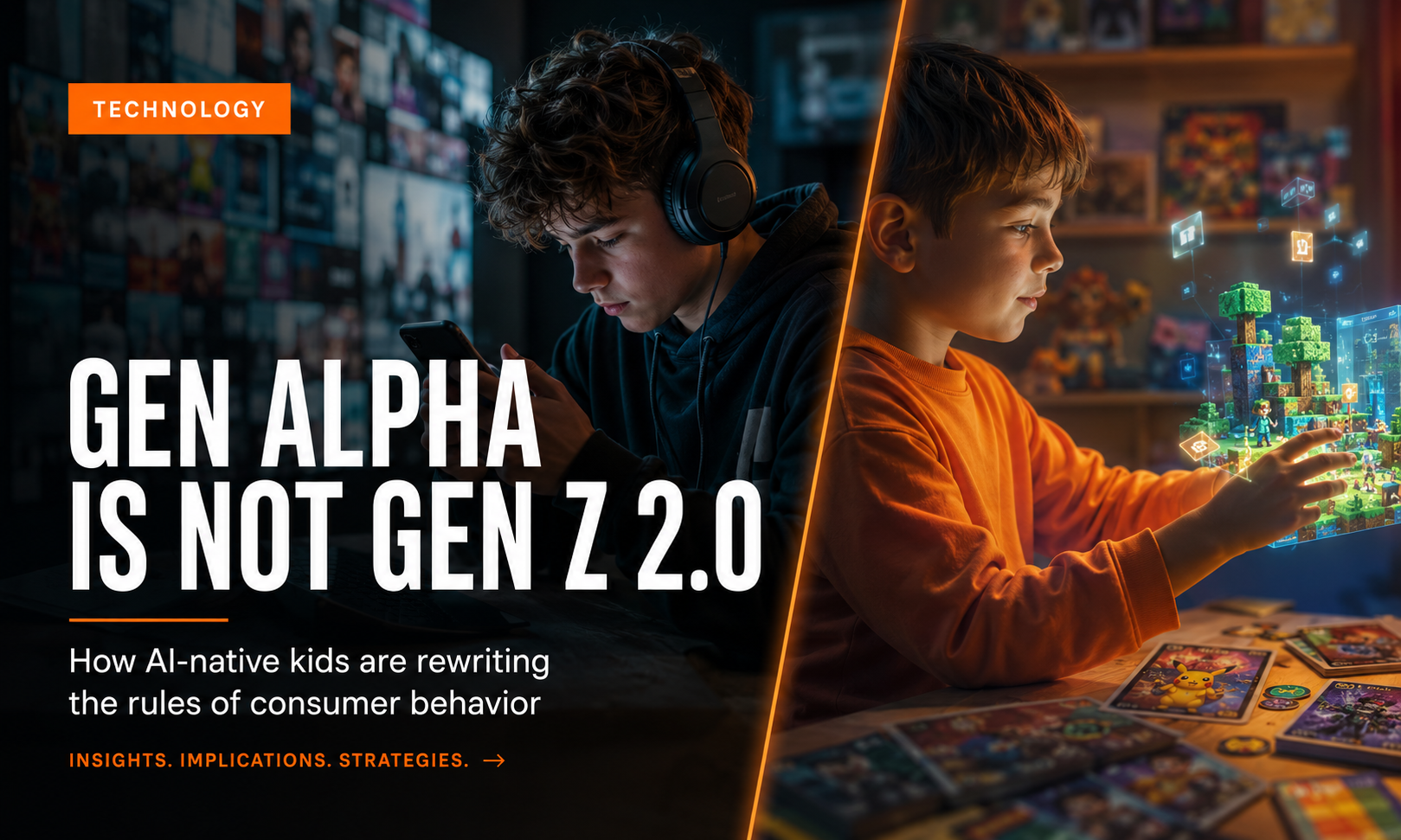
Why Gen Alpha will break your marketing if you still use yesterday’s playbook
Gen Alpha is already reshaping the future of consumer behavior, yet most marketers are still heavily focused on Gen Z. That may be one of the biggest strategic blind spots in marketing right now.
For years, Gen Z has dominated the conversation around digital culture, creator economies, authenticity and social commerce. And rightly so.
But while brands are still optimizing for Gen Z, Gen Alpha has quietly entered the system with a fundamentally different operating logic.
Watching my own son and his peer group, one thing became increasingly obvious:
They don’t think in brands.
They think in ecosystems.
That distinction matters.
Because if Gen Z taught brands how to be social, Gen Alpha will force brands to become adaptive systems.
And most brands are not ready.
The dangerous mistake marketers are making
Many assume Gen Alpha is simply younger Gen Z.
That’s a strategic error.
Gen Z grew up transitioning into digital life.
They adapted to platforms.
They learned how algorithms worked and how to perform within them.
Gen Alpha doesn’t.
They were born into fully integrated digital environments where platforms are infrastructure.
That changes:
how they discover
how they trust
how they compare
how they influence
how they expect brands to behave
This is not just a demographic shift.
It is a behavioral one.
And behavior is where the next decade of brand relevance will be decided.
Gen Alpha vs Gen Z: from algorithm-native to AI-native
Gen Z grew up in algorithmic ecosystems.
Instagram
TikTok
YouTube
They adapted to the machine.
Gen Alpha will not.
They will expect AI to adapt to them.
That changes everything.
For Gen Alpha:
search becomes conversation
information becomes instant
recommendation becomes personalized
technology becomes responsive
They will ask AI before Google.
They will expect answers, not links.
They will expect relevance by default.
Gen Z asked:
“What does this brand stand for?”
Gen Alpha asks:
“What can this brand do for me right now?”
That moves marketing from positioning to utility.
From storytelling to intelligent interaction.
Why marketers need to study ecosystems, not demographics
If you want to understand Gen Alpha, don’t start with demographics.
Start with ecosystems.
Because ecosystems create behavior.
And behavior creates expectations.
Scarcity, status and collecting have existed for generations.
But today they operate with:
higher speed
higher density
higher persistence
higher social amplification
That changes behavioral intensity.
And that changes what brands can learn.
Brawl Stars: compressed reward psychology
Brawl Stars is built on compressed reward loops.
Fast rounds.
Fast feedback.
Fast progression.
Fast social validation.
The psychological trigger here is reward compression.
Gen Alpha learns:
reward must be immediate
progress must be visible
novelty must be constant
That expectation transfers into commerce.
For marketers:
loyalty systems need instant rewards
promotions need visible progression
product systems need constant freshness
The lesson:
The shorter the gratification loop, the stronger the engagement loop.
Minecraft: participatory ownership
Minecraft teaches ownership through creation.
Build.
Customize.
Remix.
Share.
The psychological trigger here is co-creation.
People value what they help shape.
Gen Alpha normalizes this very early.
That means they increasingly expect:
customizable products
modifiable services
adaptive experiences
The lesson:
Participation creates stronger emotional lock-in than possession.
That’s one of the biggest strategic shifts ahead.
Pokémon Trading Card Game: social scarcity economics
Pokémon cards combine:
scarcity
discovery
status
tradability
storytelling
But the real trigger is not scarcity.
It is social scarcity.
Scarcity that matters because peers validate it.
That creates:
playground economies
social ranking
behavioral training in value perception
The lesson:
Scarcity alone does not create demand.
Social scarcity does.
And that’s where demand multiplies.
Consumer electronics: the next battleground
Take smartphones.
Gen Z typically evaluates:
camera
creator tools
ecosystem
self-expression
Gen Alpha evaluates:
gaming performance
speed
battery
social inclusion
what friends already use
That matters.
Because the decision is social.
A child influences.
A parent buys.
Brands like Apple and Samsung must think beyond specs.
They need to think in:
playability
belonging
status
frictionless utility
The product becomes part of the peer ecosystem.
FMCG: the shelf is becoming social media
This is one of the most underestimated shifts.
Gen Alpha increasingly drives demand based on social interaction.
They want:
limited flavors
surprise mechanics
weird colors
collectibility
Look at Prime Hydration.
This isn’t just beverage strategy.
It’s social participation strategy.
Or candy.
For Gen Alpha, sweets are increasingly about discovery.
“Did you try the new one?”
That changes innovation strategy.
Brands like Haribo and Ferrero should pay attention.
Because packaging itself is becoming content.
And shelf space is becoming social space.
The invisible force: inter-generational influence
Generations do not operate in isolation anymore.
Influence now flows in multiple directions.
Gen Alpha influences Millennials (parents)
Gen Alpha influences Gen Z (siblings)
Gen Z transfers culture downward
Millennials fund purchases
Gen X shapes infrastructure and household choices
One child can trigger a three-generation purchase chain.
That’s modern demand architecture.
The buyer is not always the influencer.
The influencer is not always the user.
And the user is not always the payer.
Brands must understand:
who wants it
who validates it
who funds it
who amplifies it
That should fundamentally reshape targeting.
10 quick wins: how brands can win with Gen Alpha now
Understanding Gen Alpha is one thing.
Acting on it is another.
Here are ten practical ways brands can adapt now.
1. Shorten your reward loops
Use:
instant coupons
streak rewards
micro-unlocks
visible point systems
Fast feedback builds habit.
2. Design for participation
Ask:
Can customers shape it?
Can they customize it?
Can they remix it?
Participation creates emotional ownership.
Learn from Minecraft.
3. Build social scarcity
Use:
drops
exclusive access
collectibles
community-first releases
Scarcity without social visibility has less power.
Learn from Pokémon Trading Card Game.
4. Turn packaging into content
Packaging must trigger:
curiosity
sharing
surprise
conversation
Think shelf-first and social-first.
5. Create progression systems
Use:
levels
badges
unlockables
tiers
Progress keeps attention alive.
6. Target the influence chain
Don’t just target the buyer.
Target:
the influencer
the validator
the payer
the sharer
That’s modern targeting.
7. Make your brand feel alive
Use:
weekly updates
seasonal drops
micro-events
fresh content
Learn from Brawl Stars.
8. Reduce friction
Fast onboarding.
Fast answers.
Fast checkout.
Every extra step kills momentum.
Gen Alpha expects speed.
9. Build ecosystems, not campaigns
Campaigns create attention.
Ecosystems create retention.
Think:
community
membership
interaction
exclusive experiences
10. Shift from storytelling to utility
Gen Alpha increasingly asks:
“What does this brand do for me now?”
Be useful.
Be responsive.
Be adaptive.
That’s how relevance is built.
Final thought
The future customer is already here.
Playing Brawl Stars.
Building in Minecraft.
Trading Pokémon Trading Card Game.
Talking to AI.
Not because it’s innovative.
But because it’s normal.
The brands that win the next decade won’t be the ones that understand Gen Z best.
They will be the ones that understand what Gen Alpha expects next.