

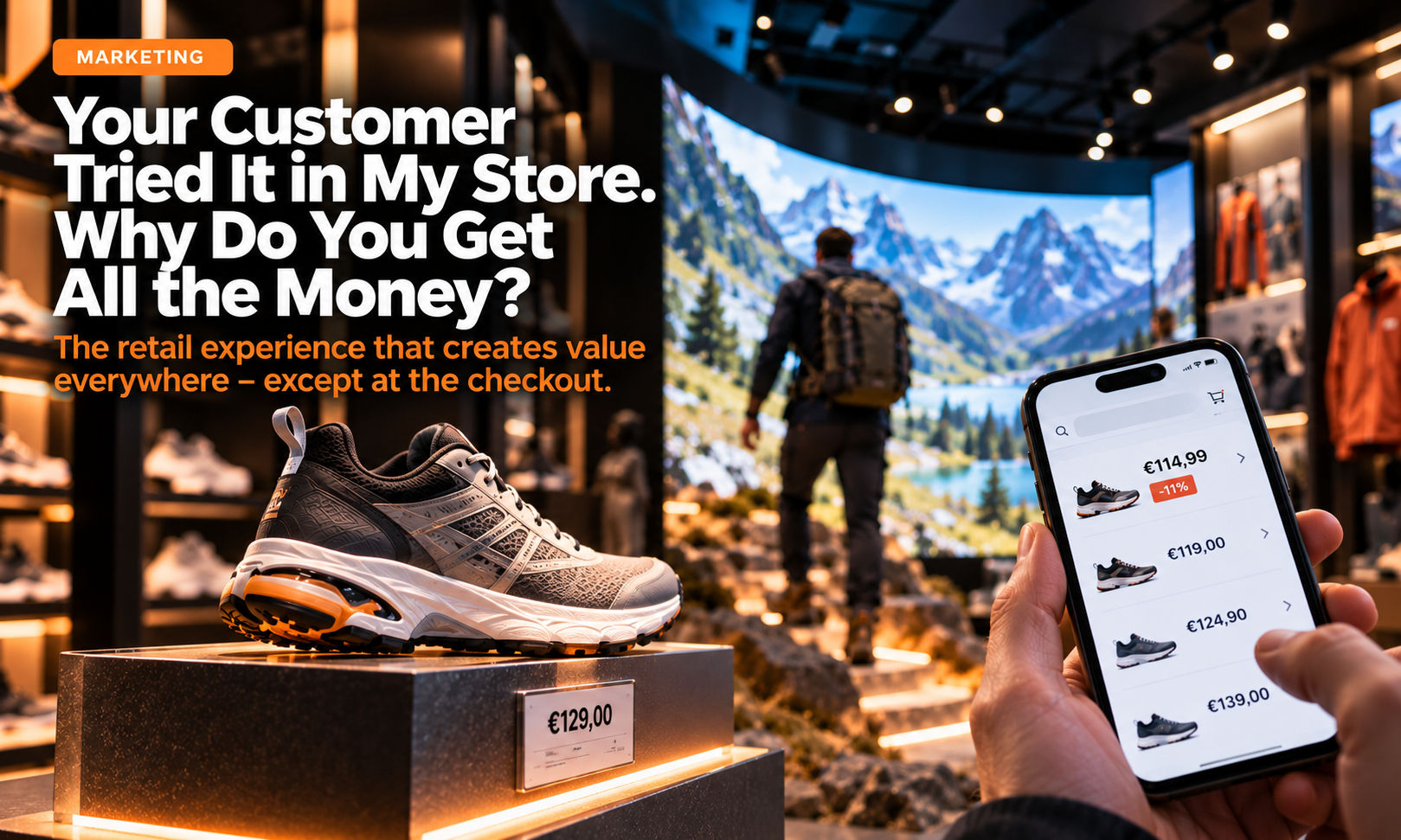
What if a new retail experience business model could reward physical stores for the value they create, even when customers complete their purchases online?
The Experience Dividend explores how AI-powered simulations, immersive commerce, cross-brand partnerships and intelligent cross-selling could transform traditional retail into a collaborative experience economy. This detailed business case examines the commercial opportunities, financial assumptions and challenges of making that vision a reality.
The €15 Problem That Reveals a Bigger Retail Challenge
A customer enters a specialist shoe store.
He spends 30 minutes trying different models, comparing materials and receiving professional advice.
The employee explains cushioning, stability and fit. The customer finally finds the perfect shoe.
Then he checks his smartphone.
The same model is available online for €15 less.
He leaves without buying.
The physical retailer paid for the store, inventory, employee, training and product experience.
The online retailer completes the transaction.
The experience was created offline. The revenue was captured online.
This is showrooming, a familiar phenomenon in omnichannel retail.
But the deeper problem is not simply price competition.
It is the way value is recognised and distributed across the customer journey.
A 2025 study published in the Journal of Consumer Marketing found that customers tend to use a single channel for cheaper products but are more inclined towards showrooming for higher-priced products.
That distinction matters.
The more complex or expensive a purchase becomes, the more valuable professional advice and physical product experience can be.
Yet conventional retail economics often recognise only the final transaction.
What if we changed that?
The Experience Dividend: A New Retail Experience Business Model
Imagine an independent outdoor retailer participating in a shared commercial ecosystem.
The retailer provides specialist consultations, product demonstrations and immersive experiences.
Manufacturers contribute product knowledge, equipment, training and experience funding.
E-commerce platforms provide availability, payment processing and fulfilment.
An attribution system recognises verified contributions to customer purchases.
When a customer receives advice in the store and subsequently purchases from a participating online retailer, the store receives an agreed experience-related payment.
The customer remains free to choose where to buy.
The store no longer needs to own every transaction to participate in the economic value it creates.
I call this proposed model The Experience Dividend.
Its ambition is to move beyond conventional omnichannel integration.
Most omnichannel strategies connect touchpoints.
The Experience Dividend would also connect their economics.
Instead of asking which channel owns the customer, the partners would ask which activities created measurable value and how those contributions should be rewarded.
The Next Opportunity: From Product Showrooms to Immersive Experience Hubs
Now imagine taking the concept one step further.
A customer visits an outdoor store looking for trekking boots.
Rather than simply trying on footwear, he enters an immersive mountain environment.
A large panoramic display recreates an Alpine landscape.
A controlled testing surface simulates rocky terrain, wet ground and uneven paths.
Lighting, sound and environmental effects create a more realistic impression of different trekking conditions.
A trained specialist guides the customer through the experience.
AI-supported software adapts the demonstration to the customer’s intended activity and experience level.
A weekend hike in the Alps requires different equipment from a multi-day expedition in Scandinavia.
The customer tests footwear, compares backpack carrying systems and explores different layering options.
The simulation does not replace certified product testing or real-world safety assessments. It creates a more relevant, engaging environment for education and comparison.
The customer is no longer simply examining products. The customer is exploring the situations in which those products will be used.
This changes the commercial potential of the store.
Because the customer rarely needs just one product.
Cross-Selling Through Experience, Not Sales Pressure
Consider what happens during the simulated trekking journey.
The customer begins by testing boots.
As the terrain changes, a specialist explains the benefits of trekking poles.
When simulated weather conditions deteriorate, the customer discovers the differences between waterproof jackets.
A backpack demonstration reveals the importance of weight distribution.
An AI-supported recommendation engine identifies compatible equipment, drawing on the customer’s planned activity, preferences and existing gear.
The journey naturally introduces complementary categories.
Footwear, backpacks, clothing, navigation equipment, hydration systems and potentially outdoor services.
This is not traditional cross-selling based on generic product bundles.
It is experience-driven cross-selling, where recommendations emerge from a realistic use case.
For example, a customer buying trekking boots might also discover that an appropriately fitted backpack would make a planned multi-day hike more comfortable.
The additional product becomes relevant because the experience reveals a genuine need.
That distinction is essential.
Cross-selling should improve the customer’s outcome, not simply increase basket size.
A well-designed experience could potentially improve attachment rates, average order value and satisfaction while reducing unsuitable purchases.
Those outcomes would need to be validated experimentally.
Why the Entire Retail Value Chain Could Benefit
The opportunity extends beyond the physical retailer.
Manufacturers: From Product Exposure to Product Understanding
Manufacturers invest substantial resources in advertising, retail distribution and product education.
An immersive experience hub could offer a shared environment for demonstrating products in context.
A footwear manufacturer might contribute technical expertise.
An outdoor apparel brand could provide weather-protection demonstrations.
A backpack manufacturer could support load-distribution testing.
A navigation technology provider could demonstrate route-planning functionality.
The participating brands would gain opportunities for qualified customer engagement and, where appropriately permitted, aggregated insights into product preferences and common customer questions.
Physical Retailers: From Transaction Revenue to Experience Revenue
Retailers could develop several complementary revenue streams.
Traditional product sales would remain important.
But additional income could come from verified purchase referrals, paid specialist experiences and commercial partnerships supporting the experience environment.
This would reduce dependence on the physical checkout as the only measure of commercial success.
E-Commerce Platforms: Better Purchase Quality
An online retailer receiving customers who have already tested products and received specialist advice may benefit from more informed purchasing decisions.
That could translate into stronger conversion quality, better product suitability and fewer returns.
The potential is commercially relevant.
According to the National Retail Federation’s 2025 Retail Returns Landscape report, an estimated 19.3% of online sales in the United States were expected to be returned.
That figure is an industry-wide estimate, not a benchmark for outdoor equipment or European retail.
Nevertheless, it illustrates why reducing unsuitable purchases could create substantial value.
Employees: Expertise as a Revenue-Generating Capability
A specialist employee could contribute directly to consultation revenue, customer satisfaction, cross-selling and verified online purchases.
Instead of evaluating staff exclusively through immediate sales, retailers could measure the quality and commercial impact of customer experiences.
Customers: Better Decisions Without Channel Restrictions
Customers would receive more relevant advice, practical demonstrations and greater confidence in their purchasing decisions.
They would retain the freedom to buy immediately, order later or choose another participating channel.
The objective is not to restrict customer choice.
It is to make better experiences economically sustainable.
Business Case: An Independent Outdoor Retailer
Let’s translate the concept into a financial model.
Imagine a medium-sized independent outdoor retailer introducing a modular immersive experience zone.
The store already exists and continues its normal retail operations.
The proposed investment covers an additional experience environment, digital attribution capabilities, staff training and AI-assisted product discovery.
This distinction matters.
The following calculation is an incremental business case. It evaluates the additional revenue and costs of the Experience Dividend programme, rather than the profitability of the entire retail store.
All figures are hypothetical planning assumptions, not observed market results.
1. Initial Investment
| Investment category | Estimated cost |
| Modular terrain and testing installation | €15,000 |
| Immersive display and audiovisual equipment | €12,000 |
| CRM, attribution and AI integration | €10,000 |
| Staff training and experience design | €5,000 |
| Launch and contingency | €3,000 |
| Total initial investment | €45,000 |
The concept deliberately avoids starting with an expensive, fully immersive installation.
A modular environment would allow the retailer to test demand and commercial viability before making larger investments.
2. Revenue Model
The proposed programme has three incremental revenue streams.
A. Verified Online Purchase Compensation
Assume the store conducts 600 qualifying consultations per month.
Of those, 40% result in an eligible, verified online purchase through a participating partner.
With an average transaction value of €150 and an 8% experience compensation:
600 × 40% × €150 × 8% = €2,880 monthly.
Annual revenue: €34,560
The 40% figure represents an assumed attribution-eligible purchase rate, not a demonstrated conversion benchmark.
B. Paid Immersive Experiences
The retailer offers specialist experience sessions, such as backpack fitting or guided trekking equipment preparation.
Assume 120 paid sessions per month at an average net price of €18.
120 × €18 × 12 = €25,920 annually.
Annual revenue: €25,920
These paid sessions are modelled separately from the consultations compensated through online referrals to avoid counting the same service twice.
C. Brand Experience Partnerships
Three complementary brands participate in the experience environment.
Each contributes an assumed €1,000 per month for defined demonstrations, staff education and experience participation.
3 × €1,000 × 12 = €36,000 annually.
Annual revenue: €36,000
Brand payments would need to be supported by independently measurable commercial value. They cannot be assumed to be available automatically.
3. Annual Revenue Summary
| Revenue stream | Annual revenue |
| Verified purchase compensation | €34,560 |
| Paid immersive experiences | €25,920 |
| Brand partnerships | €36,000 |
| Total incremental revenue | €96,480 |
4. Annual Operating Costs
| Cost category | Annual cost |
| Incremental specialist staffing | €42,000 |
| Technology, software and maintenance | €18,000 |
| Experience operations and content | €12,000 |
| Attribution, administration and data governance | €8,000 |
| Total incremental operating costs | €80,000 |
The model assumes the existing store provides the necessary space without material additional rent. Where this is not possible, an opportunity cost for floor space must be included.
5. Operating Result
Annual incremental revenue: €96,480
Annual incremental operating costs: €80,000
Indicative annual operating surplus: €16,480
That represents an operating surplus margin of approximately 17.1% on programme revenue.
The €45,000 initial investment is excluded from annual operating costs.
Under these simplified assumptions, the initial investment would be recovered through operating surplus after approximately 2.7 years if annual performance remained constant.
This is not a guaranteed ROI.
The result is sensitive to consultation volumes, customer willingness to pay, partner contributions, attribution rules and actual operating costs.
It also excludes financing, tax, depreciation and any material displacement of existing store sales.
Three-Year Financial Outlook
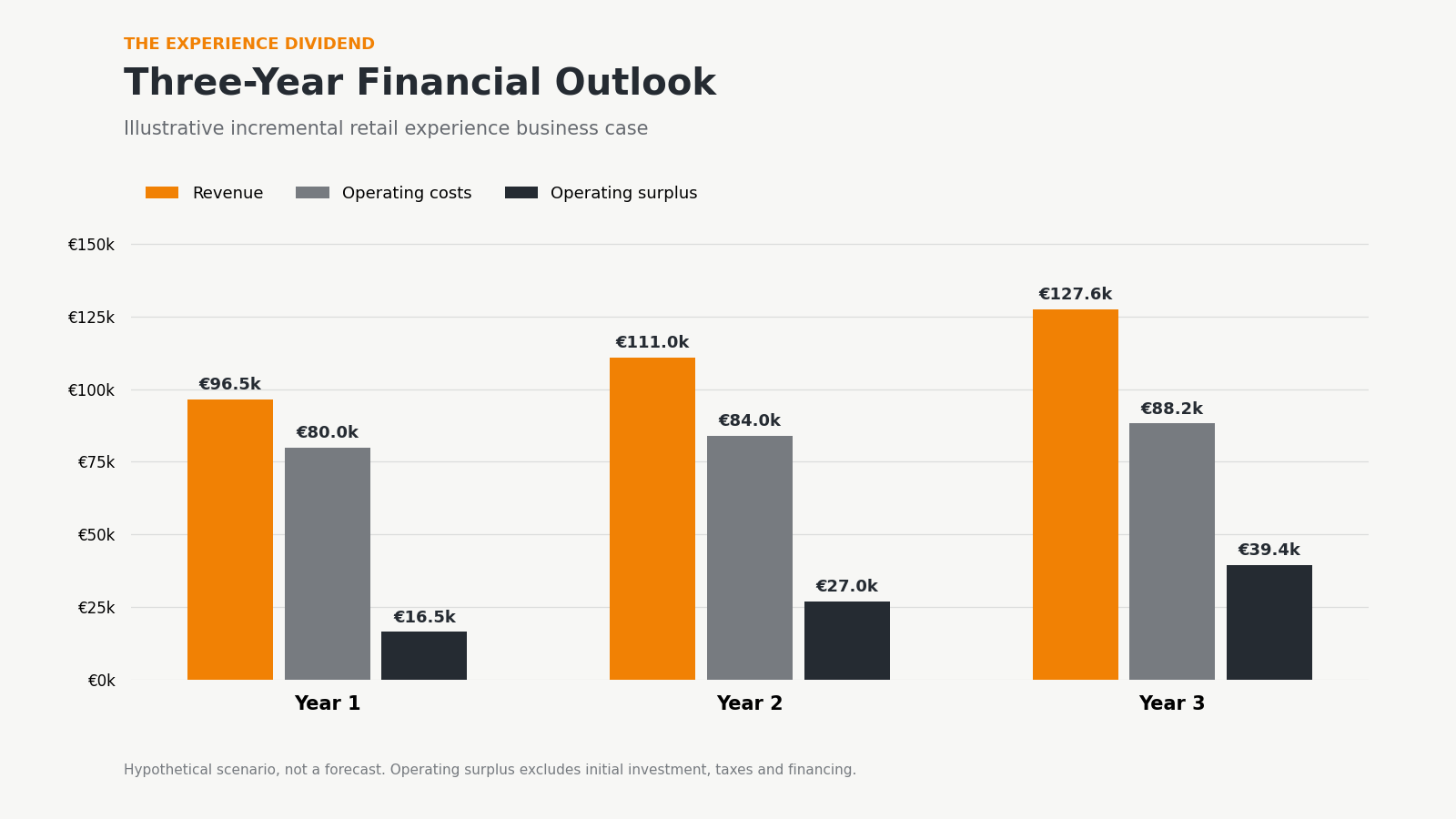
Assume programme revenue grows by 15% annually after Year 1 as customer awareness and partner participation increase.
Operating costs rise by 5% annually.
| Financial metric | Year 1 | Year 2 | Year 3 |
| Revenue | €96,480 | €110,952 | €127,595 |
| Operating costs | €80,000 | €84,000 | €88,200 |
| Operating surplus | €16,480 | €26,952 | €39,395 |
The cumulative three-year operating surplus would be approximately €82,827.
After subtracting the initial €45,000 investment, the simplified cumulative programme cash contribution would be approximately €37,827.
This projection assumes that revenue growth can be achieved without proportionate increases in staffing or technology costs.
It is therefore an illustrative scenario rather than a forecast.
The important question is not whether these exact figures will materialise.
It is whether shared experience funding, verified purchase compensation and relevant cross-selling can collectively generate enough incremental contribution to support the investment.
Where the Additional Value Really Comes From
The financial model above considers direct programme revenue.
But the wider value chain could generate additional benefits.
Cross-Selling Contribution
Imagine that immersive consultations increase the share of customers purchasing relevant complementary products.
The resulting incremental contribution margin could improve the economics for participating retailers, brands and platforms.
However, additional sales should only count as incremental if they exceed what a comparable customer group would have purchased without the experience.
Return Reduction
Better fitting and product understanding might reduce unsuitable purchases.
A reduction in returns could create savings in reverse logistics, handling, inspection and inventory losses.
Those savings should be measured after accounting for the costs of providing the experience.
Brand Experience Efficiency
Instead of financing separate installations, brands could share a single experience environment.
That could reduce duplicated investment and improve access to qualified customers.
Employee Productivity
AI-assisted product information and preparation tools could help employees deliver more relevant consultations.
But productivity should not be measured solely through shorter interactions.
For complex purchases, a longer, higher-quality consultation may create more value than a faster transaction.
The Critical Economic Question: Who Pays Whom?
A shared value model only works if the participants understand the economic exchange.
Consider a customer purchasing a €150 product online after receiving specialist advice in a participating store.
An 8% experience compensation would equal €12.
The online retailer cannot automatically afford that payment.
It would need to be funded by a combination of incremental contribution margin, avoided acquisition costs, measurable return savings or a separately agreed manufacturer contribution.
The commercial arrangement must also account for existing wholesale margins, marketing allowances and fulfilment costs.
Otherwise, the system could simply redistribute margin without creating additional value.
The Experience Dividend therefore needs two separate mechanisms.
Attribution: Which interaction materially contributed to the purchase?
Compensation: What verified incremental value was created, and how much can the participating partners sustainably share?
These are related but different questions.
A customer may receive advice in several locations, encounter advertising and compare multiple online retailers before purchasing.
The system should not assume that the last recorded store visit deserves full credit.
A practical pilot could begin with simple, consent-based referral identifiers and predefined compensation rules.
More sophisticated multi-touch attribution should only be introduced if it improves accuracy enough to justify its cost and complexity.
AI at the Point of Sale: Beyond Recommendation Engines
The role of AI in this concept goes beyond suggesting another product.
It could connect five capabilities.
Contextual discovery: Understanding the customer’s intended activity and product requirements.
Adaptive simulation: Selecting relevant scenarios, such as different hiking environments or weather conditions.
Product compatibility: Identifying suitable combinations of footwear, clothing and equipment.
Human-assisted guidance: Giving trained employees reliable information to support their recommendations.
Commercial measurement: Analysing which experiences contribute to customer satisfaction, suitable purchases and verified incremental value.
The customer should remain in control of personal information.
An anonymous experience should be possible without creating a customer profile.
Cross-channel tracking would require a valid legal basis and appropriate transparency, with consent where required.
AI recommendations should be explainable, based on reliable product information and subject to human oversight, especially where safety-related equipment is involved.
AI should make the experience more relevant. It should not make the customer feel monitored.
What Could Go Wrong?
A credible business case must consider failure scenarios.
Attribution failure: Purchases cannot be reliably linked to consultations, or several partners claim the same contribution.
Commercial resistance: Platforms and manufacturers refuse to fund the proposed compensation model.
Low utilisation: Customers enjoy the installation but are unwilling to pay for sessions or do not purchase additional products.
Experience novelty decay: Initial interest declines once the immersive environment is no longer new.
Technology costs: Software, hardware maintenance and content updates exceed the initial budget.
Channel conflict: Existing retailers or distribution partners perceive the model as unfair competition.
Data protection: Customers do not want their in-store activity connected with online purchases.
Weak incrementality: The programme rewards transactions that would have occurred anyway.
None of these risks can be solved through storytelling.
They require commercial negotiation, operational discipline, careful system design and real-world testing.
A 90-Day Pilot: From Concept to Evidence
Rather than launching a large network immediately, the concept should begin with a controlled experiment.
Days 1–30: Establish the Foundation
Select three to five independent outdoor retailers, complementary brands and one participating online retailer.
Agree on commercial responsibilities, customer data handling and attribution rules.
Establish baseline metrics and suitable comparison groups.
Build a modular experience prototype focused on one use case, such as trekking footwear and backpack fitting.
Days 31–60: Launch and Measure
Introduce the experience to customers.
Train staff in product consultation and AI-assisted discovery.
Measure participation, consultation quality, relevant product attachment, customer satisfaction and subsequent purchases.
Monitor operating costs and technical reliability.
Days 61–90: Evaluate the Economics
Compare pilot results with the baseline and control group.
Determine whether the programme generated incremental contribution margin.
Assess whether cross-selling improved product suitability rather than merely increasing sales volume.
Measure any early signals relating to returns, recognising that the full return window may extend beyond the pilot.
Review the financial viability for every participating partner.
Then decide whether to stop, redesign or scale the concept.
A 90-day experiment would not prove long-term profitability or employment effects.
But it could establish whether the central commercial hypothesis deserves further investment.
From Retail Fiction to a Different Economic Reality
There is just one problem with the integrated ecosystem described here.
The Experience Dividend, in this proposed form, is fictional.
The financial projections are hypothetical.
The immersive outdoor experience is a concept scenario, not an operating pilot.
And no brand, retailer or e-commerce platform is represented as having committed to this model.
Yet many of the underlying capabilities already exist.
Retailers already provide professional consultations.
Brands already invest in product experiences.
E-commerce platforms already use referral systems.
AI already supports product discovery and personalisation.
Immersive technologies already allow customers to experience simulated environments.
What remains unresolved is how these capabilities could be integrated into a commercially fair, interoperable system.
The innovation may not be another technology. It may be a new agreement about who creates value and who deserves to benefit from it.
The Future of Retail Is a Value Chain Question
For years, retail transformation has focused on connecting physical and digital channels.
But connecting channels is not the same as aligning their economics.
If physical retailers are expected to provide product discovery, personal expertise and immersive experiences, they need a viable commercial model to support those investments.
If online platforms benefit from more confident customers and better product choices, there may be an opportunity to recognise the contribution of physical experiences.
If manufacturers want richer product engagement, shared experience environments could offer a new form of cooperation.
And if local stores can generate sustainable income from expertise rather than relying exclusively on checkout transactions, that could create new opportunities for investment, training and employment.
The objective should not be to protect physical retail from digital commerce.
It should be to create a more productive relationship between them.
What if we stopped treating physical retail as a distribution channel and started treating it as an experience economy?
And here is the question I would put to retail leaders, brand manufacturers and e-commerce platforms:
Would you reward a retail partner who created the customer experience, even if your business completed the sale?
And would you invest alongside other brands in immersive experiences that none of you could justify building alone?
Perhaps that is where the next chapter of retail innovation begins.
Concept disclosure: The Experience Dividend is an independent, hypothetical retail business model developed as a thought-leadership exercise. Financial figures are illustrative assumptions and should not be interpreted as forecasts, market benchmarks or evidence of an operating commercial network. The proposed pilot, partnerships and immersive experience environment are fictional scenarios.
Research & Data Sources
The following research publications and industry reports provide context for the retail trends, customer behaviour and data governance considerations discussed in this article.
- National Retail Federation (NRF) – 2025 Retail Returns Landscape
Industry research examining retail return rates, the economic impact of product returns and the challenges associated with online shopping, particularly in the US market.
View Report - Journal of Consumer Marketing (2025) – Omnichannel Usage, Webrooming and Showrooming
Academic research exploring omnichannel shopping behaviour, including how product prices influence customers’ decisions to research and purchase across physical and digital channels.
Read Publication - Journal of Business Research (2025) – How Do Omnichannel Customer Experiences Affect Customer Engagement?
Academic research investigating the relationship between omnichannel customer experiences and customer engagement, highlighting the importance of understanding how different touchpoints contribute to customer relationships.
Read Publication - European Data Protection Board (EDPB) – Guidelines 05/2020 on Consent under Regulation 2016/679
Official European guidance on valid consent under the General Data Protection Regulation (GDPR), relevant to customer data collection, personalisation and consent-based attribution across physical and digital retail environments.
Read Guidelines
Research note: The Experience Dividend is a hypothetical retail business model. The sources above provide supporting industry context and academic perspectives; they do not validate the proposed financial projections, revenue-sharing mechanisms or commercial feasibility of the concept.