
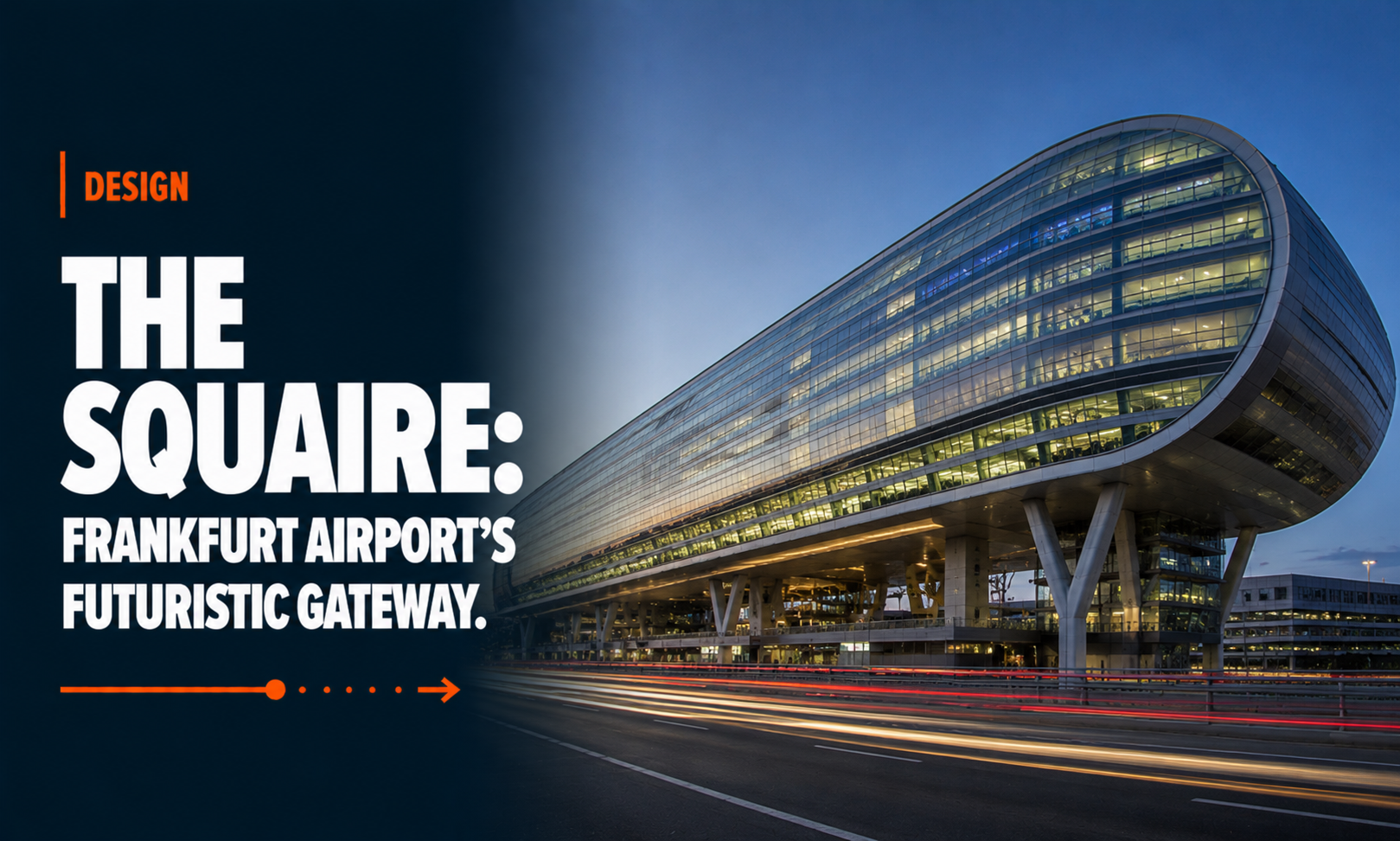
The Squaire is more than architecture. It’s a physical blueprint of how modern life works: connected, compressed, fluid, and constantly in motion.
The Design Philosophy of The Squaire
1. Architecture as Motion, Not Monument
What makes The Squaire fascinating is that it rejects the static, vertical skyscraper logic. Instead, it stretches horizontally for over 660 meters, almost like an airport fuselage itself.
Its elongated aerodynamic form reflects:
- speed
- flow
- transit
- continuity
The design mirrors the psychology of its users: people in motion.
This is architecture built for movement, not permanence.
Blog angle:
“The Squaire doesn’t stand still — it moves, even when it doesn’t.”
2. Compression of Time Through Design
One of the core philosophies is time efficiency.
The building sits directly above the long-distance train station and beside Terminal 1. That’s not accidental. It collapses multiple travel touchpoints into one ecosystem:
Plane ? Train ? Hotel ? Office ? Meeting.
This creates what designers call:
Spatial compression
Meaning: reducing perceived friction between experiences.
That’s exactly what great CX does.
For your marketing audience this is gold:
The Squaire is basically physical Customer Journey Design.
3. The Hybridization of Spaces
The Squaire dissolves traditional boundaries:
- airport infrastructure
- office campus
- premium hospitality
- retail
- conference spaces
It’s an early prototype of what we now call:
mixed-use hyperconnectivity
Today this is standard in urban development. In 2011 it was visionary.
The philosophy:
Why separate functions if human behavior doesn’t?
4. Transparency and Openness
Glass dominates the architecture.
Not just aesthetically — psychologically.
Glass in architecture communicates:
- trust
- openness
- orientation
- lightness
For travelers under time pressure, transparency reduces cognitive load.
You instinctively understand where to go.
That’s powerful design.
5. Infrastructure as Experience
Most infrastructure is invisible until it fails.
The Squaire turns infrastructure into a branded experience.
That’s rare.
It elevates logistics into emotional perception.
This is why it feels premium despite being a transit node.
This links beautifully to your Experience-led Growth philosophy:
Functional excellence becomes emotional value.
6. A Symbol of Modern German Precision
The Squaire feels unmistakably German:
- engineered
- efficient
- precise
- systematic
But unlike older German architecture, it introduces softness through curves.
That balance is important:
precision + fluidity
That’s what modern design increasingly aims for.