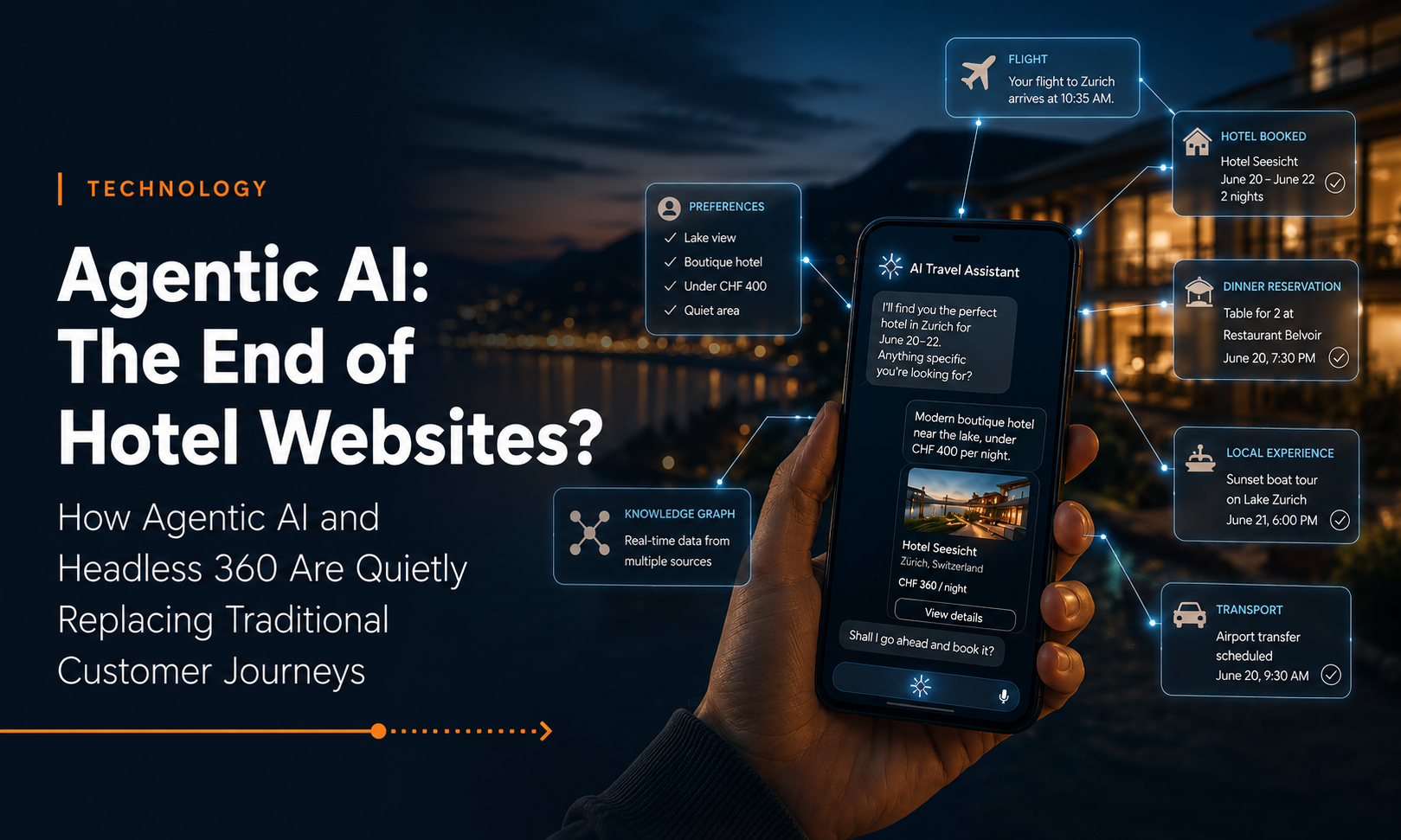

Agentic AI: The End of Hotel Websites? How Agentic AI and Headless 360 Are Quietly Replacing Traditional Customer Journeys

Agentic AI: The end of hotel websites?
Agentic_AI_Hospitality
Check in with Agentic AI

Why the future of hospitality may no longer start with your homepage

For more than two decades, hospitality brands have optimized websites, booking engines, loyalty platforms, CRM ecosystems and digital campaigns to guide guests through carefully orchestrated customer journeys.

But what happens when the customer journey no longer starts on your website?

What happens when AI agents begin researching, comparing, negotiating, booking, upselling and even servicing customers autonomously?

Welcome to the era of Agentic AI combined with Headless 360 architecture — where experiences become modular, intelligent and frictionless across every touchpoint.

And yes: this changes everything for hospitality brands.


What Is Agentic AI?

Unlike traditional AI systems that simply answer prompts, Agentic AI acts autonomously toward goals.

It can:

  • plan tasks
  • gather information
  • make decisions
  • trigger workflows
  • communicate across systems
  • learn from context
  • optimize outcomes continuously

Think of it less as a chatbot and more as a digital concierge, sales manager, operations assistant and customer advisor combined.

Now combine this with a modern Headless 360 ecosystem.


What Is Headless 360?

Headless architecture separates the frontend experience from backend systems.

Instead of one monolithic website controlling everything, APIs connect:

  • CRM
  • PMS
  • booking engine
  • loyalty systems
  • content platforms
  • payment systems
  • event tools
  • marketing automation
  • customer data platforms
  • AI orchestration layers

The result?

Experiences can happen anywhere.

Inside:

  • voice assistants
  • wearables
  • WhatsApp
  • automotive systems
  • travel platforms
  • AI agents
  • smart TVs
  • airport apps
  • virtual concierges
  • mixed reality interfaces

The website becomes only one interface among many.

Sometimes not even the primary one anymore.


A Hospitality Example: The AI-Driven Luxury Weekend

Imagine a guest planning a spontaneous long weekend.

Instead of browsing 14 hotel websites, comparing rates manually and checking review platforms, the guest simply tells their personal AI assistant:

“Find me a quiet luxury spa hotel within 3 hours of Frankfurt with great food, late checkout, hiking nearby and a suite under €900.”

The AI agent now:

  • checks calendar availability
  • analyzes preferences
  • compares reviews
  • evaluates loyalty benefits
  • negotiates rates dynamically
  • books transportation
  • reserves dinner
  • schedules spa treatments
  • syncs everything into the guest calendar

The hotel’s Headless 360 ecosystem enables all of this seamlessly through APIs.

No lengthy website navigation.
No call center.
No repetitive form filling.

The experience becomes invisible.

And that is exactly the point.


Why This Is a Massive Opportunity for Hospitality Brands

1. Frictionless Customer Experience

The modern customer values simplicity more than ever.

Agentic AI reduces:

  • search friction
  • booking complexity
  • repetitive interactions
  • waiting times
  • service inconsistencies

The guest feels understood instantly.

That creates emotional loyalty.


2. Hyper-Personalization at Scale

Traditional personalization was mostly segmentation.

Agentic AI enables contextual personalization in real time.

Examples:

  • room preferences automatically applied
  • dynamic dining recommendations
  • wellness suggestions based on stress indicators
  • family experiences adapted to children’s age
  • personalized itineraries based on weather and behavior

This moves hospitality closer to true anticipatory service.


3. Operational Efficiency

Hotels struggle globally with:

  • staffing shortages
  • rising operational costs
  • inconsistent service delivery

AI agents can automate:

  • reservation handling
  • FAQ communication
  • internal task coordination
  • upselling workflows
  • multilingual guest communication
  • post-stay feedback loops

Teams can focus more on high-value guest interaction instead of administrative repetition.


4. Omnichannel Becomes Reality

Many brands still talk about omnichannel.

Few truly execute it.

Headless 360 finally enables consistent experiences across:

  • web
  • app
  • social
  • voice
  • messaging
  • partner ecosystems
  • in-room systems
  • physical touchpoints

The customer journey becomes continuous instead of fragmented.


But Here Comes the Dangerous Part

The hospitality industry must be careful not to automate away its humanity.

Because luxury hospitality is not only about efficiency.

It is about emotion.

And emotion remains deeply human.


Where Human Service Still Wins

Emotional Intelligence

AI can recognize sentiment patterns.

But it cannot genuinely empathize.

A great concierge understands nuance:

  • nervousness before a proposal
  • cultural sensitivity
  • emotional tone
  • unspoken expectations
  • moments requiring discretion

Human intuition still creates magic.


Authentic Relationships

Guests remember:

  • names
  • smiles
  • conversations
  • humor
  • warmth
  • empathy
  • anticipation

Not API response times.

Especially in luxury hospitality, relationships are still the real differentiator.


Complex Problem Solving

AI performs exceptionally well in structured environments.

But hospitality is often chaotic.

Examples:

  • flight cancellations
  • emotional complaints
  • VIP sensitivities
  • family emergencies
  • weather disruptions
  • cultural misunderstandings

Experienced staff navigate ambiguity with creativity and emotional judgment.

That remains difficult to automate fully.


Brand Soul Cannot Be Automated

Many brands risk becoming technically efficient but emotionally interchangeable.

If every hotel uses similar AI systems, the true differentiator becomes:

  • people
  • culture
  • service mindset
  • storytelling
  • atmosphere
  • authenticity

Technology scales operations.

Humans create memories.


The Real Future: AI-Augmented Hospitality

The future is probably not AI versus humans.

It is AI-enhanced humans.

The winning hospitality brands will:

  • automate repetitive complexity
  • empower employees with better insights
  • reduce operational friction
  • free teams for meaningful interaction

In other words:

Less administration.
More hospitality.

That is where the real opportunity lies.


Strategic Questions Hospitality Leaders Should Ask Now

Is your current architecture API-ready?

Many legacy hotel systems are still heavily fragmented.

Without modern API connectivity, agentic ecosystems become difficult to scale.


Who owns the customer relationship in an AI-agent world?

If AI assistants become the primary booking interface, brands risk losing direct customer ownership.

That changes:

  • loyalty economics
  • acquisition models
  • SEO strategies
  • media investments
  • distribution power

A massive shift may already be underway.


Is your organization culturally ready?

Technology transformation is rarely the hardest part.

Mindset transformation is.

Future-ready hospitality organizations need:

  • agile structures
  • data literacy
  • service innovation culture
  • interdisciplinary collaboration
  • AI governance frameworks

Final Thought

Hospitality has always evolved alongside technology.

From telephone reservations to online booking.
From desktop to mobile.
From transactional CRM to experience ecosystems.

Agentic AI combined with Headless 360 may become the next major shift.

The brands that succeed will not simply deploy more AI.

They will redesign experiences around seamless human-centric journeys.

Because in the end, guests rarely remember the technology.

They remember how the experience made them feel.

And that is still profoundly human.
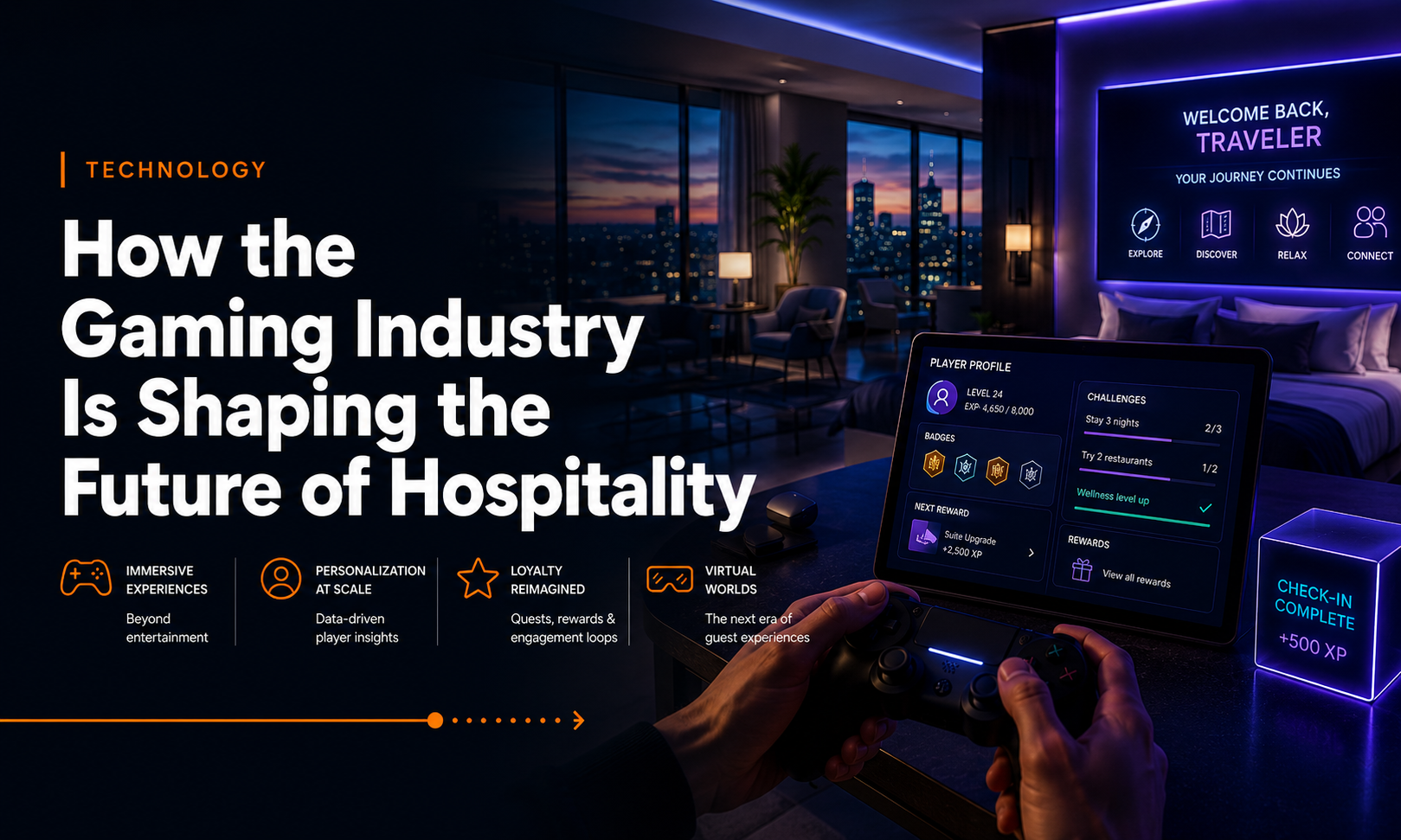

How the Gaming Industry Is Shaping the Future of Hospitality

How the gaming industry is shaping the future of hospitality

They guide users when they get stuck.
They anticipate needs.
They personalise the experience dynamically.

In other words:

A good game doesn’t ask the player to understand the system.

The system learns the player.

Hospitality, however, still often relies on static digital experiences.

Hotel apps rarely remember preferences.
Recommendations often feel generic.
Guest journeys restart with every visit.

Yet the opportunity to create dynamic and personalised experiences has never been greater.

What can the Gaming Industry teach the Futue of Hospitality?

A Glimpse of the Future: AI Avatars

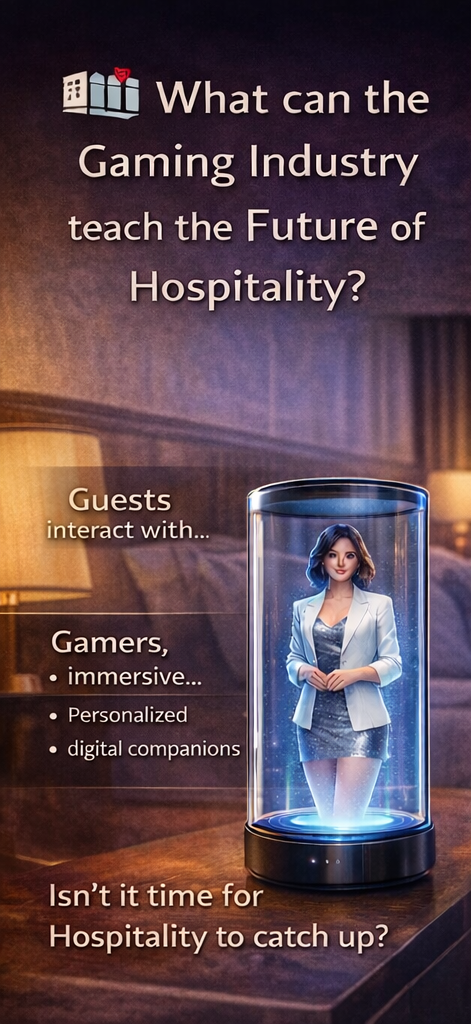
At the Game Developers Conference, Razer demonstrated an intriguing prototype called Razer Ava.

The concept features a small device with a holographic avatar living inside a glass cylinder.

The AI assistant observes the player’s screen, analyses the situation and provides guidance.

It can:

  • analyse context
  • search for information
  • execute tasks
  • coordinate with other AI agents

While designed for gaming, the underlying concept is far more powerful.

It represents the shift from chatbots to persistent AI companions.


How the Gaming Industry Is Shaping the Future of Hospitality: Imagine This in a Hotel Room

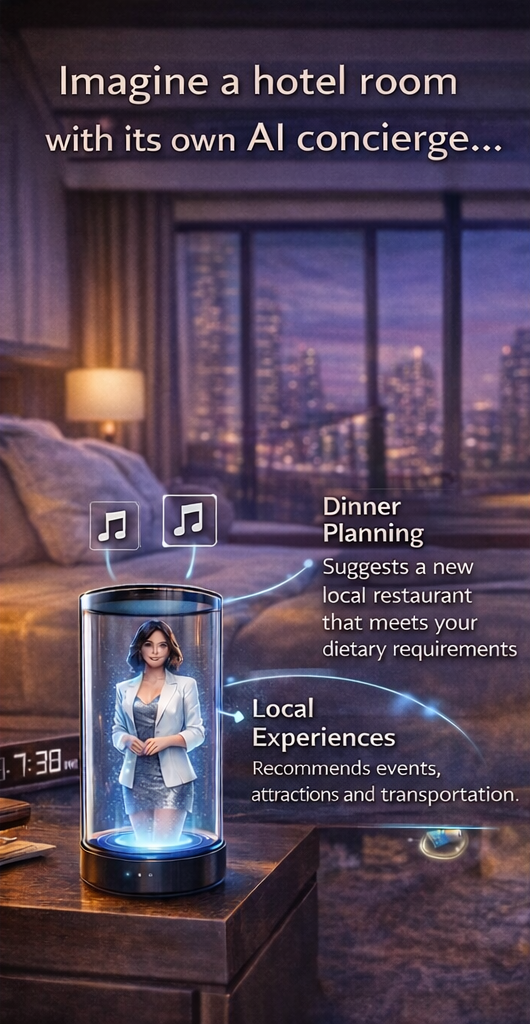
Now imagine entering your hotel room.

On the bedside table sits a small glass device.

Inside it appears a subtle digital avatar.

Think of it as a genie in a bottle — powered by AI.

Your personal concierge.

It already knows:

  • your dietary preferences
  • your favourite music
  • your preferred lighting temperature
  • your wellness habits
  • the type of restaurants you enjoy

Instead of browsing multiple apps, you simply ask:

“Where should I have dinner tonight?”

The assistant might respond:

“There is a Mediterranean restaurant five minutes away that fits your dietary preferences. Would you like me to reserve a table?”

It could also:

  • adjust lighting and room settings
  • recommend events happening nearby
  • organise transportation
  • suggest activities for the next day

All seamlessly integrated into the guest journey.


A New Revenue Engine for Hotels

Beyond guest experience, this concept also opens significant economic opportunities for the hospitality industry.

AI-powered concierge systems could unlock new revenue streams such as:

Cross-Selling and Upselling

Hotels could dynamically recommend:

  • spa treatments
  • dining experiences
  • room upgrades
  • wellness services
  • premium amenities

Because recommendations are personalised and contextual, conversion rates would likely increase significantly.


Local Experience Ecosystems

Hotels could integrate partnerships with local businesses and earn commissions on:

  • restaurant reservations
  • event tickets
  • cultural experiences
  • guided tours
  • transportation services

The AI concierge becomes a digital marketplace for local experiences, curated around each guest.


Continuous Guest Engagement

Unlike static information folders or generic apps, an AI companion can interact with the guest throughout the stay.

This creates multiple opportunities for:

  • personalised offers
  • last-minute upgrades
  • event suggestions
  • partner services

The result is not just better service — but higher ancillary revenue per guest.


AI Does Not Replace Human Hospitality

Whenever AI is discussed in hospitality, the first concern is often job displacement.

But the real opportunity lies elsewhere.

AI assistants can take over routine operational tasks, including:

  • answering standard questions
  • basic recommendations
  • reservation coordination
  • room environment adjustments

This frees human concierges to focus on what truly defines hospitality:

  • designing unique experiences
  • solving complex guest requests
  • building emotional connections
  • delivering cultural insight

Technology increases efficiency.

Humans create meaning.

In this model, concierges evolve from information providers to experience curators.


Why the Industry Needs Testing Spaces

The hospitality industry rarely experiments with radical digital concepts in real environments.

What if hotels introduced AI innovation rooms?

Spaces where technologies could be tested together with:

  • gaming companies
  • AI startups
  • hospitality tech providers
  • universities
  • local partners

Gaming companies have built innovation ecosystems like this for years.

Hospitality could benefit from a similar model.


The Real Question

The holographic AI avatar may seem futuristic today.

But many innovations that started in gaming eventually reshaped other industries.

Real-time graphics.
Virtual economies.
Immersive digital worlds.

AI companions may be next.

And hospitality has the opportunity to turn them into real-world guest experiences and new revenue streams.


A Question to the Industry

What if hotels started experimenting with AI-powered concierge rooms?

Spaces where new guest experiences could be tested with partners from technology, gaming and hospitality.

Which organisations should be involved?

Gaming studios?
AI startups?
Hospitality tech providers?
Universities?

And perhaps the most interesting question:

Which hotel brand will open the first experimental “AI concierge room”?

Because the future of hospitality might not start with a new app.

It might start with a small avatar on the bedside table.

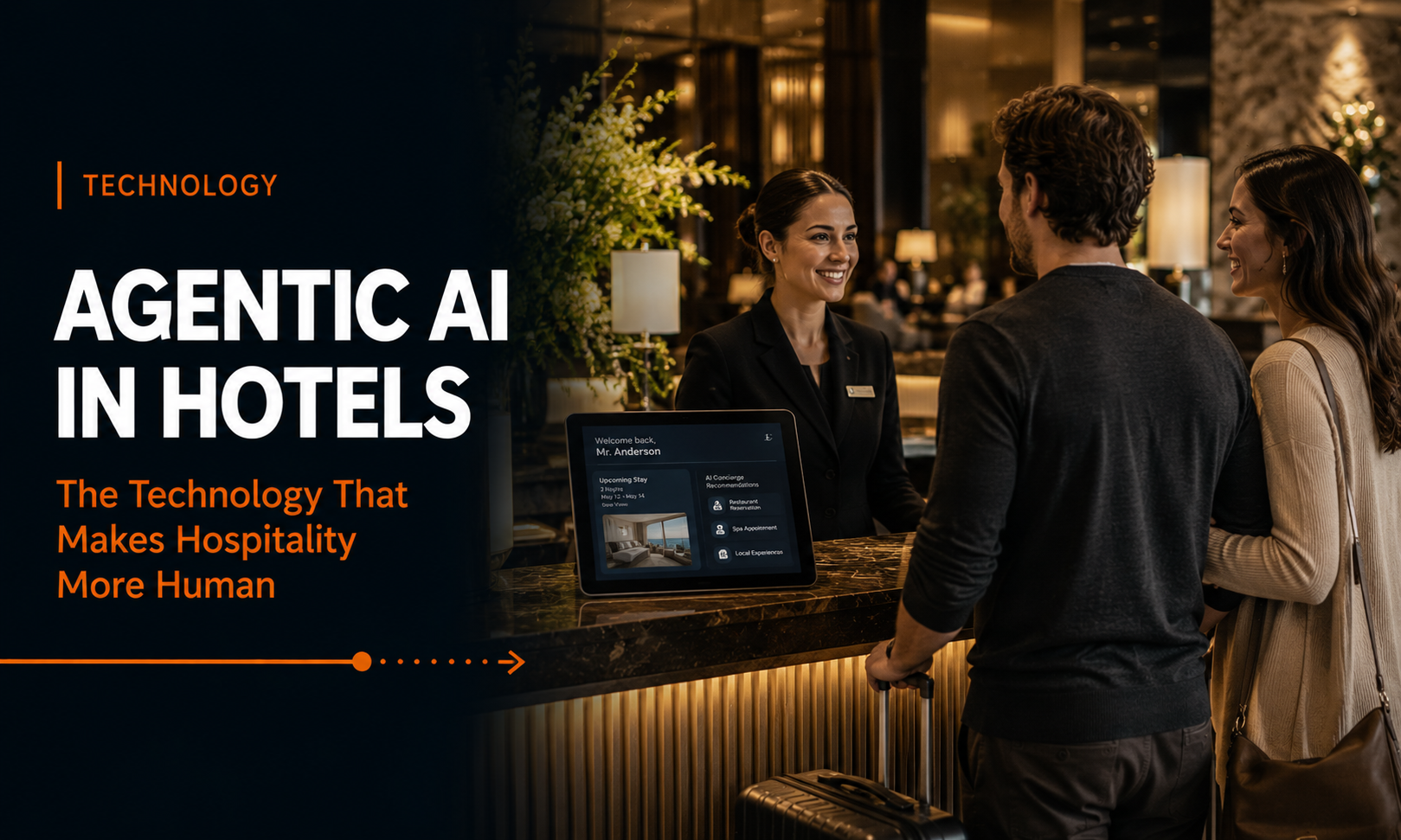
Agentic AI in Hotels: The Technology That Makes Hospitality More Human

Agentic AI in hotels
Agentic AI in Hospitality Management
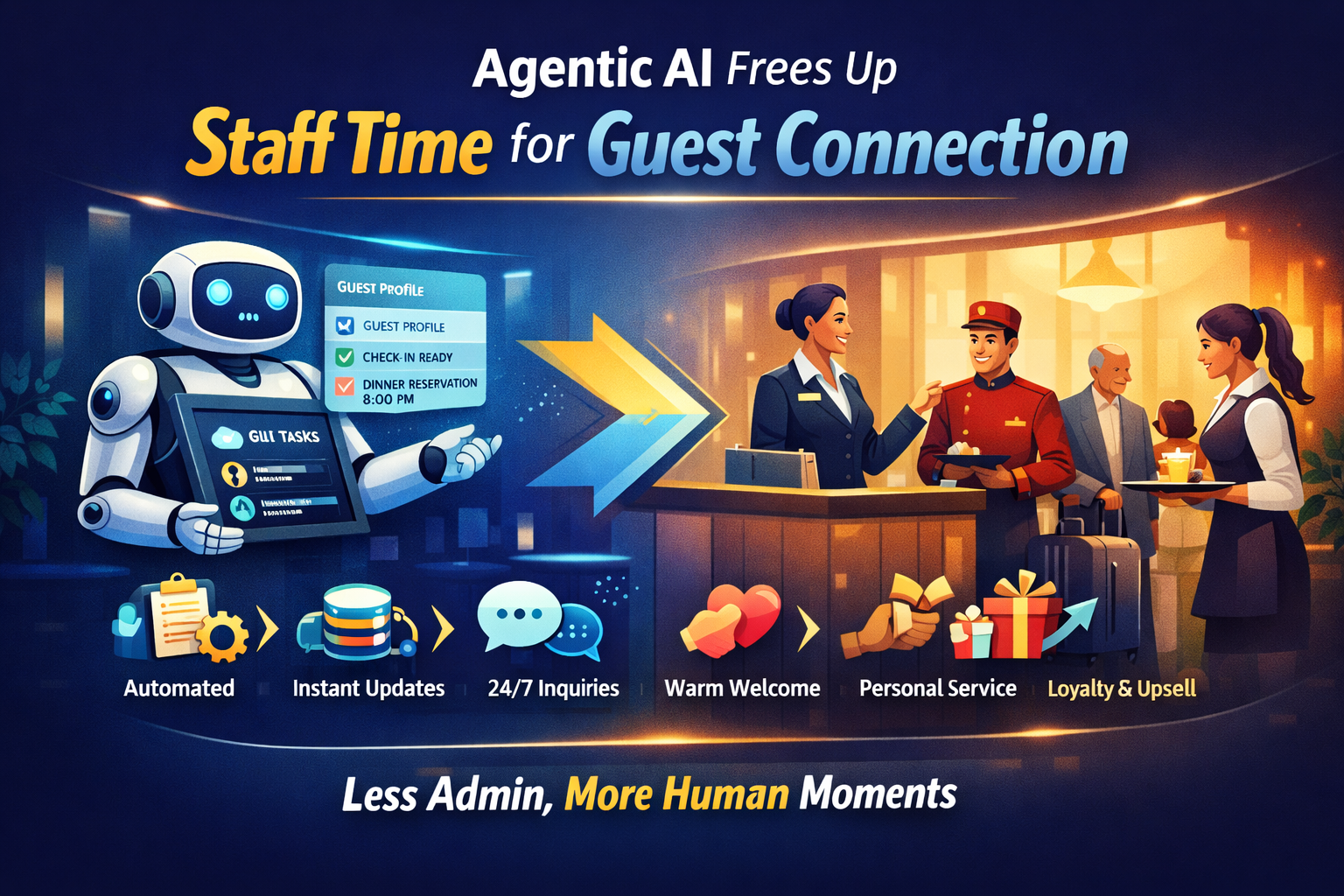
Agentic AI Frees Uo valuable one-to-one guest time!

The hotel industry has a paradox: the more we aim for personalization, the more we bury staff in administration.

Preferences are scattered. Guest context lives in multiple tools. Requests arrive through every channel. And the team—front office, reservations, housekeeping, F&B—spends valuable minutes collecting information instead of creating connection.

Agentic AI changes that. Not because it’s “smarter automation,” but because it introduces a new operating model: software that can take a goal (“prepare for this guest’s arrival”) and execute coordinated steps across your digital ecosystem—while keeping humans in control.

Done right, agentic AI doesn’t replace hospitality. It protects it.


What “agentic AI” actually means in a hotel context

Think of agentic AI as an orchestrator, not a single feature.

Instead of only answering questions, it can:

  • pull context (reservation, history, preferences, disruptions, spend patterns)
  • trigger actions (create tasks, update notes, route tickets, send messages, propose offers)
  • learn from outcomes (was the offer accepted? did the issue recur? what improves satisfaction?)

It’s the difference between:

  • “Here’s an answer.”
    and
  • “I handled it—and I documented it across the systems your team uses.”

The operational problem it solves: “information work”

Most friction in hotel operations is not “service work.” It’s information work:

  • hunting down guest details
  • re-typing the same information
  • answering repetitive questions
  • manually coordinating between departments
  • inconsistent handovers between shifts and properties

A global hotel-chain report (171 unique hotel chains) shows adoption is happening, but execution is fragmented: 78% use AI today, 89% plan more, yet only 8% have a formal, company-wide strategy.

That gap is your opportunity: the winners won’t be the hotels that “try AI.”
They’ll be the hotels that operationalize it.


Where the value shows up (with hard numbers)

1) Cost-to-serve drops without cutting service

McKinsey estimates that applying generative AI to customer care can increase productivity by ~30–45% of current function costs.

In hotel terms, that translates to:

  • fewer repetitive calls/messages reaching the front desk
  • faster resolution time
  • less night-shift pressure for routine questions
  • cleaner escalation to humans for complex or emotional cases

Case studies in hospitality also show large deflection potential (example: one hospitality chatbot case reports 72% of queries handled without agent assistance). Treat these as directional, not guaranteed—results depend on integration and content quality.

2) Personalization drives measurable revenue lift

McKinsey’s research on personalization shows it most often drives ~10–15% revenue lift (execution-dependent).

Hotels feel this lift through:

  • higher direct conversion
  • improved satisfaction (fewer “repeat explanations”)
  • more relevant add-ons (late checkout, breakfast, parking, spa, room category upgrades)

3) Upselling scales across the portfolio (not just with your best receptionist)

One of the most underappreciated benefits of agentic AI is portfolio consistency:

  • the same guest recognized across properties
  • the same preferences carried over
  • the same offer logic and brand standards applied

Hotel chains themselves signal this direction: in the h2c study, 54% plan AI-supported upselling and 49% plan personalized booking in the next 12–24 months.

And when conversational AI is paired with upsell tooling, some groups report very large conversion improvements (again: case-study results, not universal).


The real “plot twist”: AI increases human-to-human contact

When AI agents absorb the repetitive work, staff time shifts to what guests actually remember:

  • warm arrivals
  • proactive recovery
  • genuine recommendations
  • relationship-building that leads to loyalty

This is the message teams need to hear clearly:

Agentic AI is not a headcount strategy. It’s a hospitality strategy.

Because the experience improves precisely where humans are irreplaceable: empathy, judgment, presence.


How to operationalize agentic AI with your existing infrastructure

You don’t need to replace your entire stack. You need a thin orchestration layer plus strong governance.

Step 1: Pick “connected moments” across the guest journey

Start where information work is heavy and value is immediate:

  • pre-arrival questions + special requests
  • check-in coordination (ETA, room readiness)
  • in-stay requests (maintenance, housekeeping, amenities)
  • post-stay feedback + service recovery

Step 2: Integrate the minimum systems for a unified guest context

Typically:

  • PMS (reservation, stay history, room status)
  • CRM / loyalty (member status, preferences, lifecycle)
  • Guest messaging (WhatsApp/SMS/app chat/email routing)
  • Ops ticketing (maintenance/housekeeping tasks)
    Optionally later:
  • POS / spa / golf / outlets for richer personalization and upsell targeting

The h2c report flags data silos and incomplete integrations as core blockers to personalization—so treat integration as a value prerequisite, not an IT nice-to-have.

Step 3: Define guardrails (this is where trust is built)

  • consent + privacy rules (what can be used for personalization)
  • human-in-the-loop thresholds (when must the AI escalate)
  • brand voice + service recovery policies
  • logging (what actions were taken, by whom/what)

Step 4: Train staff like you’re introducing a new team member

The same study shows lack of AI expertise (62%) is a bigger barrier than the tech itself.

Training that works:

  • role-based playbooks (front office vs reservations vs housekeeping leaders)
  • escalation training (“what the AI handles, what I handle”)
  • quality loops: weekly review of misroutes, missed intents, bad offers
  • KPI literacy: staff should understand what “deflection,” “AHT,” “conversion,” and “guest sentiment” mean operationally

Step 5: Measure outcomes with a hotel-operator scoreboard

Minimum KPIs:

  • % of inquiries resolved without staff (“deflection”)
  • average response time (by channel)
  • ticket cycle time (maintenance/housekeeping)
  • upsell conversion and ancillary revenue per occupied room
  • loyalty metrics: repeat rate, member enrollment, direct share, NPS/comment sentiment

Notably, 42% of chains don’t track AI ROI at all—which is why pilots stall. Make measurement non-negotiable.


A simple recommendation for hotel leaders

If you take only one idea from this:

Deploy agentic AI to protect your team’s attention.
Attention is the scarce resource in hospitality.
Not data. Not tools. Not even time.

When staff are freed from collecting information, they can do what guests came for in the first place: be hosted by a human.