
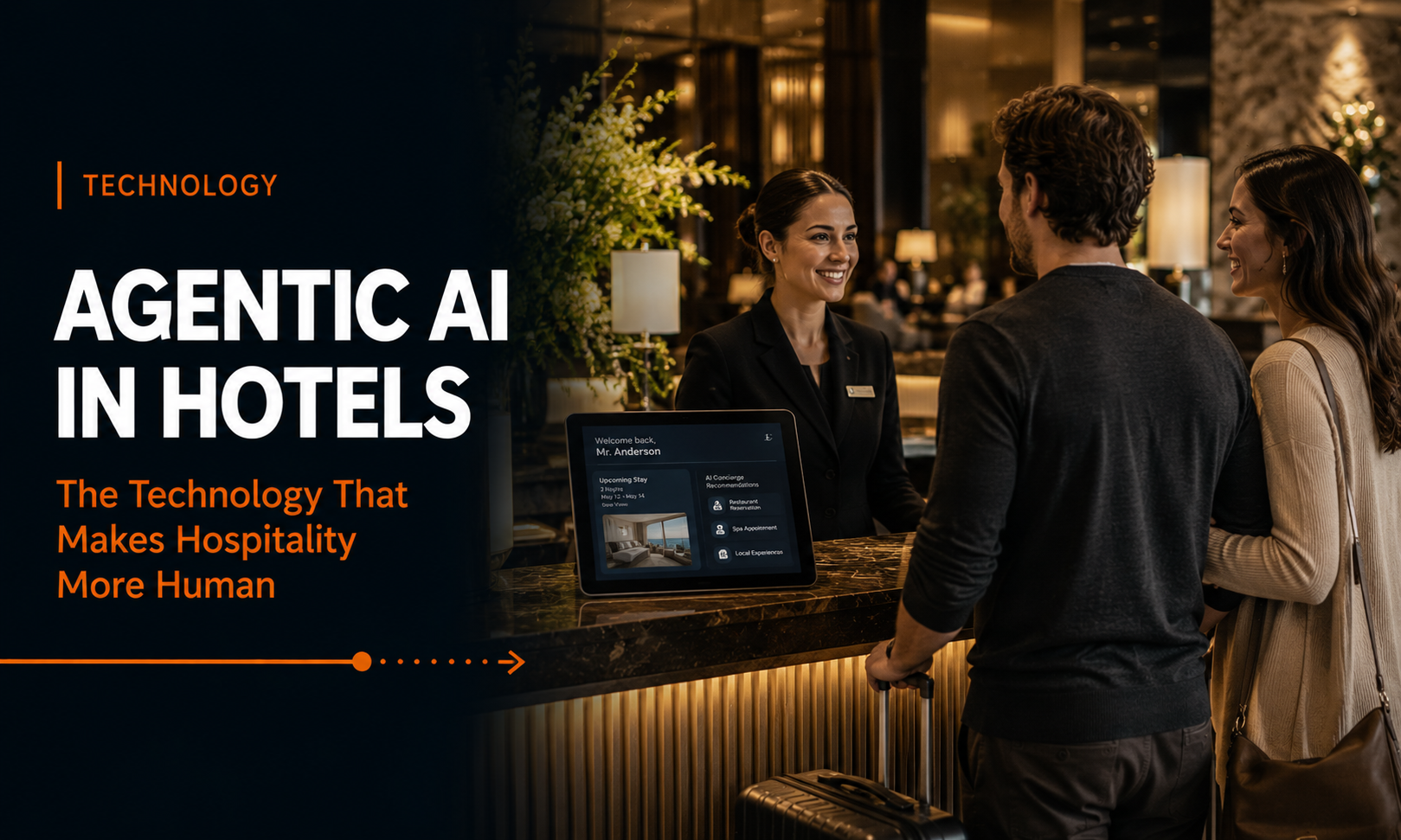
The hotel industry has a paradox: the more we aim for personalization, the more we bury staff in administration.
Preferences are scattered. Guest context lives in multiple tools. Requests arrive through every channel. And the team—front office, reservations, housekeeping, F&B—spends valuable minutes collecting information instead of creating connection.
Agentic AI changes that. Not because it’s “smarter automation,” but because it introduces a new operating model: software that can take a goal (“prepare for this guest’s arrival”) and execute coordinated steps across your digital ecosystem—while keeping humans in control.
Done right, agentic AI doesn’t replace hospitality. It protects it.
What “agentic AI” actually means in a hotel context
Think of agentic AI as an orchestrator, not a single feature.
Instead of only answering questions, it can:
- pull context (reservation, history, preferences, disruptions, spend patterns)
- trigger actions (create tasks, update notes, route tickets, send messages, propose offers)
- learn from outcomes (was the offer accepted? did the issue recur? what improves satisfaction?)
It’s the difference between:
- “Here’s an answer.”
and - “I handled it—and I documented it across the systems your team uses.”
The operational problem it solves: “information work”
Most friction in hotel operations is not “service work.” It’s information work:
- hunting down guest details
- re-typing the same information
- answering repetitive questions
- manually coordinating between departments
- inconsistent handovers between shifts and properties
A global hotel-chain report (171 unique hotel chains) shows adoption is happening, but execution is fragmented: 78% use AI today, 89% plan more, yet only 8% have a formal, company-wide strategy.
That gap is your opportunity: the winners won’t be the hotels that “try AI.”
They’ll be the hotels that operationalize it.
Where the value shows up (with hard numbers)
1) Cost-to-serve drops without cutting service
McKinsey estimates that applying generative AI to customer care can increase productivity by ~30–45% of current function costs.
In hotel terms, that translates to:
- fewer repetitive calls/messages reaching the front desk
- faster resolution time
- less night-shift pressure for routine questions
- cleaner escalation to humans for complex or emotional cases
Case studies in hospitality also show large deflection potential (example: one hospitality chatbot case reports 72% of queries handled without agent assistance). Treat these as directional, not guaranteed—results depend on integration and content quality.
2) Personalization drives measurable revenue lift
McKinsey’s research on personalization shows it most often drives ~10–15% revenue lift (execution-dependent).
Hotels feel this lift through:
- higher direct conversion
- improved satisfaction (fewer “repeat explanations”)
- more relevant add-ons (late checkout, breakfast, parking, spa, room category upgrades)
3) Upselling scales across the portfolio (not just with your best receptionist)
One of the most underappreciated benefits of agentic AI is portfolio consistency:
- the same guest recognized across properties
- the same preferences carried over
- the same offer logic and brand standards applied
Hotel chains themselves signal this direction: in the h2c study, 54% plan AI-supported upselling and 49% plan personalized booking in the next 12–24 months.
And when conversational AI is paired with upsell tooling, some groups report very large conversion improvements (again: case-study results, not universal).
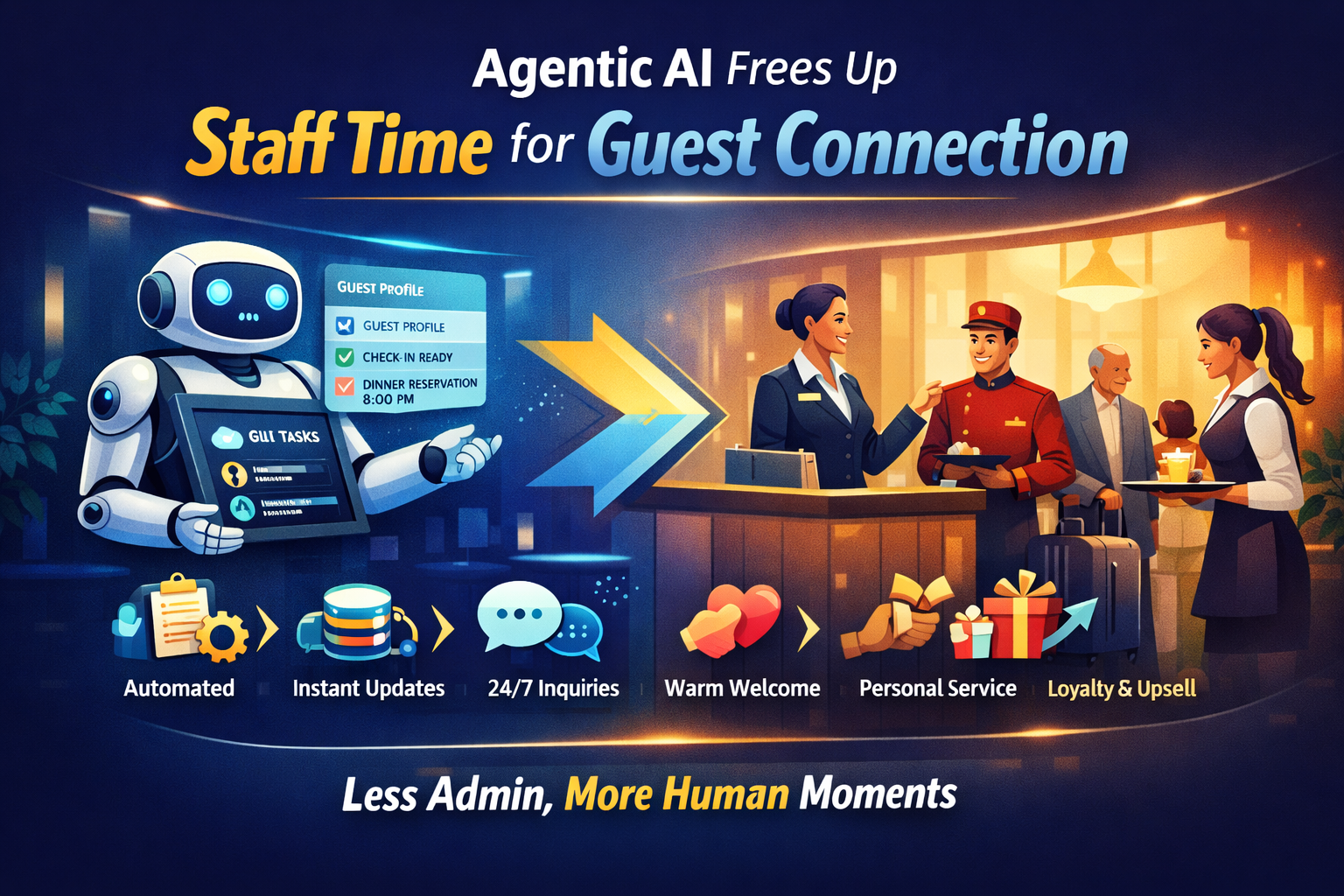
The real “plot twist”: AI increases human-to-human contact
When AI agents absorb the repetitive work, staff time shifts to what guests actually remember:
- warm arrivals
- proactive recovery
- genuine recommendations
- relationship-building that leads to loyalty
This is the message teams need to hear clearly:
Agentic AI is not a headcount strategy. It’s a hospitality strategy.
Because the experience improves precisely where humans are irreplaceable: empathy, judgment, presence.
How to operationalize agentic AI with your existing infrastructure
You don’t need to replace your entire stack. You need a thin orchestration layer plus strong governance.
Step 1: Pick “connected moments” across the guest journey
Start where information work is heavy and value is immediate:
- pre-arrival questions + special requests
- check-in coordination (ETA, room readiness)
- in-stay requests (maintenance, housekeeping, amenities)
- post-stay feedback + service recovery
Step 2: Integrate the minimum systems for a unified guest context
Typically:
- PMS (reservation, stay history, room status)
- CRM / loyalty (member status, preferences, lifecycle)
- Guest messaging (WhatsApp/SMS/app chat/email routing)
- Ops ticketing (maintenance/housekeeping tasks)
Optionally later: - POS / spa / golf / outlets for richer personalization and upsell targeting
The h2c report flags data silos and incomplete integrations as core blockers to personalization—so treat integration as a value prerequisite, not an IT nice-to-have.
Step 3: Define guardrails (this is where trust is built)
- consent + privacy rules (what can be used for personalization)
- human-in-the-loop thresholds (when must the AI escalate)
- brand voice + service recovery policies
- logging (what actions were taken, by whom/what)
Step 4: Train staff like you’re introducing a new team member
The same study shows lack of AI expertise (62%) is a bigger barrier than the tech itself.
Training that works:
- role-based playbooks (front office vs reservations vs housekeeping leaders)
- escalation training (“what the AI handles, what I handle”)
- quality loops: weekly review of misroutes, missed intents, bad offers
- KPI literacy: staff should understand what “deflection,” “AHT,” “conversion,” and “guest sentiment” mean operationally
Step 5: Measure outcomes with a hotel-operator scoreboard
Minimum KPIs:
- % of inquiries resolved without staff (“deflection”)
- average response time (by channel)
- ticket cycle time (maintenance/housekeeping)
- upsell conversion and ancillary revenue per occupied room
- loyalty metrics: repeat rate, member enrollment, direct share, NPS/comment sentiment
Notably, 42% of chains don’t track AI ROI at all—which is why pilots stall. Make measurement non-negotiable.
A simple recommendation for hotel leaders
If you take only one idea from this:
Deploy agentic AI to protect your team’s attention.
Attention is the scarce resource in hospitality.
Not data. Not tools. Not even time.
When staff are freed from collecting information, they can do what guests came for in the first place: be hosted by a human.