

Why the future of hospitality may no longer start with your homepage
For more than two decades, hospitality brands have optimized websites, booking engines, loyalty platforms, CRM ecosystems and digital campaigns to guide guests through carefully orchestrated customer journeys.
But what happens when the customer journey no longer starts on your website?
What happens when AI agents begin researching, comparing, negotiating, booking, upselling and even servicing customers autonomously?
Welcome to the era of Agentic AI combined with Headless 360 architecture — where experiences become modular, intelligent and frictionless across every touchpoint.
And yes: this changes everything for hospitality brands.
What Is Agentic AI?
Unlike traditional AI systems that simply answer prompts, Agentic AI acts autonomously toward goals.
It can:
- plan tasks
- gather information
- make decisions
- trigger workflows
- communicate across systems
- learn from context
- optimize outcomes continuously
Think of it less as a chatbot and more as a digital concierge, sales manager, operations assistant and customer advisor combined.
Now combine this with a modern Headless 360 ecosystem.
What Is Headless 360?
Headless architecture separates the frontend experience from backend systems.
Instead of one monolithic website controlling everything, APIs connect:
- CRM
- PMS
- booking engine
- loyalty systems
- content platforms
- payment systems
- event tools
- marketing automation
- customer data platforms
- AI orchestration layers
The result?
Experiences can happen anywhere.
Inside:
- voice assistants
- wearables
- automotive systems
- travel platforms
- AI agents
- smart TVs
- airport apps
- virtual concierges
- mixed reality interfaces
The website becomes only one interface among many.
Sometimes not even the primary one anymore.
A Hospitality Example: The AI-Driven Luxury Weekend
Imagine a guest planning a spontaneous long weekend.
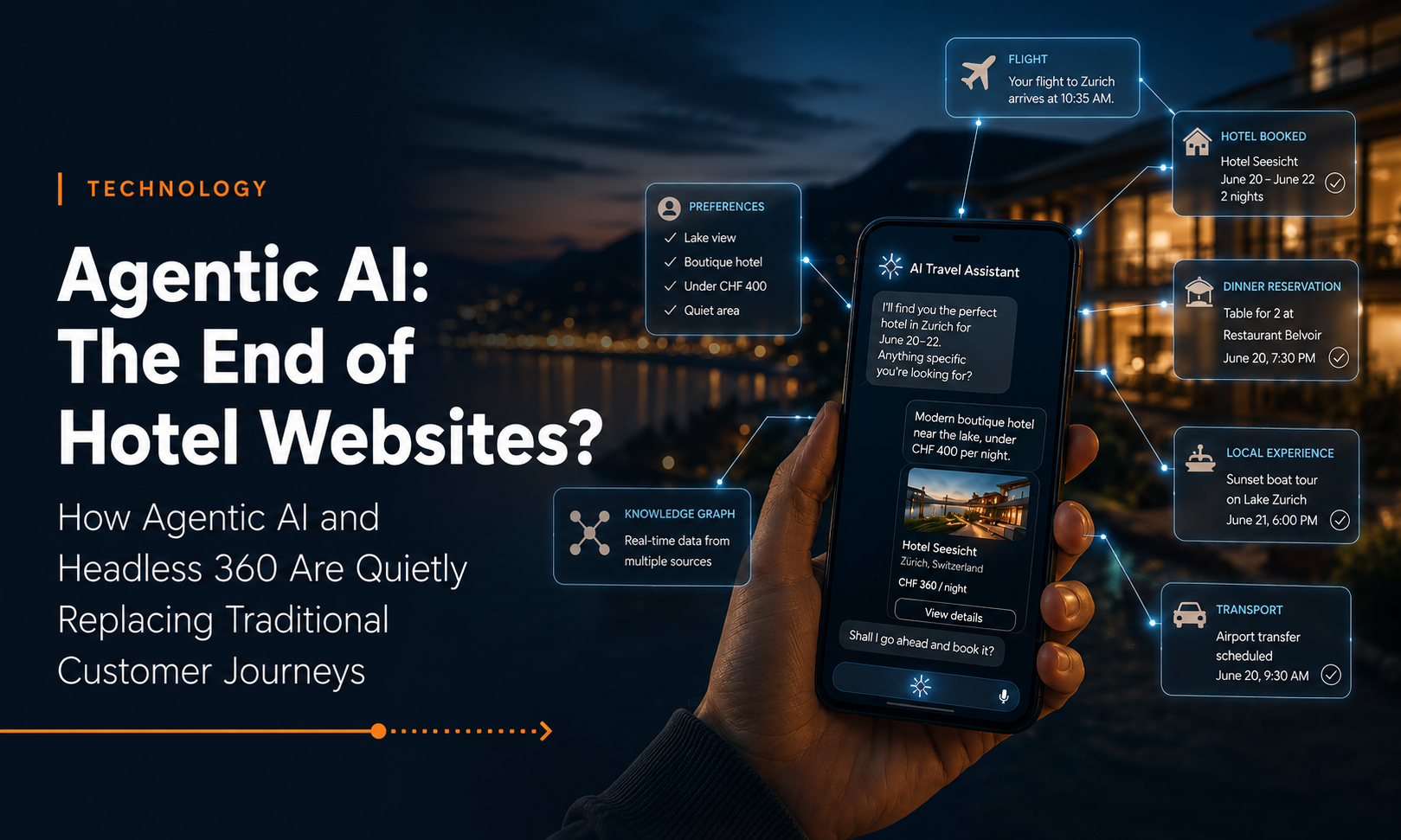
Instead of browsing 14 hotel websites, comparing rates manually and checking review platforms, the guest simply tells their personal AI assistant:
“Find me a quiet luxury spa hotel within 3 hours of Frankfurt with great food, late checkout, hiking nearby and a suite under €900.”
The AI agent now:
- checks calendar availability
- analyzes preferences
- compares reviews
- evaluates loyalty benefits
- negotiates rates dynamically
- books transportation
- reserves dinner
- schedules spa treatments
- syncs everything into the guest calendar
The hotel’s Headless 360 ecosystem enables all of this seamlessly through APIs.
No lengthy website navigation.
No call center.
No repetitive form filling.
The experience becomes invisible.
And that is exactly the point.
Why This Is a Massive Opportunity for Hospitality Brands
1. Frictionless Customer Experience
The modern customer values simplicity more than ever.
Agentic AI reduces:
- search friction
- booking complexity
- repetitive interactions
- waiting times
- service inconsistencies
The guest feels understood instantly.
That creates emotional loyalty.
2. Hyper-Personalization at Scale
Traditional personalization was mostly segmentation.
Agentic AI enables contextual personalization in real time.
Examples:
- room preferences automatically applied
- dynamic dining recommendations
- wellness suggestions based on stress indicators
- family experiences adapted to children’s age
- personalized itineraries based on weather and behavior
This moves hospitality closer to true anticipatory service.
3. Operational Efficiency
Hotels struggle globally with:
- staffing shortages
- rising operational costs
- inconsistent service delivery
AI agents can automate:
- reservation handling
- FAQ communication
- internal task coordination
- upselling workflows
- multilingual guest communication
- post-stay feedback loops
Teams can focus more on high-value guest interaction instead of administrative repetition.
4. Omnichannel Becomes Reality
Many brands still talk about omnichannel.
Few truly execute it.
Headless 360 finally enables consistent experiences across:
- web
- app
- social
- voice
- messaging
- partner ecosystems
- in-room systems
- physical touchpoints
The customer journey becomes continuous instead of fragmented.
But Here Comes the Dangerous Part
The hospitality industry must be careful not to automate away its humanity.
Because luxury hospitality is not only about efficiency.
It is about emotion.
And emotion remains deeply human.
Where Human Service Still Wins
Emotional Intelligence
AI can recognize sentiment patterns.
But it cannot genuinely empathize.
A great concierge understands nuance:
- nervousness before a proposal
- cultural sensitivity
- emotional tone
- unspoken expectations
- moments requiring discretion
Human intuition still creates magic.
Authentic Relationships
Guests remember:
- names
- smiles
- conversations
- humor
- warmth
- empathy
- anticipation
Not API response times.
Especially in luxury hospitality, relationships are still the real differentiator.
Complex Problem Solving
AI performs exceptionally well in structured environments.
But hospitality is often chaotic.
Examples:
- flight cancellations
- emotional complaints
- VIP sensitivities
- family emergencies
- weather disruptions
- cultural misunderstandings
Experienced staff navigate ambiguity with creativity and emotional judgment.
That remains difficult to automate fully.
Brand Soul Cannot Be Automated
Many brands risk becoming technically efficient but emotionally interchangeable.
If every hotel uses similar AI systems, the true differentiator becomes:
- people
- culture
- service mindset
- storytelling
- atmosphere
- authenticity
Technology scales operations.
Humans create memories.
The Real Future: AI-Augmented Hospitality
The future is probably not AI versus humans.
It is AI-enhanced humans.
The winning hospitality brands will:
- automate repetitive complexity
- empower employees with better insights
- reduce operational friction
- free teams for meaningful interaction
In other words:
Less administration.
More hospitality.
That is where the real opportunity lies.
Strategic Questions Hospitality Leaders Should Ask Now
Is your current architecture API-ready?
Many legacy hotel systems are still heavily fragmented.
Without modern API connectivity, agentic ecosystems become difficult to scale.
Who owns the customer relationship in an AI-agent world?
If AI assistants become the primary booking interface, brands risk losing direct customer ownership.
That changes:
- loyalty economics
- acquisition models
- SEO strategies
- media investments
- distribution power
A massive shift may already be underway.
Is your organization culturally ready?
Technology transformation is rarely the hardest part.
Mindset transformation is.
Future-ready hospitality organizations need:
- agile structures
- data literacy
- service innovation culture
- interdisciplinary collaboration
- AI governance frameworks
Final Thought
Hospitality has always evolved alongside technology.
From telephone reservations to online booking.
From desktop to mobile.
From transactional CRM to experience ecosystems.
Agentic AI combined with Headless 360 may become the next major shift.
The brands that succeed will not simply deploy more AI.
They will redesign experiences around seamless human-centric journeys.
Because in the end, guests rarely remember the technology.
They remember how the experience made them feel.
And that is still profoundly human.