

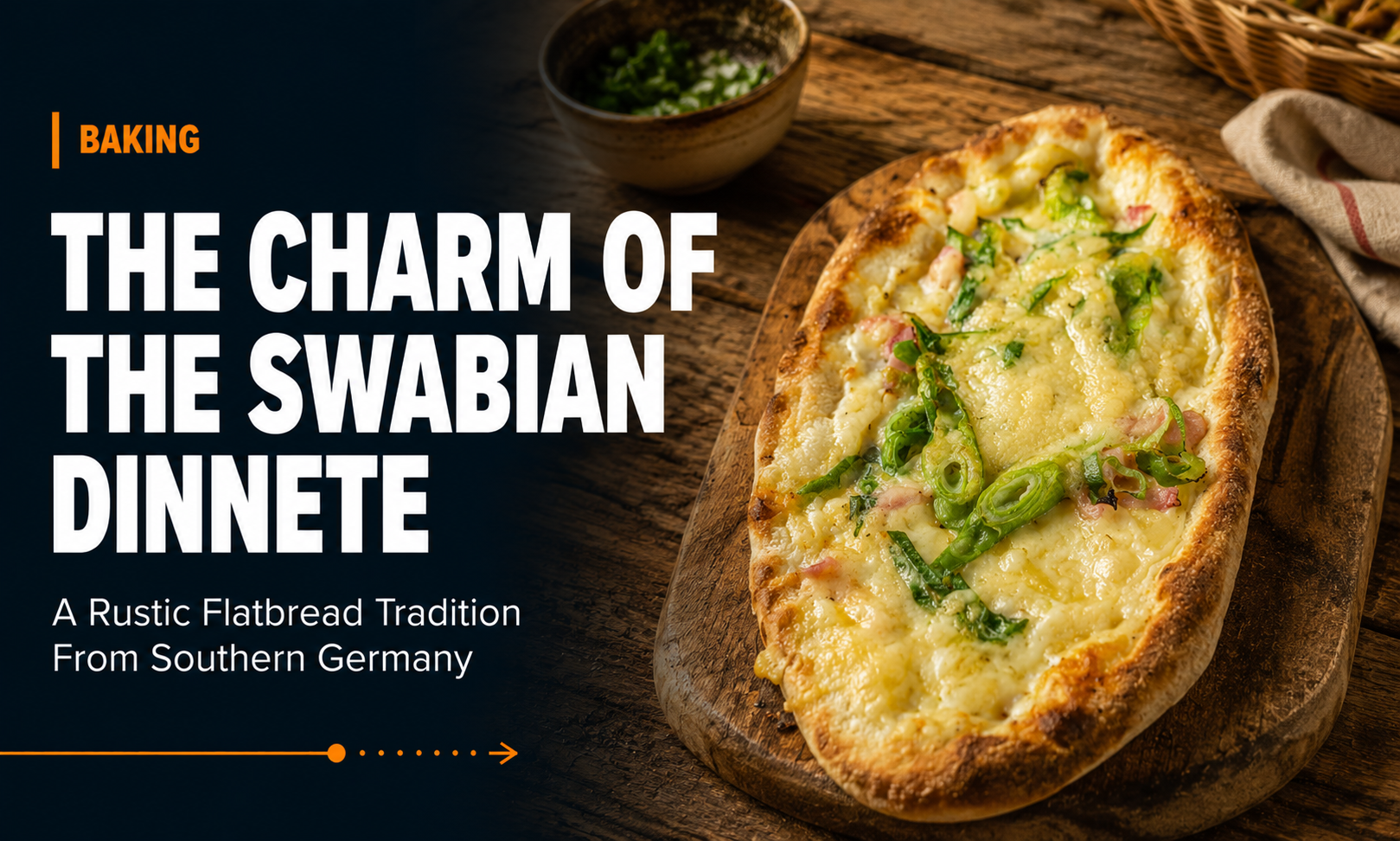
There are dishes that feed us, and dishes that connect us — and the Dinnete is unmistakably the latter. This rustic Swabian flatbread, with its crisp edges, creamy topping, and comforting aroma, is woven into the everyday life and heritage of southern Germany. What began as a simple, practical way to use up bread dough has become a culinary symbol of warmth, family, and tradition.
The Dinnete is the kind of food that doesn’t need a grand presentation. It’s the food you bake on market days, the treat you look forward to at village festivals, and the dish that transports you instantly back to a grandmother’s kitchen with its wood-fired oven and slow-rising dough. Its charm lies in its simplicity — a handcrafted dough, a topping of cream, onions, bacon, or potatoes, and the gentle heat of a hot oven turning it into something deeply satisfying.
Whether you’re tasting it for the first time or rediscovering it from childhood memories, the Dinnete reminds us of the beauty of traditional cooking: humble ingredients, honest flavors, and a dish meant to be shared.

A Short History of the Dinnete
The Dinnete (also spelled Dinnete, Dinnele, Dünnele, or Dinette depending on the region) originates from Swabia, a cultural region in southwestern Germany covering parts of Baden-Württemberg and Bavaria. Its roots reach back to centuries-old baking traditions, when families baked bread just once a week.
Before placing the large loaves into the wood-fired oven, bakers tested the oven temperature by baking small pieces of dough topped with cream, onions, or potatoes. These “test breads” soon became beloved snacks of their own — the early ancestors of today’s Dinnete.
Over time, the dish spread across rural villages and market towns, especially in regions like the Swabian Alb, Oberschwaben, and the Allgäu. Each area developed its own variation in shape, topping, and name. Market stalls and bakeries started selling Dinnete on festival days and weekly markets, turning it into a true regional specialty.
Today, the Dinnete continues to be a highlight at Swabian Christmas markets, village fairs, and harvest festivals, and it’s increasingly appreciated in home kitchens across Germany and beyond. Despite modern adaptations, the essence of the dish remains unchanged: handmade, hearty, and deeply rooted in tradition.
Classic Swabian Dinnete Recipe
(Yields 4 Dinnete – ideal for 4–6 people)
Ingredients
For the dough:
- 300 g wheat flour (Type 550 recommended)
- 150 g spelt flour (optional, for a nutty flavor)
- 250–300 ml lukewarm water
- 21 g fresh yeast (or ½ packet dry yeast)
- 1 tsp sugar
- 1 tsp salt
- 1 tbsp olive oil
For the classic savory topping:
- 200–250 g sour cream or crème fraîche
- 1–2 onions, sliced into thin rings
- 150–200 g smoked bacon cubes (can substitute pancetta)
- Optional: 100–150 g grated cheese (Emmental, Bergkäse, or similar)
- Salt & pepper
- Optional spices: pinch of nutmeg, caraway seeds
Instructions
1. Prepare the dough
In a large bowl, combine the flours and salt. Dissolve the yeast and sugar in about 100 ml of the lukewarm water, then pour the mixture into a well in the center of the flour. Add the remaining water and olive oil, then knead into a smooth, elastic dough.
Cover and let it rise for about 1 hour, or until doubled in size.
2. Divide and shape
Divide the dough into 4 equal portions and shape them into balls. Let them rest for 10 minutes, then roll each piece into a thin oval or round base, about 3–5 mm thick.
3. Preheat the oven
Preheat your oven to 230–250°C (445–480°F).
For the crispiest result, use a preheated pizza stone or baking steel.
4. Add the toppings
Spread a thin layer of sour cream or crème fraîche over each dough base.
Top with onion rings, bacon cubes, and optional cheese.
Season with salt, pepper, and a hint of nutmeg or caraway if desired.
5. Bake
Bake each Dinnete for 12–15 minutes, or until the edges are crisp and golden and the toppings are lightly caramelized.
6. Serve hot
Dinnete tastes best straight from the oven. Serve warm as a snack, light dinner, or sharing platter with friends and family.
Optional Variations
- Potato Dinnete (creamy, hearty, traditional)
- Cheese & Herb Dinnete
- Vegetarian Onion & Chive Dinnete
- Sweet Apple & Cinnamon Dinnete