
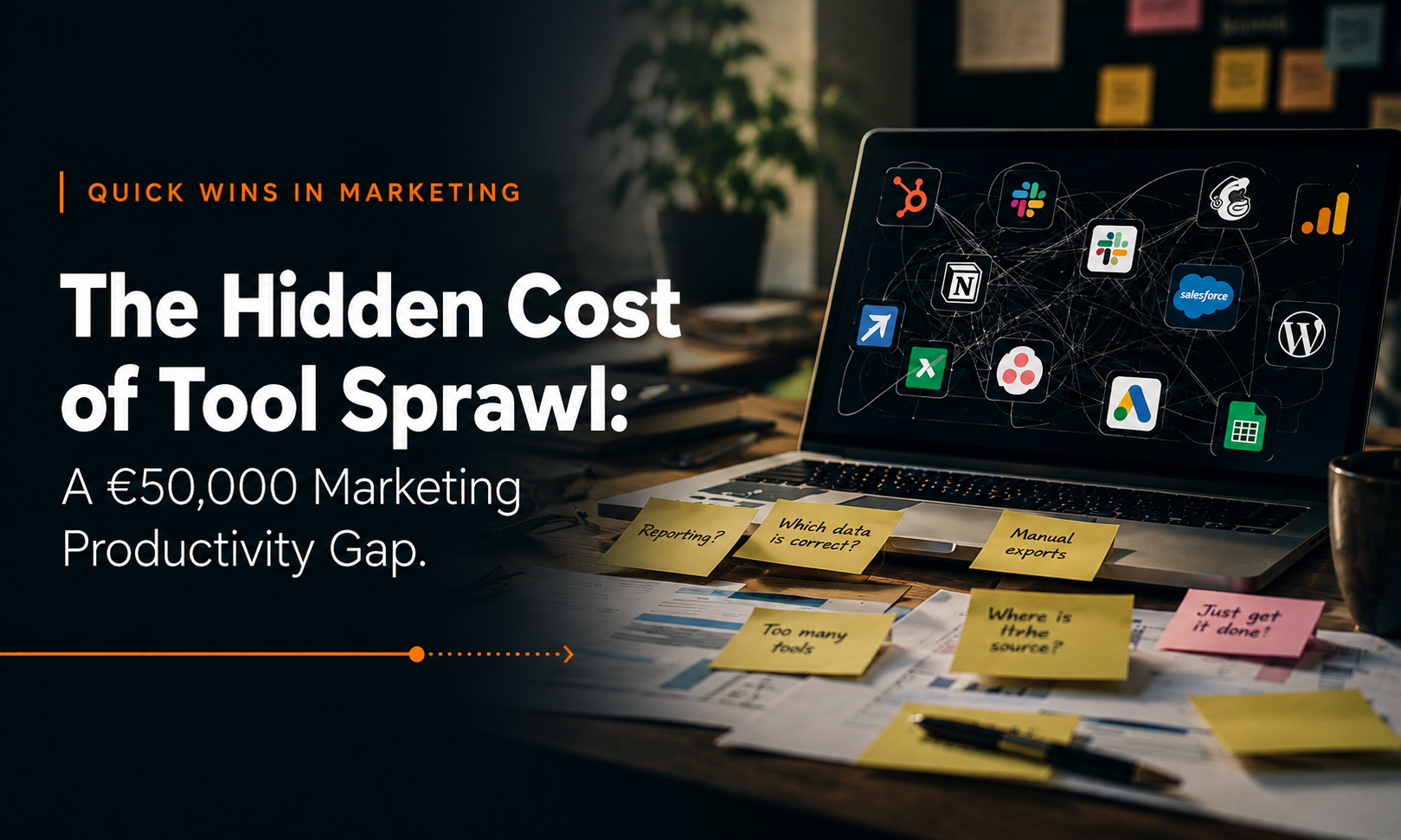
“The most expensive software in your company is often the software you already own.”
When organizations discuss productivity, the conversation quickly turns to Artificial Intelligence.
How can AI create content faster?
How can AI summarize meetings?
How can AI automate workflows?
Those are valid questions.
But they often overlook a much bigger productivity problem:
Tool Sprawl.
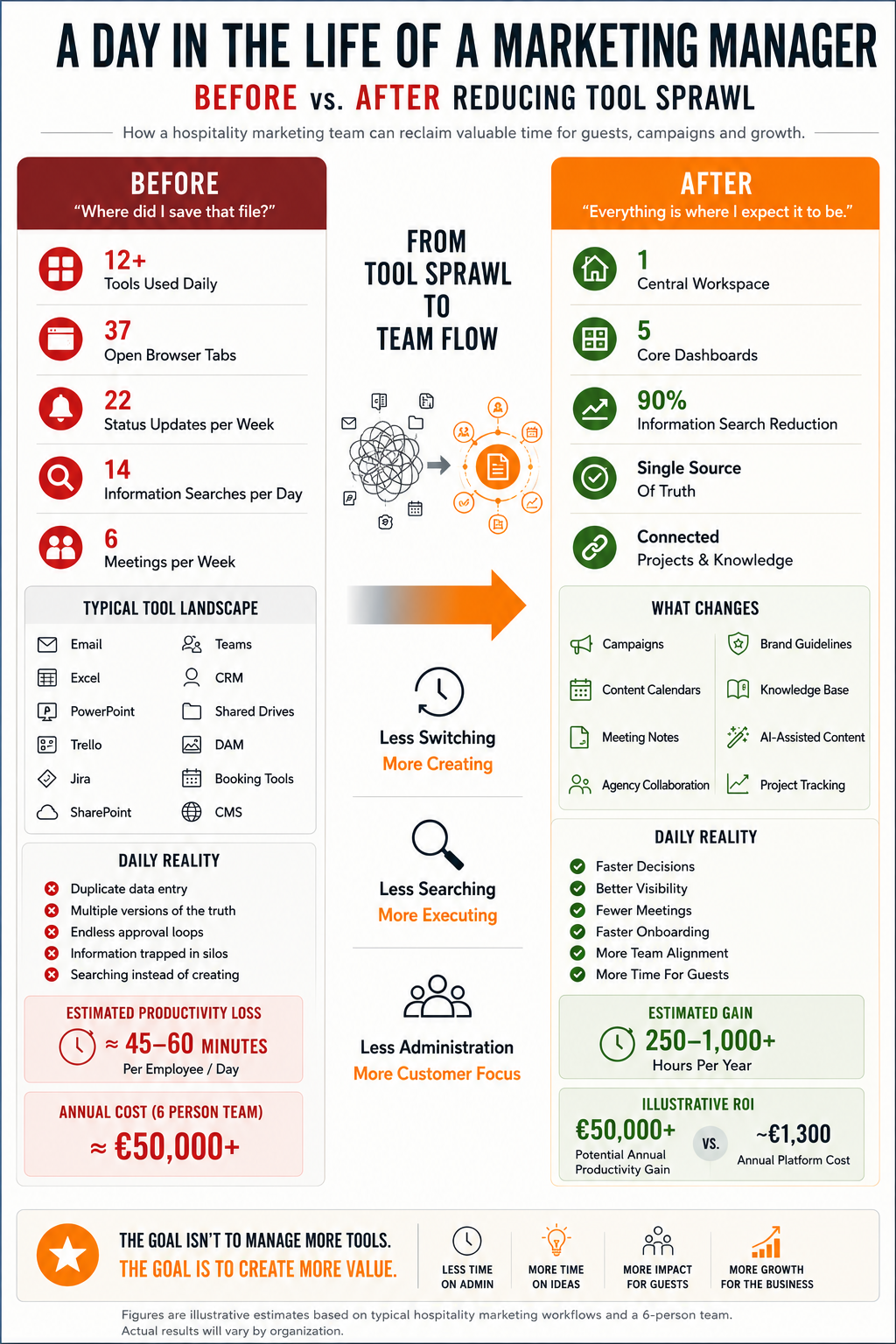
The average marketing department in the hospitality industry works across a growing ecosystem of disconnected systems:
- Teams or Slack
- Excel
- PowerPoint
- Trello
- Jira
- SharePoint
- CRM Systems
- Asset Libraries
- Booking Platforms
- Content Calendars
- Project Management Tools
Each platform solves a specific problem.
Collectively, they often create friction, duplication and hidden costs.
The Hospitality Marketing Reality
Imagine a hotel group operating:
- 8 properties
- 4 brands
- 6 marketing team members
- Multiple agencies
- Regional sales teams
- Seasonal campaigns and promotions
The team manages:
- Social media
- Website content
- Email marketing
- Events
- Partnerships
- CRM campaigns
- Brand communications
At first glance, everything appears organized.
In reality, information is scattered across multiple tools.
The result?
Highly qualified marketing professionals spend valuable time searching, updating, copying and coordinating instead of focusing on guests, campaigns and growth.
Where Productivity Gets Lost
Let’s look at a few common marketing activities.
Assumption:
- Marketing Manager hourly rate (fully loaded): €50/hour
- Team size: 6 people
- Working days per year: 220
Example 1: Weekly Status Meetings
Before
Preparing updates from:
- Excel
- Trello
- Agency reports
- CRM dashboards
Average preparation time:
45 minutes per person
6 people
Weekly effort:
4.5 hours
Annual effort:
234 hours
Annual cost:
€11,700
After (Centralized Workspace)
Single dashboard
Connected project status
Shared visibility
Preparation time:
10 minutes per person
Annual effort:
52 hours
Annual cost:
€2,600
Annual Saving
182 hours
€9,100
Example 2: Campaign Planning
Before
Campaign assets spread across:
- PowerPoint
- Excel
- Shared drives
Searching for information:
30 minutes per campaign
100 campaigns annually
50 hours
€2,500
After
Campaigns documented in one location
Search time reduced to:
5 minutes
8 hours annually
€400
Annual Saving
42 hours
€2,100
Example 3: Onboarding New Team Members
Before
Knowledge distributed across:
- Colleagues
- Drives
- Emails
- Various systems
Average onboarding effort:
20 hours
3 hires annually
60 hours
€3,000
After
Centralized playbooks
Templates
Knowledge base
8 hours onboarding effort
24 hours annually
€1,200
Annual Saving
36 hours
€1,800
Example 4: Agency Collaboration
Before
Feedback loops through:
- Teams
- Calls
- Shared documents
Average:
4 hours weekly
Annual:
208 hours
€10,400
After
Shared project workspace
Single source of truth
Reduced effort:
2 hours weekly
Annual:
104 hours
€5,200
Annual Saving
104 hours
€5,200
Example 5: Content Production
Before
Finding assets
Locating previous campaigns
Checking approvals
Average:
20 minutes per content piece
500 assets annually
167 hours
€8,350
After
Centralized content hub
5 minutes per asset
42 hours
€2,100
Annual Saving
125 hours
€6,250
Total Estimated Annual Impact
| Area | Annual Saving |
| Meeting Preparation | €9,100 |
| Campaign Planning | €2,100 |
| Onboarding | €1,800 |
| Agency Collaboration | €5,200 |
| Content Production | €6,250 |
| Total | €24,450 |
And these examples only cover a fraction of daily activities.
When additional workflows are included—budget approvals, reporting, content reviews, knowledge management, event planning and AI-supported content creation—the potential annual productivity gain can easily exceed:
€50,000+ per year
for a mid-sized hospitality marketing team.
What About the Cost?
Let’s assume:
Notion Business Plan
Approx. €18 per user/month
6 users
Annual cost:
€1,296
Even if implementation required:
- Initial setup
- Training
- Migration
The investment remains small compared to the productivity gains.
Illustrative ROI
Annual Productivity Gain:
€50,000
Annual Platform Cost:
€1,296
Potential ROI:
More than 3,700%
Few marketing initiatives deliver this level of return.
The Bigger Benefit
The true value is not cost reduction.
The true value is attention.
Less time searching.
Less time reporting.
Less time updating.
More time:
- Creating memorable guest experiences
- Developing stronger campaigns
- Supporting sales teams
- Building brand value
- Driving revenue
Technology should remove friction.
Not create it.
Final Thought
AI may become the most transformative technology of this decade.
But before adding another AI tool to your stack, ask yourself:
How many hours does your team spend every week moving information between systems?
The answer may reveal your biggest untapped productivity opportunity.
Interested in learning more about operational efficiency, customer experience and marketing transformation?
Explore Notion:
https://www.notion.so
Disclaimer: The calculations shown are illustrative examples based on typical hospitality marketing workflows and intended to demonstrate potential productivity impacts. Actual results will vary depending on organizational structure, processes and technology landscape.