Practical ideas. Clear takeaways. Measurable impact.
Short, actionable perspectives on marketing challenges, tools and opportunities that can make a difference.
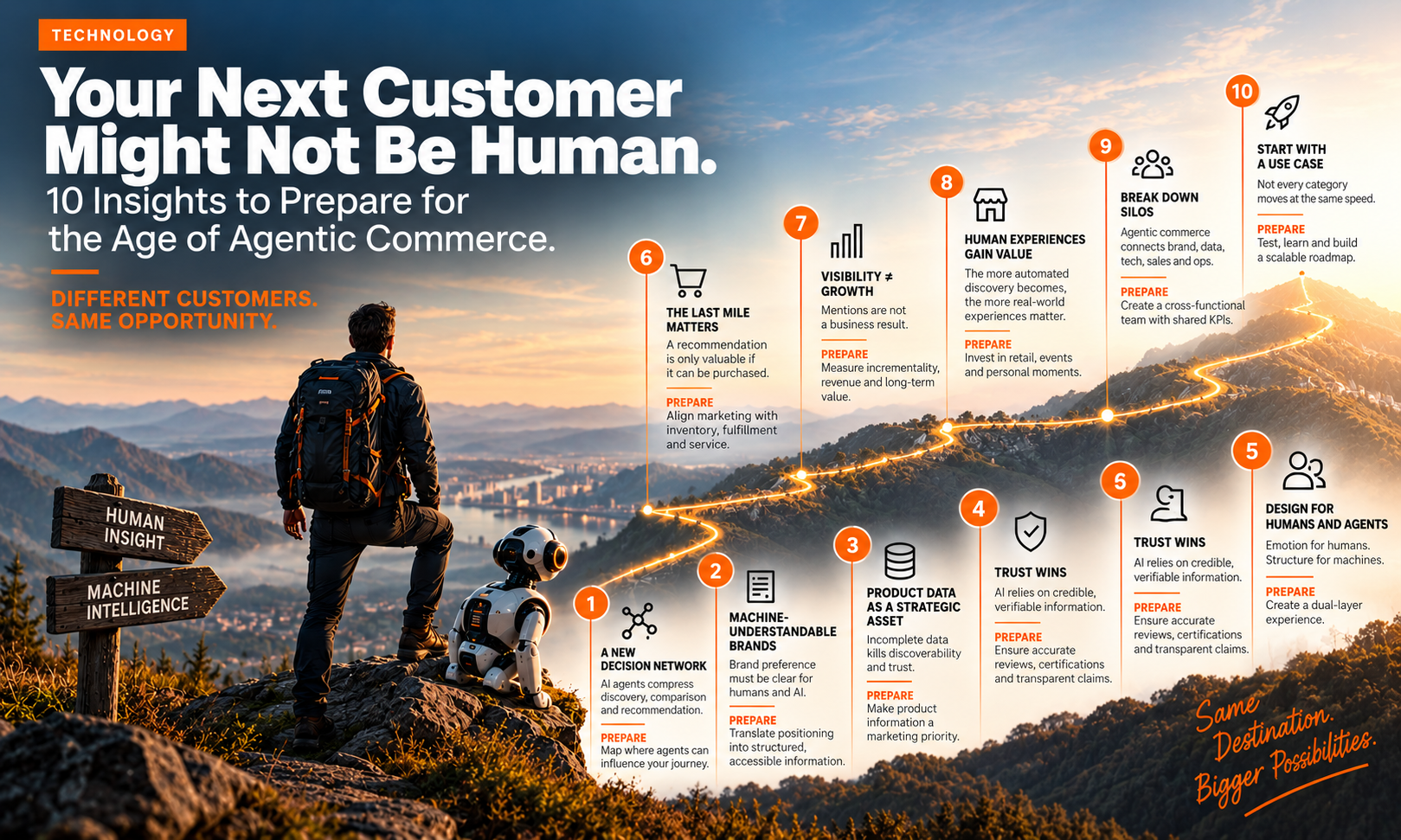
10 insights marketing leaders should prepare for in the age of agentic commerce
By Andreas Zschischang | September 9, 2026
The next major shift in marketing may not be another channel, platform or content format. It may be a new participant in the customer journey: the AI agent.
10 insights to prepare the age of agentic commerce.
The latest Future Marketing Index, published on September 8, 2026, places Agentic AI directly at number two among current marketing trends. Half of respondents consider it relevant today, rising to 61% when looking ahead. With DMEXCO 2026 approaching under the theme “Scaling Intelligence”, the conversation is moving from experimentation toward measurable business value.
But what happens to brand preference when an AI assistant researches, compares and potentially purchases on behalf of a customer?
My view: the future is not Brand vs. AI. It is Brand + AI. Marketing must prepare for a world in which human emotion and machine-readable relevance work together.
1. The customer journey is becoming a decision network
The traditional funnel assumes that people move through a sequence of touchpoints. AI agents can compress discovery, comparison and recommendation into a single interaction.
Prepare: Map where an agent could influence your existing journey, from initial research to post-purchase support.
2. Brand preference must become machine-understandable
A strong brand creates associations in the human mind. An AI agent also needs accessible, reliable information to understand why a product is relevant.
Prepare: Translate your positioning into clear product attributes, use cases, differentiators and trustworthy content without losing the emotional brand story.
3. Product data is becoming a marketing asset
Incomplete specifications, inconsistent descriptions and outdated availability can undermine discoverability and recommendation quality.
Prepare: Treat product information management as a strategic capability shared by marketing, commerce and IT, not merely an operational database.
4. Trust will become a competitive signal
AI-assisted recommendations depend on information that can be assessed. Reviews, transparent policies, credible claims and consistent brand information may influence how products are evaluated.
Prepare: Audit the evidence behind your claims and ensure that reviews, certifications, service policies and product details are accurate and accessible.
5. The experience must work for humans and agents
Humans value inspiration, reassurance and memorable experiences. Agents require structured information, clear options and reliable processes. These needs are different, but complementary.
Prepare: Design a dual-layer experience: emotionally compelling for people and functionally understandable for machines.
6. The last mile matters more than ever
A recommendation is only valuable if the product can actually be purchased. Poor availability, unclear delivery information or a complicated checkout can break the journey.
Prepare: Connect marketing promises with inventory, pricing, fulfillment and customer service. The entire commercial experience becomes part of the brand.
7. AI visibility is not the same as business growth
Being mentioned by an AI system is not automatically a commercial success. The important question is whether AI-assisted discovery generates qualified demand, profitable sales and long-term customers.
Prepare: Develop measurement beyond rankings and mentions, including qualified traffic, conversion, incremental revenue, margin and customer lifetime value.
8. Human experiences may become more valuable
As digital discovery becomes increasingly automated, physical and personal experiences can provide differentiation that is difficult to reduce to a product comparison.
Prepare: Invest selectively in retail, events, demonstrations, expert advice and other moments where customers can experience the brand rather than simply evaluate its attributes.
9. Marketing can no longer prepare in silos
Agentic commerce connects brand strategy, content, data, technology, legal, sales and operations. A campaign team alone cannot solve the underlying readiness challenge.
Prepare: Establish a cross-functional working group with clear ownership, practical use cases and shared commercial KPIs.
10. Start with a use case, not an AI transformation slogan
The market is still evolving. Not every category will adopt autonomous purchasing at the same speed, and customers will retain different levels of control depending on the purchase.
Prepare: Select one product category or customer journey, test AI-assisted discovery and comparison, identify the gaps and build a measurable roadmap before scaling.
The strategic question
The brands that succeed will not necessarily be those producing the most AI-generated content or deploying the largest number of agents. They will be those that combine a distinctive brand with reliable data, connected commerce and a customer experience that delivers on its promise.
DMEXCO’s “Scaling Intelligence” is therefore a useful challenge for marketing leaders: move beyond the technology itself and ask where intelligence creates real customer and business value.
The next customer journey may not be entirely human. The responsibility to create a meaningful brand experience still is.
Further reading and event references
BVDW, Marketing-Trends 2026: Agentische KI steigt in Top 3 ein, September 8, 2026.
DMEXCO 2026, Scaling Intelligence, September 23–24, Cologne.
DMEXCO session, Agentic Commerce: Wenn KI einkauft, September 23, 2026.
DMEXCO keynote, The Hidden Intelligence Behind AI Assisted Commerce, September 23, 2026.
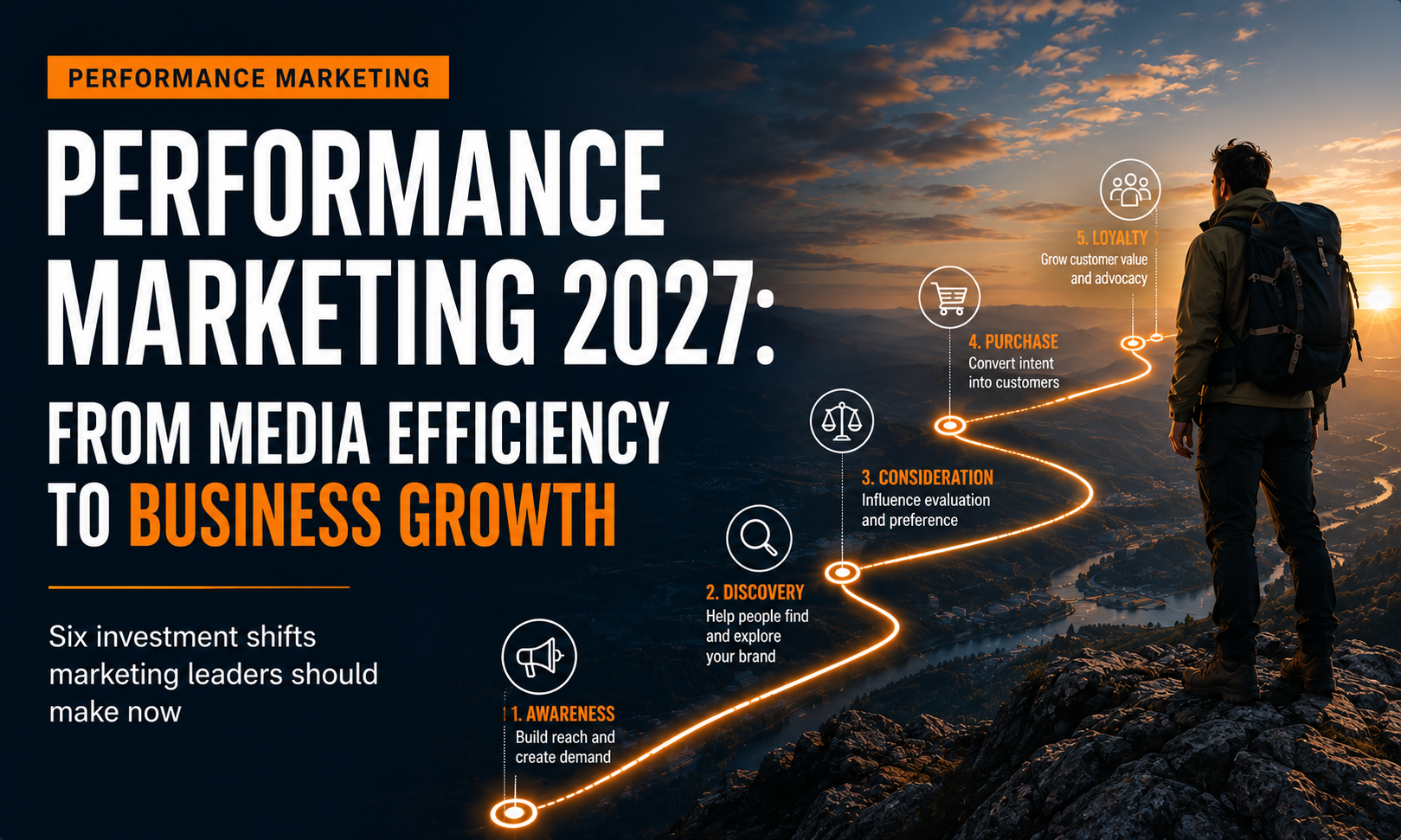
Six investment shifts marketing leaders should make now
Performance marketing has earned its seat at the management table.
It brought accountability into marketing. It connected investment with outcomes. And it gave us a common language of CTR, CPC, CPA, conversion and ROAS.
But there is a problem.
We have become incredibly good at optimizing what we can measure. That doesn’t necessarily mean we are investing in what creates the most growth.
This isn’t an argument against performance marketing.
Quite the opposite.
As marketing leaders plan for 2027, I believe we need to expand our definition of performance.
Because the next competitive advantage may not come from another 5% improvement in CPC, another automated bidding strategy or another platform added to the media plan.
It may come from making fundamentally better investment decisions.
Welcome to Performance Marketing 2027.
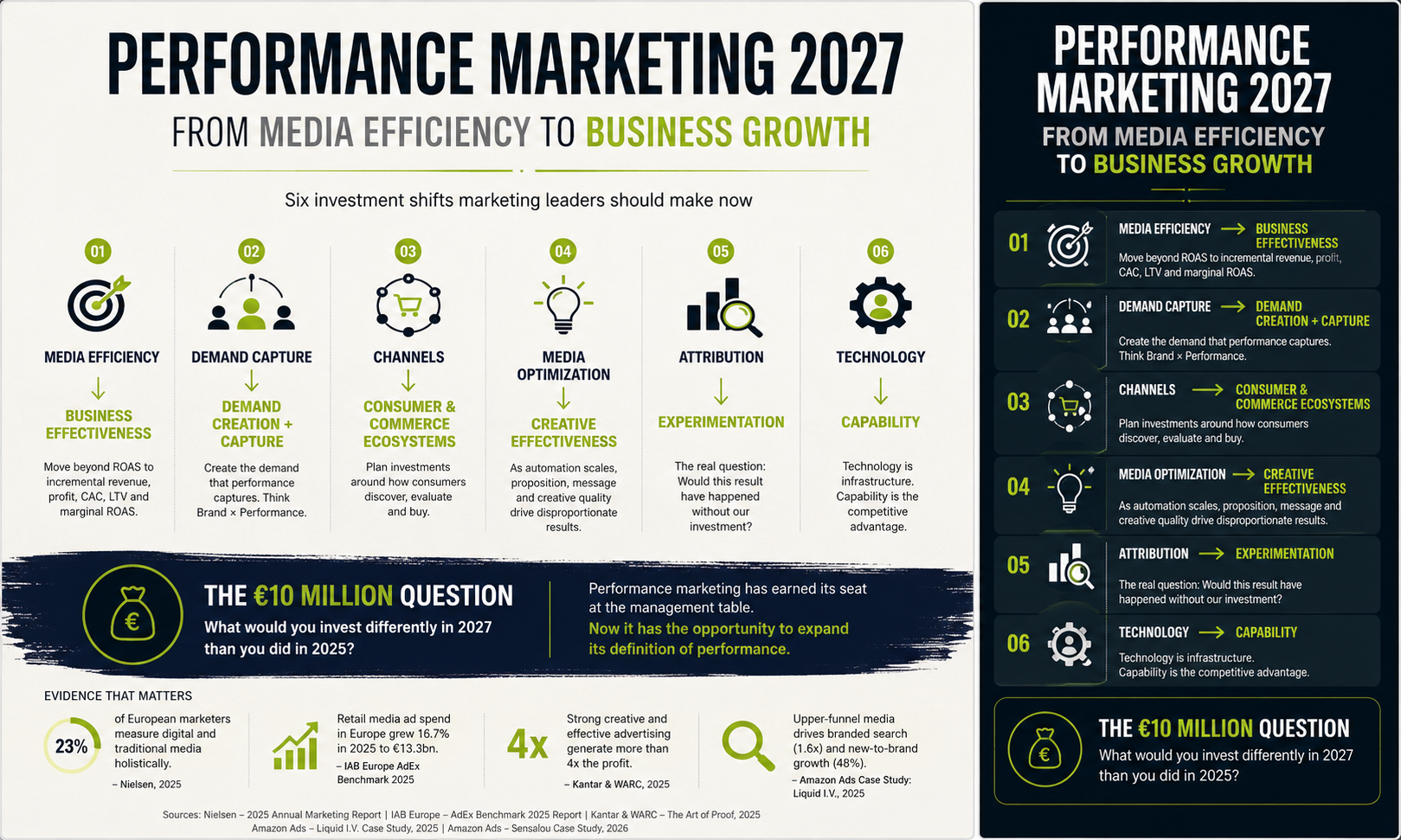
Performance Marketing 2027. From Media efficiency to business growth.
The €10 Million Question
Imagine you are responsible for a €10 million marketing budget.
Your CFO asks:
“Why should we invest this €10 million differently in 2027 than we did in 2025?”
More Google?
More Meta?
More Amazon?
More retail media?
More programmatic?
Another piece of marketing technology?
More AI?
All could be legitimate answers.
But they’re channel and technology answers to what is fundamentally a business question.
I would start somewhere else.
Where do we need to create demand?
Where can we capture existing demand?
Where do consumers discover, evaluate and buy our products?
Which customers should we acquire?
What are those customers actually worth?
Which investments generate incremental sales rather than simply claim credit for them?
Where does creative make the biggest difference?
And what capabilities will make the next €10 million more effective than the last?
Those questions change the conversation.
And they should increasingly change the investment plan.
I see six shifts.
01 | Media Efficiency ? Business Effectiveness
Performance marketing became powerful because it made marketing measurable.
But measurable and incremental are not the same thing.
Consider a campaign reporting:
ROAS: 5.0
For every €1 invested, €5 in revenue was attributed to advertising.
Excellent.
Or is it?
How many customers would have purchased anyway?
How many were existing customers?
What was the contribution margin?
Did advertising create additional demand or simply redirect existing demand through a paid touchpoint?
And what happened to profitability after media, promotion, fulfilment and marketplace costs?
These aren’t arguments against ROAS.
ROAS remains an important operational metric.
The problem begins when an operational metric becomes our definition of business success.
And there is evidence of a significant measurement gap.
Nielsen’s 2025 global research found that 85% of marketers expressed confidence in their ability to measure ROI, while only 32% actually measured ROI holistically across traditional and digital media.
In Europe, that figure was just 23%.
That is an extraordinary gap between perceived and actual measurement capability.
The next performance dashboard therefore needs another layer:
Incremental Revenue
Incremental Profit
Contribution Margin
Customer Acquisition Cost
New-to-Brand
Customer Lifetime Value
Marginal ROAS
The management question changes from:
“What revenue can we attribute to marketing?”
to:
“What business would we not have generated without this investment?”
That’s harder to answer.
It’s also far more valuable.
A simple example
Imagine:
Campaign A
ROAS: 6.2 High proportion of existing customers Strong branded-search activity Limited incremental lift
Campaign B
ROAS: 3.8 High proportion of genuinely new customers Strong incremental sales Higher predicted customer value
Which campaign performed better?
The performance dashboard may choose Campaign A.
The growth dashboard may put the next euro into Campaign B.
That distinction matters.
02 | Demand Capture ? Demand Creation + Capture
Performance marketing is exceptionally good at capturing intent.
Someone searches.
Compares.
Clicks.
Visits Amazon.
Returns to a product page.
Adds to basket.
Converts.
These are incredibly valuable signals.
But there is an uncomfortable question we should occasionally ask:
Who created that demand in the first place?
Consumers don’t suddenly want a product because a retargeting algorithm found them.
Brands, experiences, recommendations, creators, culture, PR, retail visibility, social conversations and previous product experiences all contribute to demand.
This is why the traditional debate between brand and performance increasingly feels artificial.
Brand creates familiarity, preference, mental availability and future demand.
Performance identifies, captures and converts demand.
And performance data feeds valuable signals back into brand strategy.
The two aren’t competing systems.
They are parts of the same growth system.
So perhaps the equation should no longer be:
Brand OR Performance
but:
Brand × Performance
We can see this relationship in actual commerce data.
Ahead of Prime Day 2025, Liquid I.V. used streaming TV, online video and audio to reach new audiences before the conversion moment.
According to the Amazon Ads case study, consumers exposed to the activity were 1.6× more likely to conduct a branded search, while 48% of ad-attributed purchases came from new-to-brand customers.
That is an interesting performance story precisely because it doesn’t begin at the bottom of the funnel.
Demand was created before it was captured.
The investment implication
Stop asking only:
“How much goes to brand and how much goes to performance?”
Ask:
“Where are we creating demand, where are we capturing it, and where is the system losing potential growth?”
From the consumer’s perspective, that’s one decision journey.
Inside a large organization, it might touch six teams, several agencies and multiple budgets.
That organizational fragmentation increasingly conflicts with how demand actually works.
And nowhere is that more visible than commerce.
Amazon can simultaneously function as:
a retailer,
a search environment,
an advertising platform,
a product-discovery engine,
a review ecosystem,
a conversion environment
and a source of consumer signals.
Retail media is therefore not a niche addition to the media plan anymore.
In Europe, retail media advertising investment grew 16.7% in 2025 to €13.3 billion, according to IAB Europe, and now represents more than 10% of total European digital advertising spend.
Nielsen separately found that 65% of global marketers expected retail media networks to play a growing role in their media strategies.
This isn’t simply another channel growing.
It represents a structural convergence of media + data + commerce.
Think beyond Amazon ROAS
Imagine an FMCG brand reports:
Sponsored Products ROAS: 5.2
Good.
But Performance Marketing 2027 asks:
Did upper-funnel activity increase branded search?
Did we acquire new-to-brand customers?
Did product visibility improve?
What happened to organic ranking?
Did paid investment generate incremental sales?
Did organic sales increase?
What happened to contribution margin?
Did Amazon activity create a halo elsewhere?
A 2026 Amazon Ads case illustrates this broader view particularly well.
Sensalou’s full-funnel strategy reportedly increased new-to-brand customers by 64% year-on-year, while total sales increased 38% and organic sales increased 25%.
The interesting part isn’t simply that advertising generated sales.
It’s that paid activity, customer acquisition and organic momentum were viewed as parts of the same growth system.
That is a much more useful way to think about commerce performance.
04 | Media Optimization ? Creative Effectiveness
For much of digital advertising’s history, enormous energy went into optimizing media variables:
Audience.
Bid.
Placement.
Frequency.
Timing.
Keyword.
Device.
Targeting.
All still matter.
But platforms increasingly automate them.
That creates an interesting paradox.
The more execution becomes automated, the more important genuine differentiation becomes.
If competitors have access to similar targeting capabilities, similar algorithms and increasingly similar AI tools, advantage shifts elsewhere:
The proposition.
The product truth.
The idea.
The message.
The distinctive brand assets.
And the ability to understand which creative works, for whom, where and why.
The evidence here is particularly striking.
Research combining Kantar’s creative-effectiveness database with WARC profitability data found that the strongest creative and effective advertising generated more than four times as much profit.
Think about the implication.
Marketing organizations routinely spend enormous effort negotiating fractional improvements in media costs.
Yet creative quality can have a dramatically larger impact on the economics.
Creative intelligence, not content volume
AI makes it possible to generate hundreds of creative variations.
That’s useful.
But 500 mediocre ads don’t constitute a strategy.
The opportunity is to test meaningful hypotheses:
Does convenience outperform price?
Does demonstration outperform lifestyle?
Which benefit attracts new customers?
Which proposition increases consideration?
Which creative captures attention?
Which message converts existing demand?
Which assets work differently in retail media, social and video?
That’s creative intelligence.
AI can accelerate it.
Human judgment still determines what is worth saying.
05 | Attribution ? Experimentation
Marketing has spent years asking:
“Which channel gets credit for the sale?”
But perhaps the more valuable question is:
“Would the sale have happened anyway?”
That’s the difference between attribution and causality.
Attribution distributes credit.
Experimentation tests impact.
Consider a simple journey:
A consumer sees a video campaign.
Later searches for the brand.
Clicks a paid-search advertisement.
Purchases.
Search receives the conversion.
But did search create the demand?
Or capture it?
Would the consumer have bought anyway?
What happens if paid search is removed?
What happens if video is removed?
What happens when both operate together?
These questions cannot be answered reliably by simply adding another attribution model.
They require experimentation.
That can mean:
Geo experiments
Holdout groups
Conversion-lift studies
Incrementality testing
A/B testing
Marketing Mix Modelling
Controlled retail-media experiments
No single methodology answers everything.
The capability lies in combining them intelligently.
This is why measurement shouldn’t simply sit at the end of a campaign as reporting.
Measurement is an investment capability.
It tells us where the next euro should go.
And that’s a much more important function than explaining where the last one went.
06 | Technology ? Capability
Marketing has spent the last decade assembling increasingly sophisticated technology stacks.
CRM.
CDP.
Marketing automation.
Analytics.
Personalization.
Attribution.
Retail media technology.
And now AI.
These technologies can create enormous value.
But they can also create enormous complexity.
Nielsen’s 2025 research found marketers citing siloed teams, incomparable data, unclear KPIs and too many vendors or tools among the barriers to effective ROI measurement.
Adding another platform to a fragmented operating model doesn’t necessarily solve the fragmentation.
It can simply make it more expensive.
The more interesting investment question for 2027 is therefore:
What can our organization do better because of technology?
I’d focus capability investment in five areas.
1. Measurement & Experimentation
Can we distinguish attributed revenue from incremental business impact?
2. First-Party Signals
Can we connect meaningful customer, commerce and behavioral data to decisions?
3. Creative Intelligence
Can we systematically learn which propositions, messages and assets drive both immediate response and future demand?
4. Commerce & Retail Media
Do we understand the increasingly blurred relationship between media, shopper data, product visibility and transaction?
5. Integrated Decision-Making
Can brand, performance, commerce, CRM, analytics and creative teams work from the same growth objectives?
AI cuts across all five.
But that’s precisely why “invest in AI” isn’t a strategy.
AI is becoming infrastructure.
The competitive advantage lies in the capability built on top of it.
The Performance Marketing Investment Shift 2027
If I had to summarize the change on one page, it would look like this:
MEDIA EFFICIENCY ? BUSINESS EFFECTIVENESS
DEMAND CAPTURE ? DEMAND CREATION + CAPTURE
CHANNEL PLANNING ? CONSUMER & COMMERCE ECOSYSTEMS
MEDIA OPTIMIZATION ? CREATIVE EFFECTIVENESS
ATTRIBUTION ? EXPERIMENTATION
TECHNOLOGY ? CAPABILITY
These aren’t replacements.
Efficiency still matters.
Channels still matter.
Attribution still has a role.
Technology remains essential.
But the management layer above them needs to evolve.
Back to the €10 Million
So how should our hypothetical €10 million move?
I deliberately wouldn’t prescribe percentages.
A global FMCG company shouldn’t allocate marketing investment like a D2C challenger.
A premium automotive brand shouldn’t behave like an online retailer.
A B2B technology company operates under different economics again.
Instead, I would put six questions on the investment table:
1. How much are we investing in creating future demand?
Not simply harvesting existing intent.
2. How much are we investing in capturing demand?
And are we present where customers actually make decisions?
3. How much are we investing in creative effectiveness?
Not content volume. Effectiveness.
4. How much are we investing in valuable customers?
Are we optimizing transactions or customer economics?
5. How much are we investing in proving incrementality?
Can we demonstrate what marketing actually added?
6. How much are we investing in making the system itself better?
People.
Data.
Measurement.
Experimentation.
Processes.
Technology.
Capabilities.
Because the €10 million budget shouldn’t only buy this year’s growth.
Part of it should make next year’s €10 million work harder.
The CMO Dashboard Needs Another Layer
I wouldn’t remove:
CTR CPC CPA CVR ROAS
Performance teams need them.
But above them, I would increasingly put:
Incremental Revenue
What additional revenue did marketing create?
Incremental Profit
Did that growth create economic value?
CAC
What does acquiring a genuinely new customer cost?
LTV
Are we acquiring customers worth acquiring?
New-to-Brand
Are we expanding the customer base?
Marginal ROAS
What return does the next euro generate?
Contribution Margin
Does growth remain attractive after the economics of delivering it?
These metrics move performance marketing closer to the language of business leadership.
That’s where it belongs.
Where Does AI Fit?
Almost everywhere.
And that’s exactly why it doesn’t need to be the headline.
AI is changing discovery.
Media buying is becoming increasingly automated.
Creative production is accelerating.
Analytics is becoming more predictive.
Personalization can operate at greater scale.
But virtually everyone will have access to these capabilities.
Google will.
Meta will.
Amazon will.
Agencies will.
Brands will.
Your competitors will.
Having AI will not be a strategy.
The strategic questions remain:
Which customers matter?
Where will growth come from?
What should the brand stand for?
Where should we invest?
What should we stop doing?
What constitutes profitable growth?
And what evidence would make us change our decision?
AI can help us answer those questions faster.
It doesn’t remove the need to ask them.
Performance Marketing Has Earned the Right to Think Bigger
Performance marketing shouldn’t retreat from its obsession with accountability.
It should expand it.
From clicks to customers.
From attributed revenue to incremental growth.
From channel optimization to consumer journeys.
From media efficiency to business effectiveness.
From content production to creative intelligence.
From attribution to experimentation.
From technology acquisition to organizational capability.
That doesn’t make performance marketing less performance-driven.
It makes our definition of performance more ambitious.
So when the CFO asks:
“Why should our €10 million marketing investment look different in 2027?”
the answer shouldn’t simply be:
because the platforms changed,
because AI arrived,
or because another new channel emerged.
It should be:
Because we now have the data, technology and measurement capabilities to hold marketing accountable for something bigger than media efficiency.
Business growth.
That, to me, is the next chapter of performance marketing.
Most corporate merchandise ends up forgotten in a drawer. A modern merchandise strategy should do far more than display a logo. It should create utility, strengthen brand awareness, support ESG ambitions and become another meaningful customer touchpoint. Summer is the perfect time to step back, reflect and ask a simple question: are we creating memorable brand experiences or simply producing more promotional clutter?
Summer has a way of slowing us down.
It gives us space to recharge, spend time with family and reflect on habits that have quietly become routines.
For many marketers, summer is also trade fair planning season. Budgets are reviewed, autumn events are scheduled, and the familiar checklist appears once again.
Pens.
Lanyards.
Notebooks.
Cotton bags.
Power banks.
Whatever the latest trend may be.
And somewhere in the planning meeting, someone inevitably asks:
“What should we give away this year?”
Perhaps we’re asking the wrong question.
Open Your Drawer
Before answering it, open the drawer next to your desk.
You’ll probably find a collection of conference giveaways gathered over the years.
Pens from companies you can’t remember.
USB sticks from technology conferences.
Lanyards from exhibitions you’ve long forgotten.
Stress balls.
Cheap keyrings.
Notepads you’ll never use.
Every single one carries a perfectly printed corporate logo.
Almost none created a memorable brand experience.
That drawer tells a story.
Not about successful merchandising.
But about missed opportunities.
Why Most Merchandise Strategies Fail
The problem isn’t branded merchandise itself.
The problem is that many organisations still design merchandise from their own perspective instead of the customer’s.
The conversation often starts with questions like:
How many visitors do we expect?
What’s our budget?
Which supplier offers the best price?
Where can we print the biggest logo?
Rarely does it begin with the most important question:
What will people actually use?
A successful merchandise strategy starts by understanding what creates value for the recipient, not what is easiest to produce.
Brand awareness isn’t created when someone receives an item.
It’s created every time they use it.
A Merchandise Strategy Needs New KPIs
For decades, merchandise has been measured by quantity.
2,000 visitors
2,000 giveaways
Campaign completed
But distribution is not impact.
Imagine measuring your merchandise strategy differently.
Instead of asking how many items were handed out, ask:
How long will this product remain in use?
How often will someone interact with it?
Does it solve a genuine problem?
Will it still be useful six months from now?
Does it create a positive association with the brand?
Would someone recommend it to a colleague?
Suddenly, merchandise becomes much more than a promotional expense.
It becomes another customer touchpoint.
A Successful Merchandise Strategy Creates Utility
One simple question can transform an entire merchandise strategy.
Would someone still want this if our logo wasn’t printed on it?
If the answer is no, perhaps it shouldn’t be produced.
People rarely keep products because they’re branded.
They keep them because they’re useful.
Everyday utility creates repeated exposure.
Repeated exposure builds familiarity.
Familiarity builds trust.
Trust strengthens brands.
The logo doesn’t create the value.
The usefulness does.
Merchandise Strategy Starts with Customer Value
Perhaps it’s time to stop thinking about giveaways altogether.
Instead, think about Brand Utility.
Brand Utility is the ability of every branded touchpoint to create recurring value for the user while simultaneously reinforcing the brand.
The best merchandise usually shares three characteristics.
It solves a small everyday problem
Useful products naturally become part of daily routines.
The more often they’re used, the more often your brand is experienced.
It survives the event
Good merchandise doesn’t end when the exhibition closes.
Its value continues long afterwards.
Months later.
Sometimes years.
It creates positive emotion
Every interaction becomes another micro-experience.
A small reminder that your company cared enough to create something genuinely valuable instead of simply printing another logo.
A Sustainable Merchandise Strategy Starts Before Production
Sustainability has become an important part of corporate merchandise discussions.
Recycled materials.
FSC-certified paper.
Organic cotton.
Bamboo.
These are all positive developments.
But they don’t answer the most important sustainability question.
Was the product actually needed?
A recycled notebook that remains unopened isn’t sustainable.
A bamboo pen that ends up in landfill after two weeks isn’t sustainable.
Perhaps the most sustainable promotional product is one that replaces disposable alternatives, remains useful for years or simply doesn’t need to be produced at all.
ESG isn’t only about materials.
It’s also about purpose.
A thoughtful merchandise strategy reduces waste by creating products people genuinely value.
Merchandise Strategy Is Customer Experience
Customer experience professionals spend enormous amounts of time analysing every touchpoint.
Websites.
Retail stores.
Packaging.
Customer service.
Digital journeys.
Yet merchandise often escapes the same level of strategic thinking.
It shouldn’t.
Every branded object is another customer touchpoint.
Every interaction contributes to perception.
Every useful experience reinforces trust.
Merchandise shouldn’t simply display a logo.
It should demonstrate your brand promise.
Imagine if every promotional product had to pass the same design thinking workshops as your website or mobile app.
Would you still choose another cheap plastic pen?
Probably not.
What Makes Sense in 2026?
The question isn’t which product is trending.
The question is which product creates lasting value.
Instead of chasing novelty, think in terms of utility.
Examples might include:
Premium reusable bottles that replace disposable plastics.
Refillable notebooks instead of disposable notepads.
High-quality cable organisers that travel everywhere.
NFC-enabled business cards that never become outdated.
Smart luggage tags for frequent travellers.
Digital resources, AI prompt collections or exclusive industry insights delivered through QR codes.
Products designed to be repaired rather than replaced.
In every case, the product should continue the brand experience long after the event has ended.
The Future of Merchandise Strategy
Rather than choosing products because they’re inexpensive, ask different questions.
Will people genuinely keep this?
Does it solve a real problem?
Is it consistent with our brand positioning?
Does it reduce waste?
Can it replace disposable products?
Is the quality good enough to reflect our brand?
Would I personally use it every week?
If the answer is yes, you’re probably investing in brand building rather than promotional clutter.
The best merchandise strategy doesn’t produce more items.
It produces better ones.
Frequently Asked Questions About Merchandise Strategy
What is a merchandise strategy?
A merchandise strategy defines how branded products support marketing, customer experience, brand awareness and sustainability. Instead of simply distributing promotional items, it focuses on creating products people genuinely use, remember and value.
How can merchandise increase brand awareness?
Useful merchandise creates repeated brand exposure over months or even years. Every interaction becomes another positive brand touchpoint, making the brand far more memorable than one-off promotional giveaways.
What makes sustainable merchandise?
Sustainable merchandise is designed for long-term use, solves a real customer problem and avoids unnecessary waste. The most sustainable promotional product is often the one people keep for years rather than replacing after a single event.
Final Thought
The next time you’re planning a trade fair, conference or customer event, don’t begin with the catalogue.
Begin with your customer.
Ask yourself one question:
What could we create that people would genuinely miss if they lost it?
That’s where a great merchandise strategy begins.
Because nobody remembers the company that handed them another pen.
But people do remember the brand that made their day just a little easier.
And perhaps that’s what merchandise was always supposed to do.
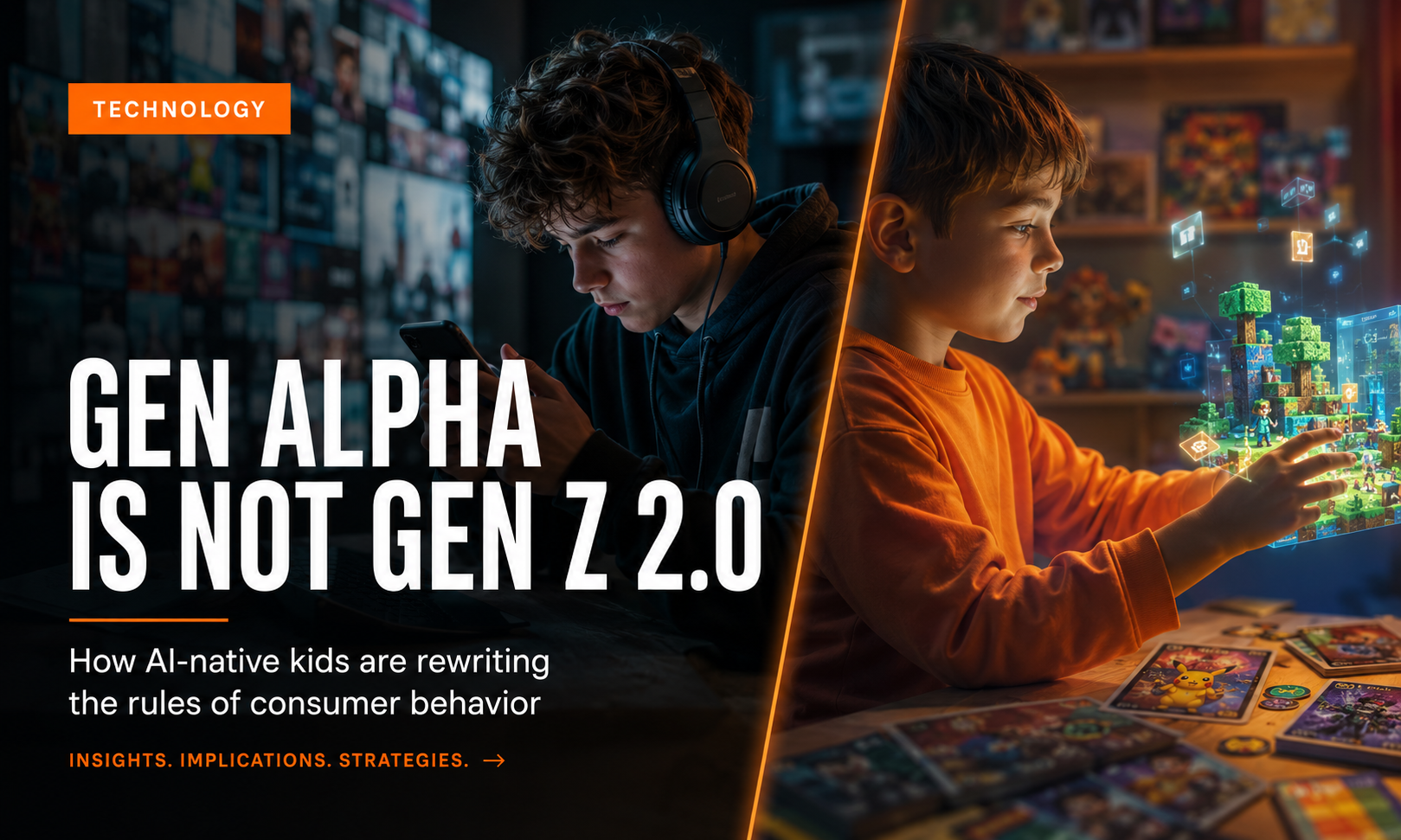
Why Gen Alpha will break your marketing if you still use yesterday’s playbook
Gen Alpha is already reshaping the future of consumer behavior, yet most marketers are still heavily focused on Gen Z. That may be one of the biggest strategic blind spots in marketing right now.
For years, Gen Z has dominated the conversation around digital culture, creator economies, authenticity and social commerce. And rightly so.
But while brands are still optimizing for Gen Z, Gen Alpha has quietly entered the system with a fundamentally different operating logic.
Watching my own son and his peer group, one thing became increasingly obvious:
They don’t think in brands.
They think in ecosystems.
That distinction matters.
Because if Gen Z taught brands how to be social, Gen Alpha will force brands to become adaptive systems.
And most brands are not ready.
The dangerous mistake marketers are making
Many assume Gen Alpha is simply younger Gen Z.
That’s a strategic error.
Gen Z grew up transitioning into digital life.
They adapted to platforms.
They learned how algorithms worked and how to perform within them.
Gen Alpha doesn’t.
They were born into fully integrated digital environments where platforms are infrastructure.
That changes:
how they discover how they trust how they compare how they influence how they expect brands to behave
This is not just a demographic shift.
It is a behavioral one.
And behavior is where the next decade of brand relevance will be decided.
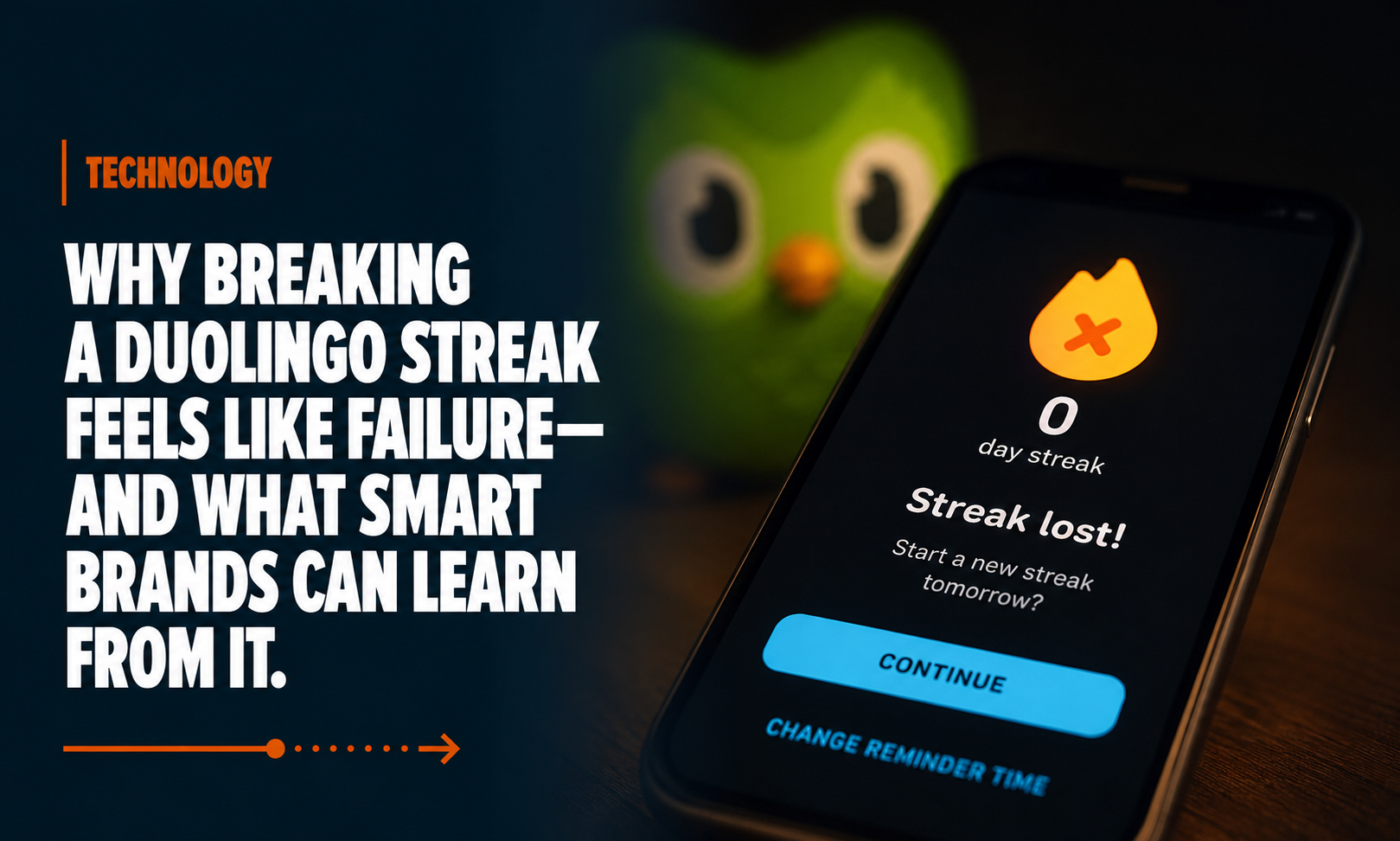
Gen Alpha vs Gen Z: from algorithm-native to AI-native
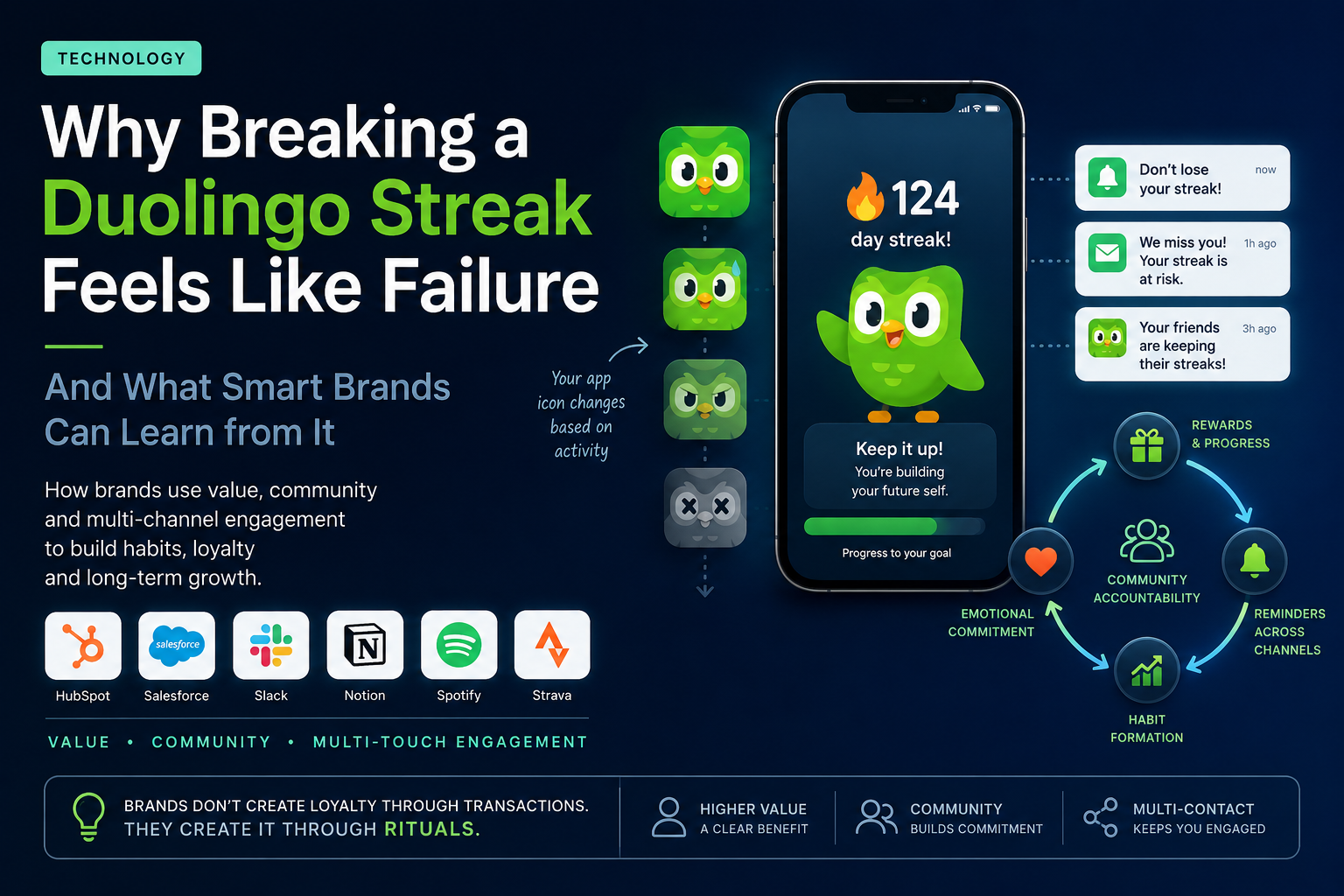
Duolingo streak psychology is one of the strongest examples of behavioral marketing in action.
Have you ever found yourself opening Duolingo just before midnight, simply to protect your streak?
Not because you had time.
Not because you felt like it.
But because you didn’t want to lose what you had built.
That moment reveals one of the most powerful truths in modern marketing:
The strongest brands don’t just sell products. They create habits.
And habits are the foundation of long-term engagement.
Duolingo has become one of the most effective examples of behavioral brand design. Not because of its product alone, but because it understands how psychology, technology and community work together to keep people engaged daily.
For B2C and B2B brands alike, there is a lot to learn here.
The psychology behind the streak: Why Duolingo streak psychology works
A streak is deceptively simple.
Complete one action every day.
Miss one, and it resets.
What makes this so powerful?
Because it combines:
Progress visibility
Commitment bias
Loss aversion
Identity reinforcement
Social accountability
Over time, the streak becomes more valuable than the action itself.
People are no longer “using the app.”
They are protecting their identity.
“I am someone who learns every day.”
That’s where emotional brand attachment begins.
Lesson 1: The value must be bigger than the product
Duolingo streak psychology works because the reward is bigger than the action itself.
This is the most important lesson.
Duolingo doesn’t sell lessons.
It sells transformation.
The future reward is clear:
“Learn consistently and one day you will master a new language.”
The streak is simply proof that the user is moving closer to that goal.
Smart brands do the same.
B2C examples
Strava Value = better health, better performance, social recognition.
Headspace Value = less stress, better focus, emotional balance.
“The most expensive software in your company is often the software you already own.”
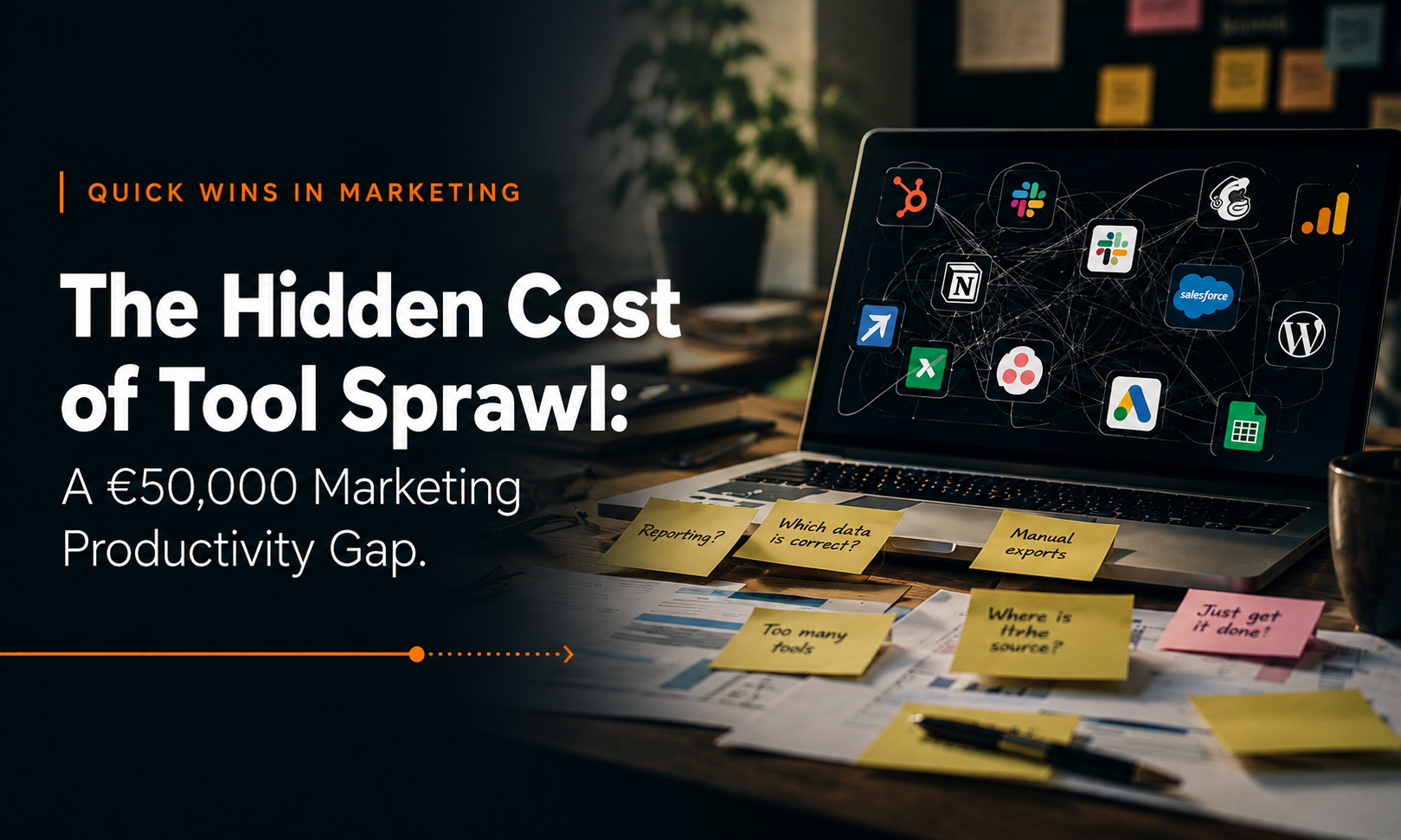
When organizations discuss productivity, the conversation quickly turns to Artificial Intelligence.
How can AI create content faster?
How can AI summarize meetings?
How can AI automate workflows?
Those are valid questions.
But they often overlook a much bigger productivity problem:
Tool Sprawl.
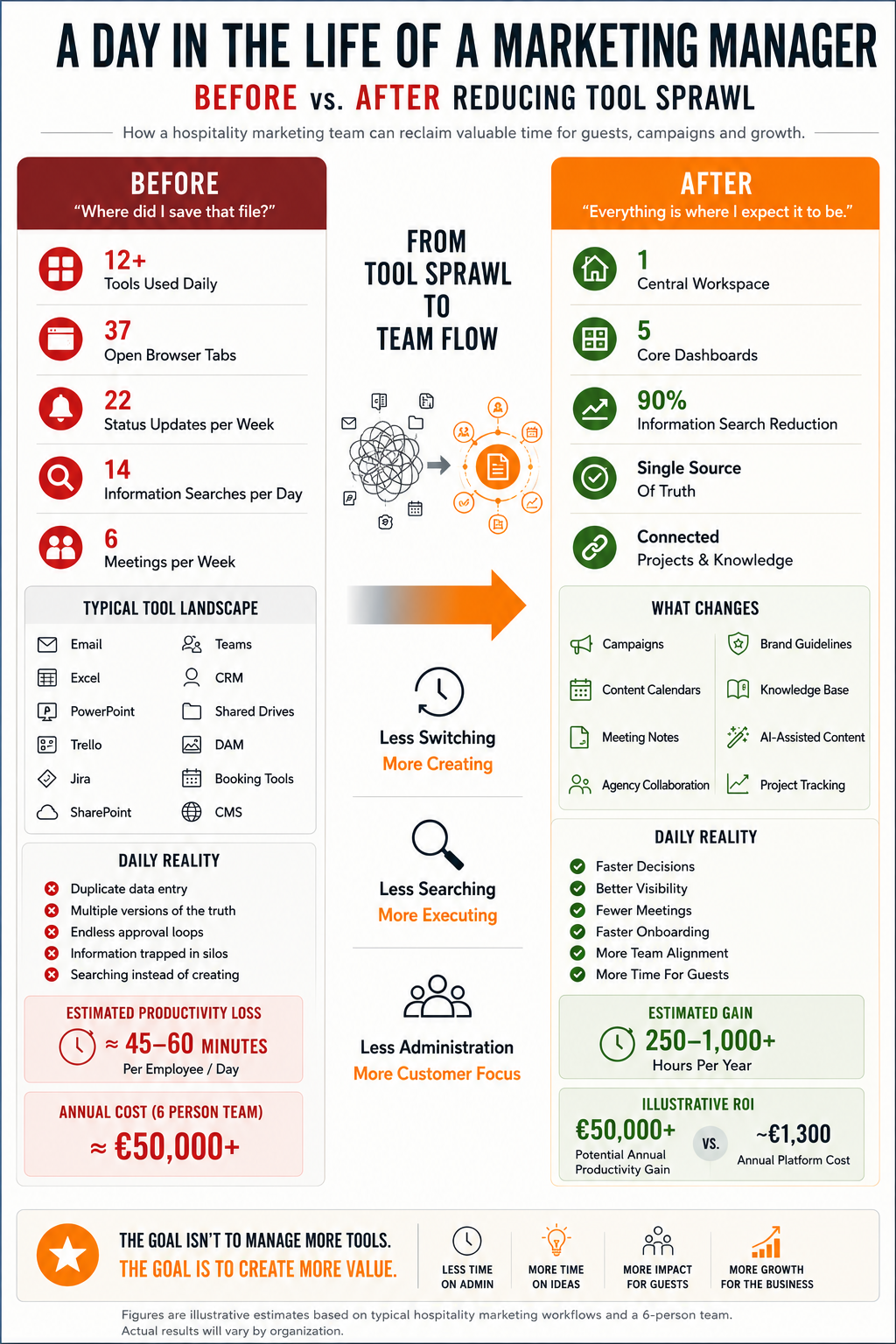
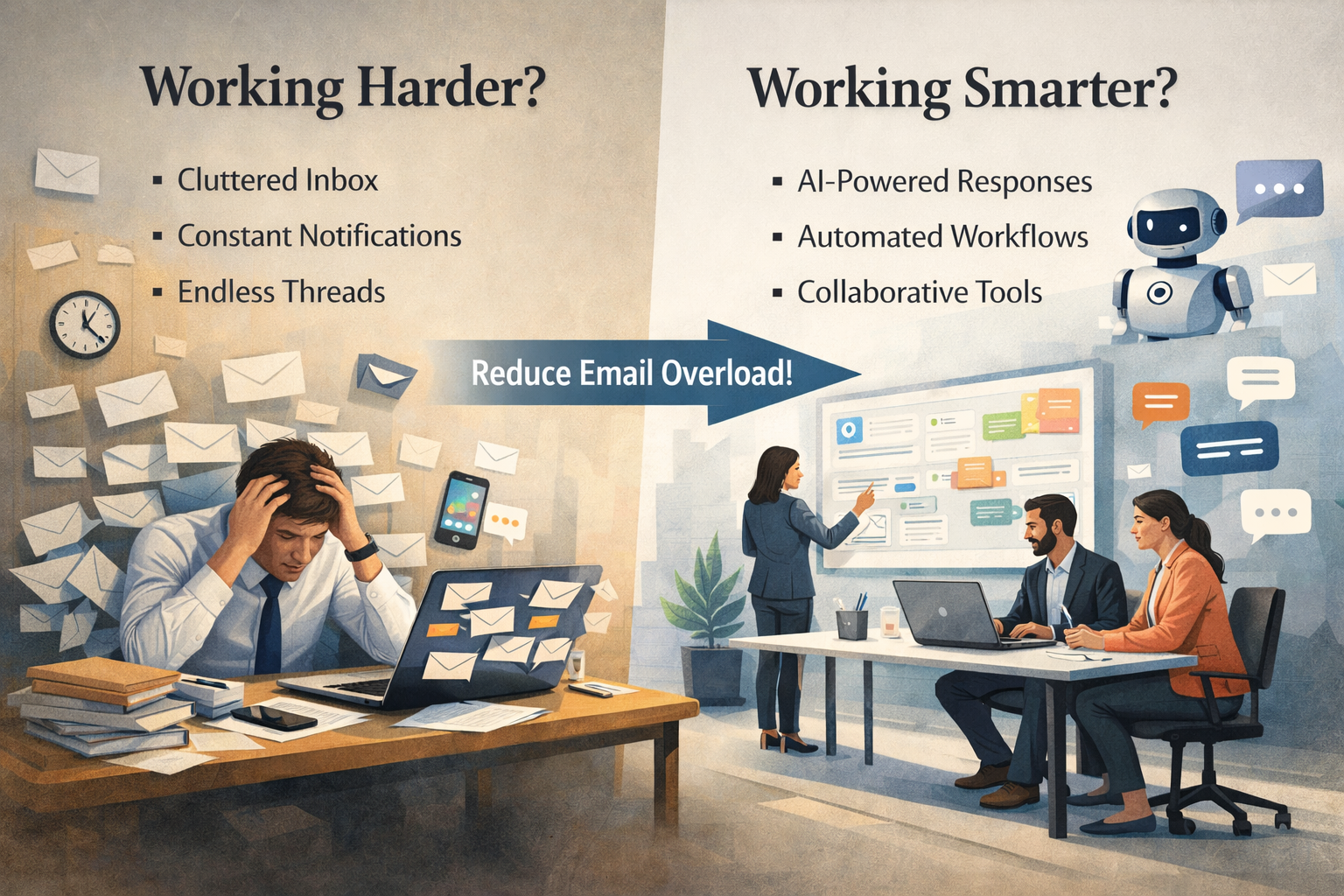
A day in the life of a marketing manager and how to avoid tool sprawl.
The average marketing department in the hospitality industry works across a growing ecosystem of disconnected systems:
Email
Teams or Slack
Excel
PowerPoint
Trello
Jira
SharePoint
CRM Systems
Asset Libraries
Booking Platforms
Content Calendars
Project Management Tools
Each platform solves a specific problem.
Collectively, they often create friction, duplication and hidden costs.
The Hospitality Marketing Reality
Imagine a hotel group operating:
8 properties
4 brands
6 marketing team members
Multiple agencies
Regional sales teams
Seasonal campaigns and promotions
The team manages:
Social media
Website content
Email marketing
Events
Partnerships
CRM campaigns
Brand communications
At first glance, everything appears organized.
In reality, information is scattered across multiple tools.
The result?
Highly qualified marketing professionals spend valuable time searching, updating, copying and coordinating instead of focusing on guests, campaigns and growth.
And these examples only cover a fraction of daily activities.
When additional workflows are included—budget approvals, reporting, content reviews, knowledge management, event planning and AI-supported content creation—the potential annual productivity gain can easily exceed:
€50,000+ per year
for a mid-sized hospitality marketing team.
What About the Cost?
Let’s assume:
Notion Business Plan
Approx. €18 per user/month
6 users
Annual cost:
€1,296
Even if implementation required:
Initial setup
Training
Migration
The investment remains small compared to the productivity gains.
Illustrative ROI
Annual Productivity Gain:
€50,000
Annual Platform Cost:
€1,296
Potential ROI:
More than 3,700%
Few marketing initiatives deliver this level of return.
The Bigger Benefit
The true value is not cost reduction.
The true value is attention.
Less time searching.
Less time reporting.
Less time updating.
More time:
Creating memorable guest experiences
Developing stronger campaigns
Supporting sales teams
Building brand value
Driving revenue
Technology should remove friction.
Not create it.
Final Thought
AI may become the most transformative technology of this decade.
But before adding another AI tool to your stack, ask yourself:
How many hours does your team spend every week moving information between systems?
The answer may reveal your biggest untapped productivity opportunity.
Interested in learning more about operational efficiency, customer experience and marketing transformation?
Disclaimer: The calculations shown are illustrative examples based on typical hospitality marketing workflows and intended to demonstrate potential productivity impacts. Actual results will vary depending on organizational structure, processes and technology landscape.
Account Based Marketing is firmly established in hospitality, especially for targeting corporate travel managers, event planners, and procurement teams. Yet many ABM initiatives fail to deliver early results.
The reason is rarely strategy. It is usually tool overload, weak CRM integration, and the absence of a fast proof point for sales.
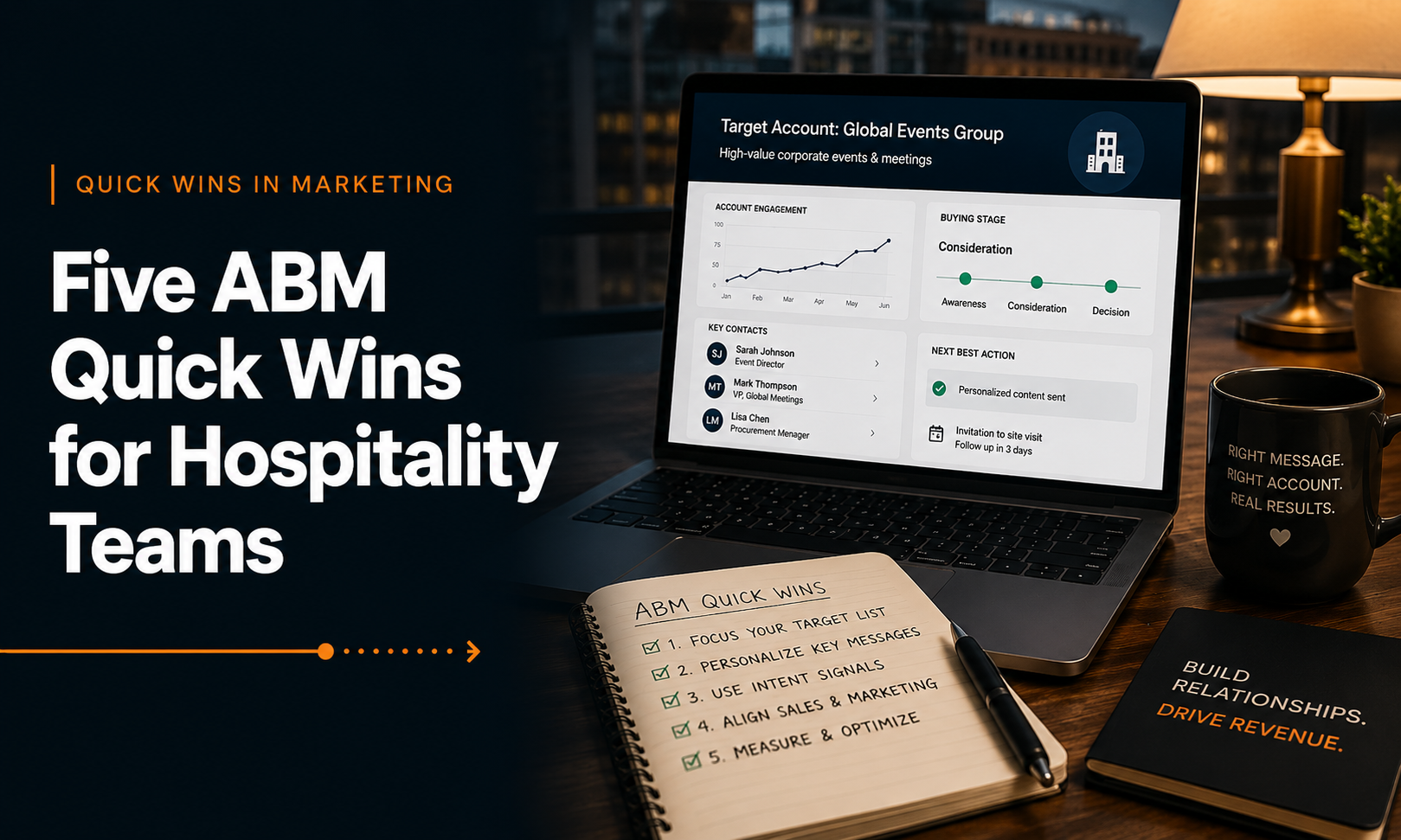
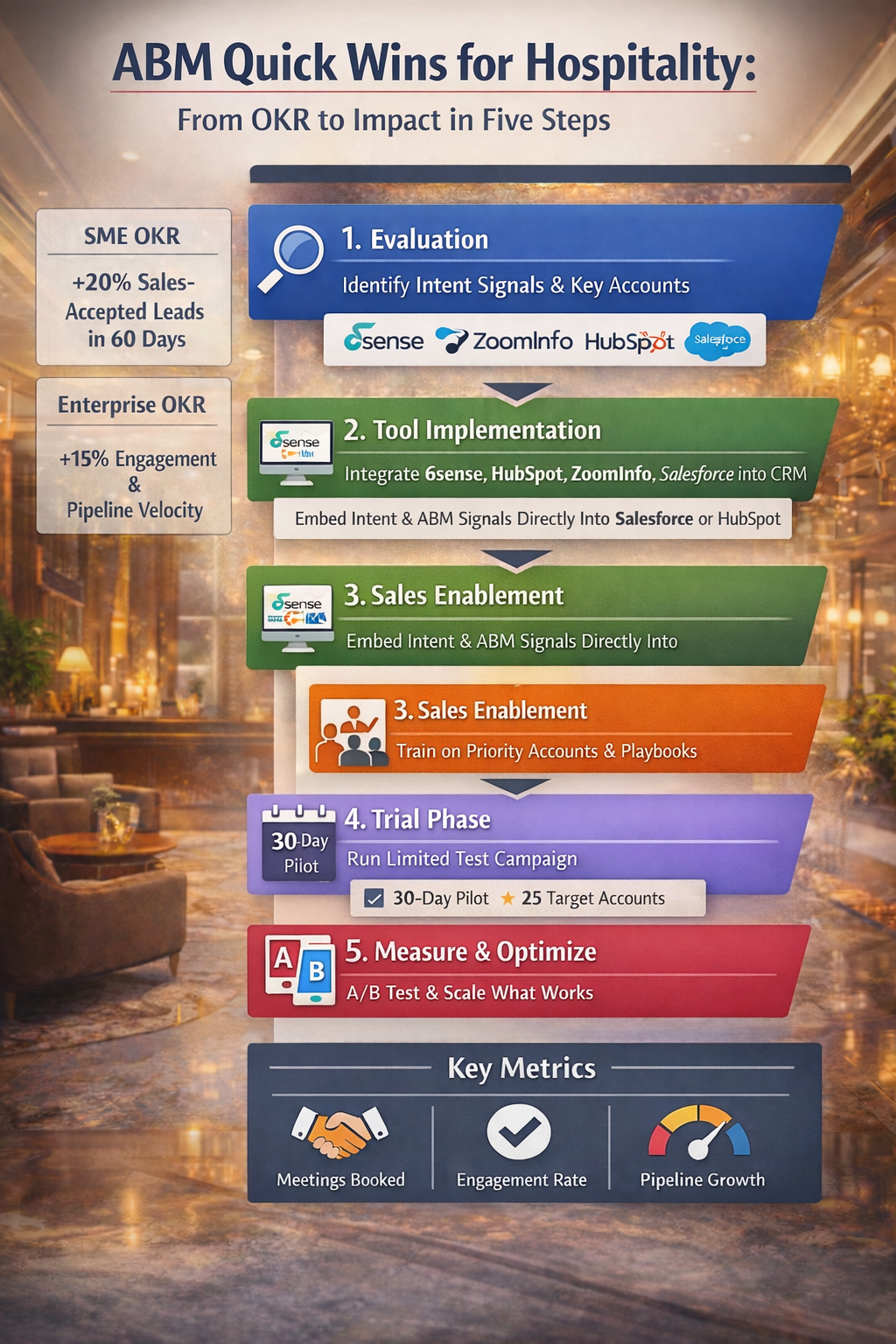
This article focuses on a technology driven ABM quick win using AI assisted tools, with a clear five step execution framework and guidance on choosing the right platforms.
ABM Quick Wins for Hospitality
Start With One Clear OKR
ABM only works when it is anchored to a measurable objective.
Sample OKR for a hospitality SME or KMU Objective: Increase qualified B2B opportunities Key Result: Increase sales accepted leads from the top fifty target accounts by twenty percent within sixty days
Sample OKR for an enterprise hospitality brand Objective: Improve ABM efficiency for corporate travel accounts Key Result: Increase tier one account engagement by fifteen percent and pipeline velocity within one quarter
Once the OKR is defined, the tool selection becomes a tactical decision instead of a political one.
The Five Step ABM Quick Win Framework
Step 1 Evaluation
Identify accounts already showing buying intent. AI assisted intent data platforms dramatically reduce the time needed to spot low hanging fruit.
Focus on intent, not volume.
Step 2 Tool Implementation
Embed intent and account signals directly into the CRM. Salesforce or HubSpot should act as the system of action, not just the system of record.
Step 3 Sales Enablement
Train sales on priorities and actions. Tools only create value when sales knows exactly what to do with the signal.
Step 4 Trial Phase
Run a limited pilot with a small account set and a defined time window. This keeps execution fast and results credible.
Step 5 Measurement and Optimization
Use A B testing on messaging, timing, and channels. Optimize what works before expanding the program.
AI Assisted ABM Tools for Hospitality
Pros and Cons to Support Decision Making
Salesforce
Best suited for mid market and enterprise hospitality organizations
Pros • Industry standard CRM with strong ecosystem • Deep integration options for ABM and intent tools • Strong reporting and pipeline visibility • Scales well across regions and brands
Cons • Requires disciplined configuration to avoid complexity • ABM value depends heavily on connected tools • Higher cost and admin effort for smaller teams
Best quick win use case Use Salesforce as the execution layer where intent signals trigger tasks, alerts, and account prioritization for sales.
6sense
Best suited for enterprise and advanced ABM teams
Pros • AI driven account intent and buying stage prediction • Strong fit for complex buying committees • Excellent for prioritizing high value accounts
Cons • Higher price point • Requires clean CRM data to perform well • Longer onboarding compared to lighter tools
Best quick win use case Identify in market hospitality accounts and push prioritized insights directly into Salesforce.
ZoomInfo
Best suited for SMEs and mid market teams
Pros • Strong contact and company data coverage • Intent signals are easy to activate • Faster time to value than heavier ABM platforms
Cons • Intent depth is lighter than specialized ABM tools • Less predictive than AI first platforms
Best quick win use case Enrich target accounts and give sales better context for outreach in early ABM pilots.
HubSpot
Best suited for SMEs and growing hospitality brands
Pros • Easy to deploy and adopt • Combines CRM, marketing automation, and reporting • Strong usability for sales teams
Cons • Less advanced ABM analytics • Limited intent modeling compared to enterprise tools
Best quick win use case Run lightweight ABM pilots where speed and adoption matter more than deep analytics.
How to Choose the Right Stack
A simple rule applies Do not start with the most powerful tool Start with the tool that creates action inside your CRM fastest
For many hospitality teams, Salesforce combined with one intent data source is enough to unlock the first ABM win.
Why This Technology Driven Approach Works
This framework minimizes risk, accelerates learning, and creates early proof of value. It aligns marketing, sales, and technology around one measurable outcome instead of a long term ABM roadmap.
In hospitality, ABM success is built step by step. The first quick win sets the foundation for scale.
Manage Consent
We use cookies and similar technologies to make our website work and to improve your experience. Some cookies are essential. We use other cookies only with your consent. You can change your choices at any time in the cookie settings.
Functional
Always active
The technical storage or access is strictly necessary for the legitimate purpose of enabling the use of a specific service explicitly requested by the subscriber or user, or for the sole purpose of carrying out the transmission of a communication over an electronic communications network.
Preferences
The technical storage or access is necessary for the legitimate purpose of storing preferences that are not requested by the subscriber or user.
Statistics
The technical storage or access that is used exclusively for statistical purposes.The technical storage or access that is used exclusively for anonymous statistical purposes. Without a subpoena, voluntary compliance on the part of your Internet Service Provider, or additional records from a third party, information stored or retrieved for this purpose alone cannot usually be used to identify you.
Marketing
The technical storage or access is required to create user profiles to send advertising, or to track the user on a website or across several websites for similar marketing purposes.